How Independent Consultants Can Write Proposals in Half the Time
The bottleneck in solo consulting proposal writing is not writing — it is decision-making.
KEY TAKEAWAYS
- The bottleneck in solo consulting proposal writing is decision-making, not typing — re-solving scope, proof, and pricing on every pitch is where time disappears.
- Scope tier systems and pre-written proof blocks eliminate the two largest time drains from the proposal process.
- A standardized discovery intake form captures the problem statement during the call — removing post-call reconstruction from the workflow entirely.
- A consultant with all three systems in place can produce a complete, client-specific proposal in under 60 minutes.
How do independent consultants write proposals faster?
Independent consultants write proposals faster by building decision infrastructure before the proposal starts — not by writing faster.
The two biggest time drains in proposal creation are custom scope design (15–60 minutes per pitch) and proof selection (20–40 minutes per pitch).
A scope tier system eliminates the first; a pre-written proof block library eliminates the second. A standardized discovery intake form eliminates the third: post-call reconstruction of what the prospect actually said. Consultants who have all three systems in place consistently produce complete proposals in under 60 minutes.
HOW IT WORKS:
- Scope tier system — 2–3 pre-defined engagement types; select one, adjust client variables only
- Proof block library — pre-written case summaries organized by industry and problem type; curate 2–3, no rewriting
- Discovery intake form — standardized template filled during the call; maps directly to the proposal template
- Proposal template — five-section structure with prompts that force specific content; no blank page
- Assembly sequence — intake → tier → blocks → template → review: under 60 minutes total
The bottleneck in solo consulting proposal writing is not writing — it is decision-making. Every time Sana starts a proposal from scratch, she is re-solving problems she has already solved before: what the scope should be, which proof cases are relevant, how to frame the price, what the next step should be. The writing is fast. The deciding is what takes four to six hours.
Speed in proposal writing comes from decision-making infrastructure built before the proposal starts, not from typing faster or using better software. Pre-decided scope tiers, pre-written proof blocks, and a locked discovery intake form compress a four-hour proposal process into under sixty minutes without reducing quality or personalization. What changes is where the work happens — before the pitch, not during it.
Where does proposal writing time actually go for solo consultants?
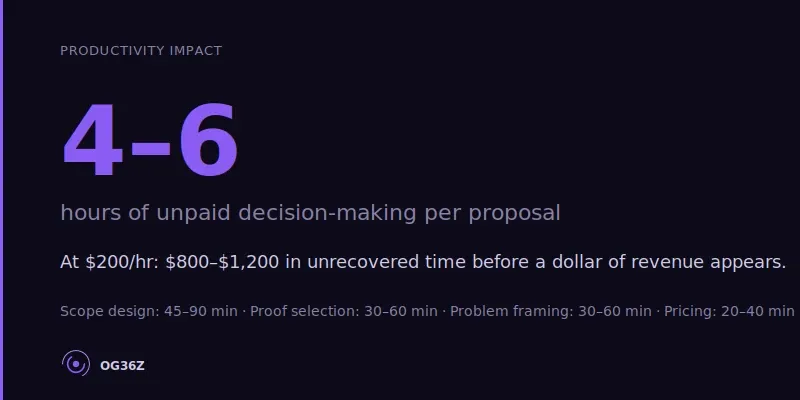
Proposal writing time for solo consultants disappears into five decision-making tasks that each require significant cognitive effort under time pressure: problem framing, scope design, proof selection, pricing justification, and next-step setting. Of these, scope design and proof selection account for the largest time blocks — typically 90 to 120 minutes of the total four-to-six-hour process.
Breaking down where a typical from-scratch proposal takes time:
Problem framing: 30–60 minutes. After a discovery call, Sana has notes but not structure. Translating raw notes into a compelling problem statement — one that captures the prospect's situation in their language and demonstrates causal understanding — requires re-reading notes, synthesizing themes, and constructing a narrative. Without a standardized format for capturing problem information during the call, this reconstruction happens after the call ends.
Scope design: 45–90 minutes. What belongs in this engagement? What is excluded? What are the milestones? What deliverables are included? What is the timeframe? These are not questions with obvious answers — they require judgment about what the prospect actually needs versus what they asked for, and what is achievable within the time and budget signals from the discovery call. Every proposal designed from first principles takes the full forty-five to ninety minutes.
Proof selection and writing: 30–60 minutes. Which past client is most analogous? What was the specific outcome? How should that case be described for this prospect's industry context? Without a library of pre-written proof blocks, this is a search exercise — scrolling through past client files, CRM notes, email threads — followed by a writing task: drafting the case summary from memory.
Pricing justification: 20–40 minutes. What does this engagement cost, and how do I explain that cost in a way that frames the value? At the early stages of a consulting practice, this is a first-principles exercise every time — even when the engagement is structurally similar to one completed three months ago.
Next-step language: 10–20 minutes. What is the closing sentence? What action is being requested? What date makes sense? This is short, but under pressure at the end of a long writing session, it often produces the weakest output in the proposal.
Total: four to six hours of decision-making with some writing. The writing itself — if all decisions were pre-made — would take thirty to forty-five minutes. See Time Audit for Solo Consultants: Where the Hours Actually Go for the broader picture of where non-billable hours disappear in a solo consulting practice.
What is a scope tier system and how does it cut decision time?
A scope tier system is a pre-defined menu of two to three engagement types — each with fixed deliverables, a fixed timeframe, and fixed pricing — that replaces the custom scope design exercise with a selection decision.
Instead of building a scope from first principles on every proposal, the consultant selects the tier that best fits the engagement and adjusts only the client-specific variables.
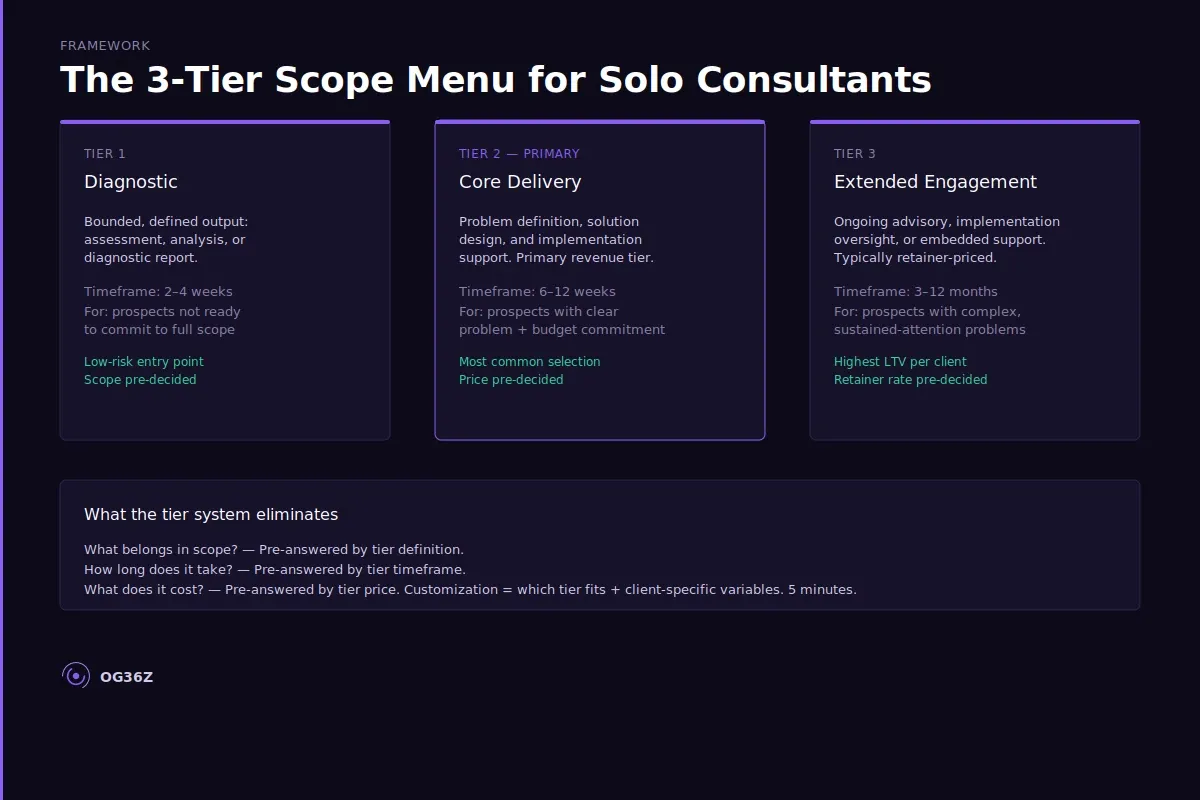
A three-tier menu typically looks like this:
Tier 1 — Diagnostic. A bounded engagement with a defined output: a diagnostic report, a strategic assessment, or an opportunity analysis. Fixed deliverable, fixed timeframe (typically two to four weeks), fixed price. This tier exists for prospects who need to understand the problem before committing to a solution. It also serves as a low-risk entry point for prospects who are not yet ready to commit to a full engagement.
Tier 2 — Core Delivery. The standard engagement: problem definition, solution design, and implementation support. This is the primary revenue tier for most solo consultants — the engagement that represents the core of the practice's value delivery. Fixed deliverables, fixed timeframe (typically six to twelve weeks), fixed price.
Tier 3 — Extended Engagement. A longer-form engagement that includes ongoing advisory, implementation oversight, or embedded support. This tier exists for prospects whose problem requires sustained attention rather than a bounded project. It is typically priced at a retainer rate.
The scope tier system cuts decision time in three ways. First, the what-is-included question is pre-answered — each tier has a defined deliverable list that does not require re-invention. Second, the how-long question is pre-answered — each tier has a fixed timeframe that represents the consultant's best judgment about what this type of engagement requires. Third, the how-much question is pre-answered — each tier has fixed pricing, which means the pricing justification in the proposal is explaining structure, not setting price.
The customization in a tier-based proposal is limited to: which tier best fits the prospect's situation, and what client-specific adjustments (timeline compression, stakeholder involvement, delivery format) are needed within that tier. That decision takes five minutes, not sixty.
The tier system also improves close rate for a counterintuitive reason: options are evaluated more easily than open-ended scope. A prospect comparing two or three defined tiers makes a faster decision than a prospect trying to evaluate a bespoke scope that has no reference point. See How to Build a Proposal System That Closes More Work as a Solo Consultant for the complete system architecture that surrounds the scope tier menu.
How do pre-written proof blocks speed up proposal creation?
Pre-written proof blocks speed up proposal creation by replacing a search-and-write exercise (30–60 minutes) with a search-and-paste exercise (5 minutes). The quality of the output does not decline — it often improves, because proof blocks written outside of proposal pressure are more carefully structured and more precisely worded than proof blocks written under a four-hour deadline.
A proof block is a 100 to 150 word case summary following a four-part structure: client context (anonymized), the problem they faced, the approach deployed, and the specific outcome. Written once, filed by industry and problem type, a proof block is available in seconds for any future proposal where the same problem type appears.
The before-and-after of proof selection is significant:
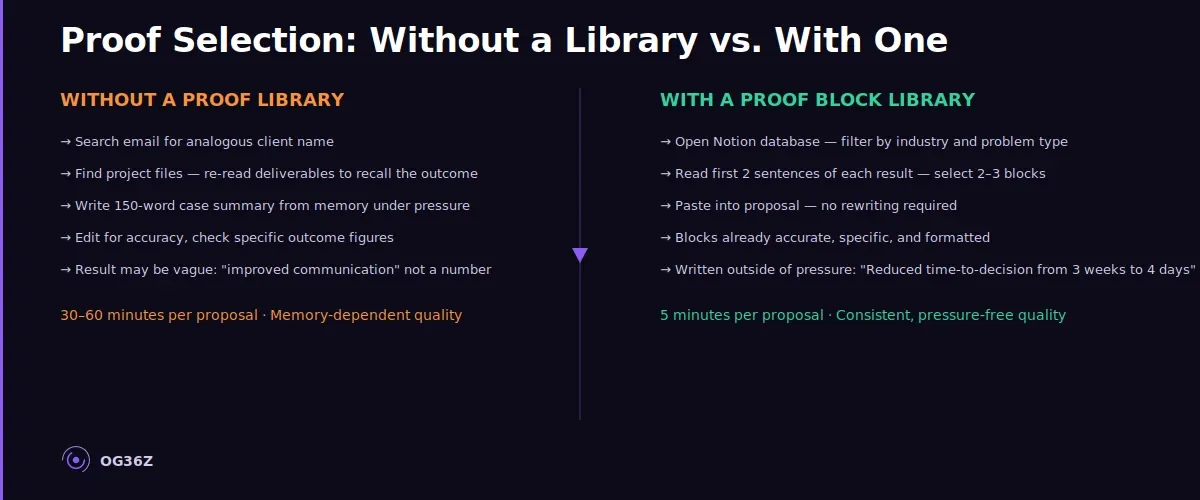
Without a proof library: Sana remembers that she helped a healthcare client with a similar challenge two years ago. She searches her email for the client name. She finds the project files. She re-reads the key deliverables. She tries to remember the specific outcome. She writes a case summary from memory, checking her notes for accuracy, drafting and editing for twenty to thirty minutes. The resulting proof block may or may not accurately represent what happened.
With a proof library: Sana opens her Notion database, filters by "healthcare" and "organizational efficiency," and finds three proof blocks. She reads the first two sentences of each, selects the two most relevant, and pastes them into the proposal template. Five minutes. The proof blocks are already accurate, already well-written, and already formatted for the five-section proposal structure.
Building a proof block library requires an initial investment of two to three hours to write blocks for the five to eight most common problem types in the practice. After that, each new engagement produces one new proof block — added to the library at project close, while the outcome is fresh. The library compounds: each engagement makes every future proposal slightly faster.
The most common objection to proof blocks is that they will sound generic. The opposite is true. A proof block that has been carefully written — outside of proposal pressure, with the actual outcome figures and the actual problem framing — is more specific and more credible than a proof block written in twenty minutes while also completing the rest of the proposal. See How to Build a Proposal Library That Makes Every New Proposal Faster for the exact structure and maintenance workflow.
What intake process makes proposals faster to start?
A standardized discovery intake form makes proposals faster to start by capturing problem statement material during the discovery call — before the conversation ends — so that the post-call reconstruction step is eliminated entirely. The intake form is not a note-taking template. It is a structured capture that maps directly to the proposal template sections.
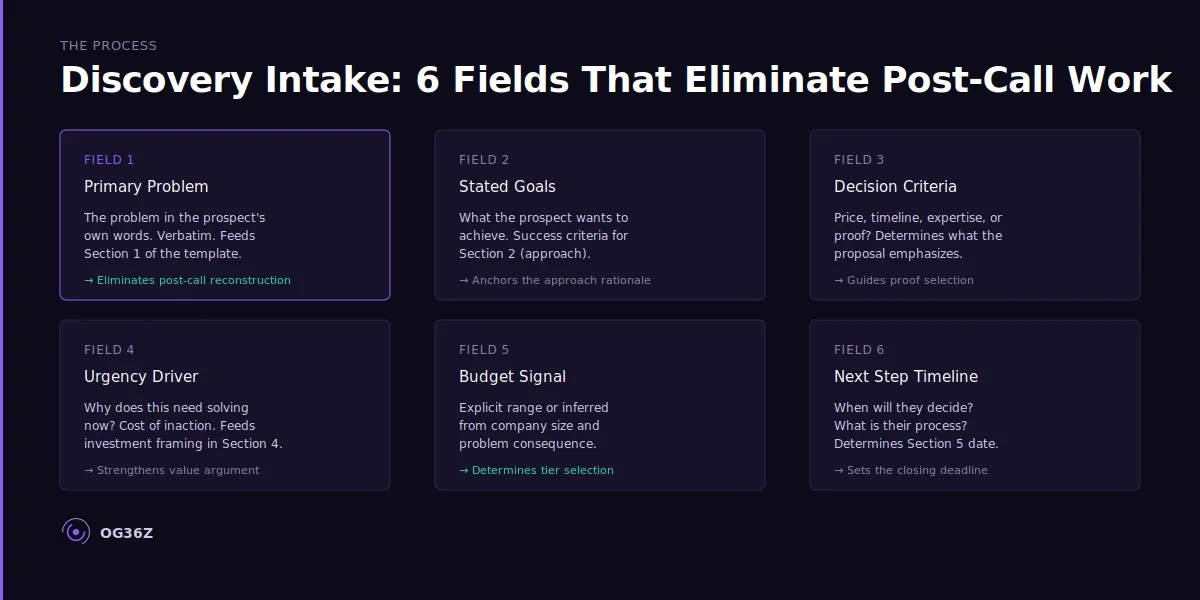
The discovery intake form contains six fields, filled during the call:
1. Primary problem statement. The single most important problem the prospect named, in their own words. This is the raw material for Section 1 of the proposal. Writing it verbatim during the call, rather than reconstructing it afterward from general notes, eliminates the post-call interpretation task.
2. Stated goals. What does the prospect want to achieve by the end of this engagement? In their words, not the consultant's paraphrase. This feeds into Section 2 (proposed approach) as the success criteria against which the scope is designed.
3. Decision criteria. What factors will they use to decide? Price? Timeline? Prior experience? Industry expertise? Understanding this during the call allows the proposal to emphasize the criteria that matter most to this specific buyer.
4. Urgency driver. Why does this problem need solving now? What is the consequence of not solving it in the next 90 days? This feeds into the investment framing in Section 4 — the value argument is stronger when the cost of inaction is explicit.
5. Budget signal. Has the prospect mentioned a budget range? What signals of budget scale appeared in the conversation (company size, the problem's visible consequence on revenue)? This determines which scope tier to select in Step 2 of the proposal assembly.
6. Next step preference. When the prospect described their decision process, what timeline did they indicate? This determines the date in the next-step section of the proposal.
A discovery call that fills all six fields takes the same amount of time as a discovery call that does not. The discipline is in asking the right questions, not in extending the call. With all six fields completed, the proposal can begin immediately after the call — not from memory, but from structured notes that map directly to the template.
The intake form lives in Notion or as a shared Google Doc, filled on a phone or tablet during the call, available the moment the proposal is opened.
What does a sub-60-minute proposal workflow look like in practice?
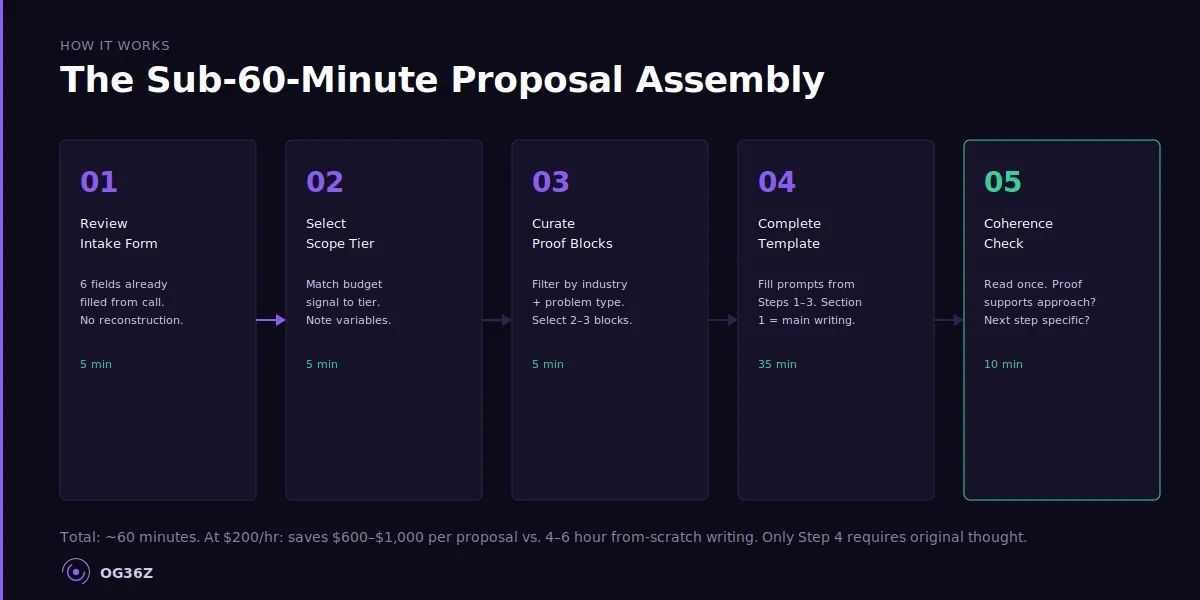
A sub-60-minute proposal workflow runs in five steps: review the discovery intake, select the scope tier, curate proof blocks, complete the template prompts, and run a coherence check. The first four steps are retrieval decisions. The fifth step is the only step that requires original synthesis.
Step 1 — Review the intake form (5 minutes). Open the discovery intake form completed during the call. Read all six fields. The problem statement is already in the prospect's language. The goals, criteria, urgency, budget, and timeline are already captured. Nothing needs to be reconstructed from memory.
Step 2 — Select the scope tier (5 minutes). Review the tier menu. Which tier best fits the budget signal and problem complexity from the intake? Note any client-specific adjustments (earlier delivery date, specific stakeholder access requirement, custom deliverable format). The scope design exercise is a selection, not an invention.
Step 3 — Curate the proof blocks (5 minutes). Open the proof library in Notion. Filter by the prospect's industry and primary problem type. Read the first two sentences of the top results. Select the two or three blocks most directly relevant to this prospect's situation. Copy them to the proposal clipboard.
Step 4 — Complete the template prompts (35 minutes). Open the proposal template. Fill the six structural prompts: problem statement (from intake, Section 1), approach rationale (why this tier for this problem, Section 2), proof blocks (pasted from Step 3, Section 3), investment (tier price plus value framing, Section 4), next step (one action plus date from intake field 6, Section 5). Section 1 is the longest prompt — it requires converting the raw intake language into a coherent narrative paragraph of 150 to 200 words. All other sections are shorter.
Step 5 — Coherence check (10 minutes). Read the completed proposal once. Confirm: does the proof support the approach? Does the approach address the stated problem? Is the next step specific and actionable? Fix the gaps. This is the one step that cannot be systematized — it is the judgment that makes a system-built proposal feel written rather than assembled.
Total: approximately 60 minutes. At Sana's rate of $200 per hour, that is $200 of recovered capacity compared to a $800–$1,200 four-to-six-hour proposal. On ten proposals per year, the system recovery is $6,000 to $10,000 in billable hours that were previously consumed by proposal writing.
Summary
Proposal writing speed comes from building decision infrastructure before the pitch, not from writing faster.
The three systems that compress a four-to-six-hour proposal process into under sixty minutes are: a scope tier menu (eliminates custom scope design), a proof block library (eliminates search-and-write for case evidence), and a standardized discovery intake form (eliminates post-call reconstruction of the problem statement). With all three in place, the proposal assembly is largely retrieval and selection — the only step requiring original synthesis is the coherence check at the end.
The time savings are direct revenue recovery: at $200 per hour, each proposal produced in sixty minutes instead of four recovers $600 per pitch in unbilled time.
The decision to build the system costs two to three hours of setup. The first proposal after setup returns that investment immediately.