
Why We Built og36z - Our Manifesto
og36z is for people who are already good at what they do. Professionals who deliver real value and know they're leaving capacity on the table.
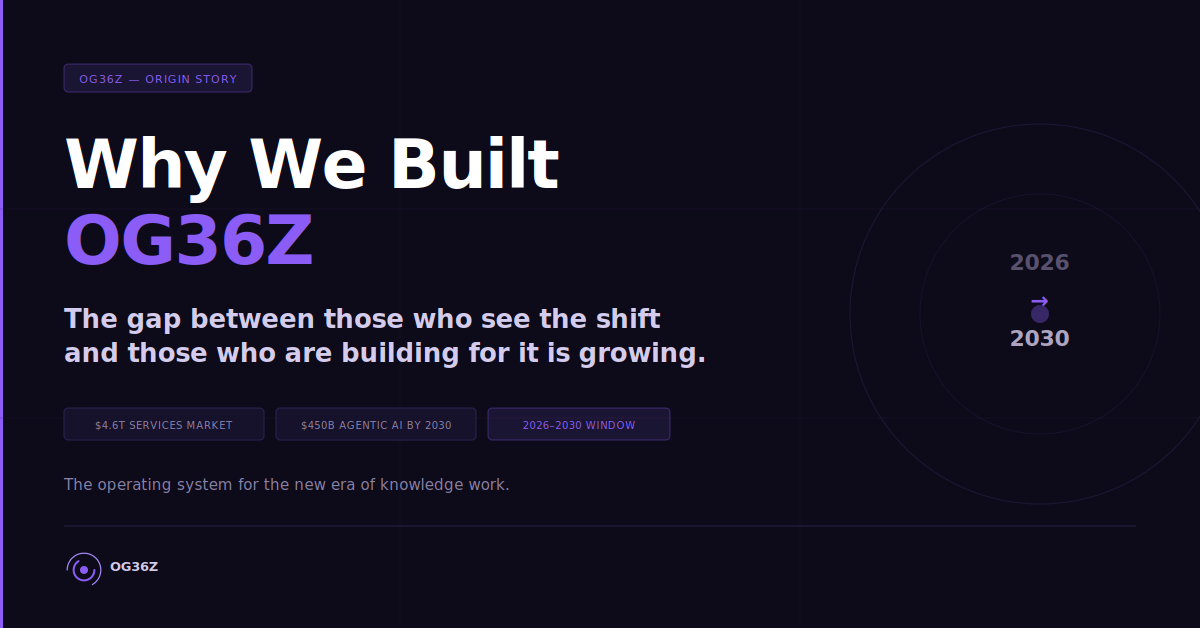
There is a moment — and it's happening right now — where the way knowledge work operates is being rewritten.
Not in some distant future. Not in a whitepaper. Right now, in real workflows, in real practices, in real careers.
The $4.6 trillion global services market is shifting underneath us. AI agents are no longer concepts in pitch decks. They're doing research. Writing first drafts. Preparing briefings. Handling follow-ups. Running operations. Not as experiments — as infrastructure.
And most people are watching from the sidelines.
We built og36z because the gap between those who see this shift and those who are building for it is growing wider every week. And we believe that gap doesn't have to exist.
The Future That's Already Here
Here is what the next 36 months look like for knowledge work:
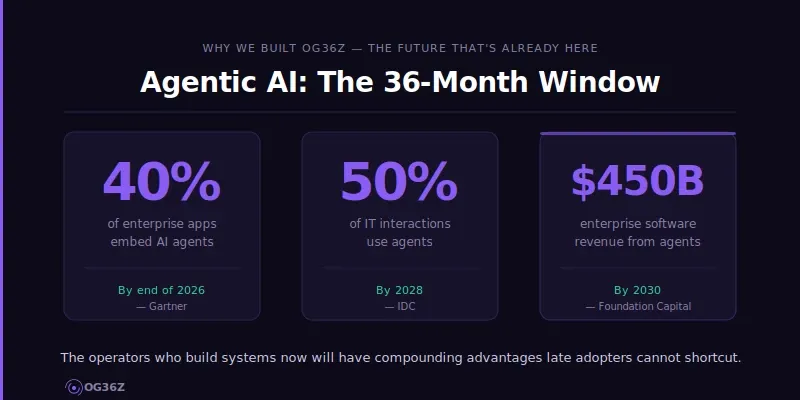
By the end of 2026, over 40% of enterprise applications will embed AI agents. By 2028, nearly half of all IT interactions will use agents as the primary interface. By 2030, agentic AI is projected to drive over $450 billion in enterprise software revenue alone.
These aren't aspirational forecasts. These are the trajectories that Gartner, IDC, and Foundation Capital are tracking — backed by the billions already flowing into agentic infrastructure.
But here's what the forecasts don't tell you: the individuals who position themselves as operators of these systems — not just users of them — will have an asymmetric advantage that compounds for years.
The future won't be divided into "people who use AI" and "people who don't." Everyone will use AI. The divide will be between people who use AI the way most people used the internet in 2002 — searching, browsing, dabbling — and people who built businesses, careers, and systems on top of it.
We're building og36z for the second group.
The Problem We Couldn't Ignore
We started with a research question: why does AI feel underwhelming for so many smart, capable people?
The answer wasn't what we expected. It wasn't about the models. It wasn't about prompting skill. It wasn't about which tool someone chose.
It was about context.
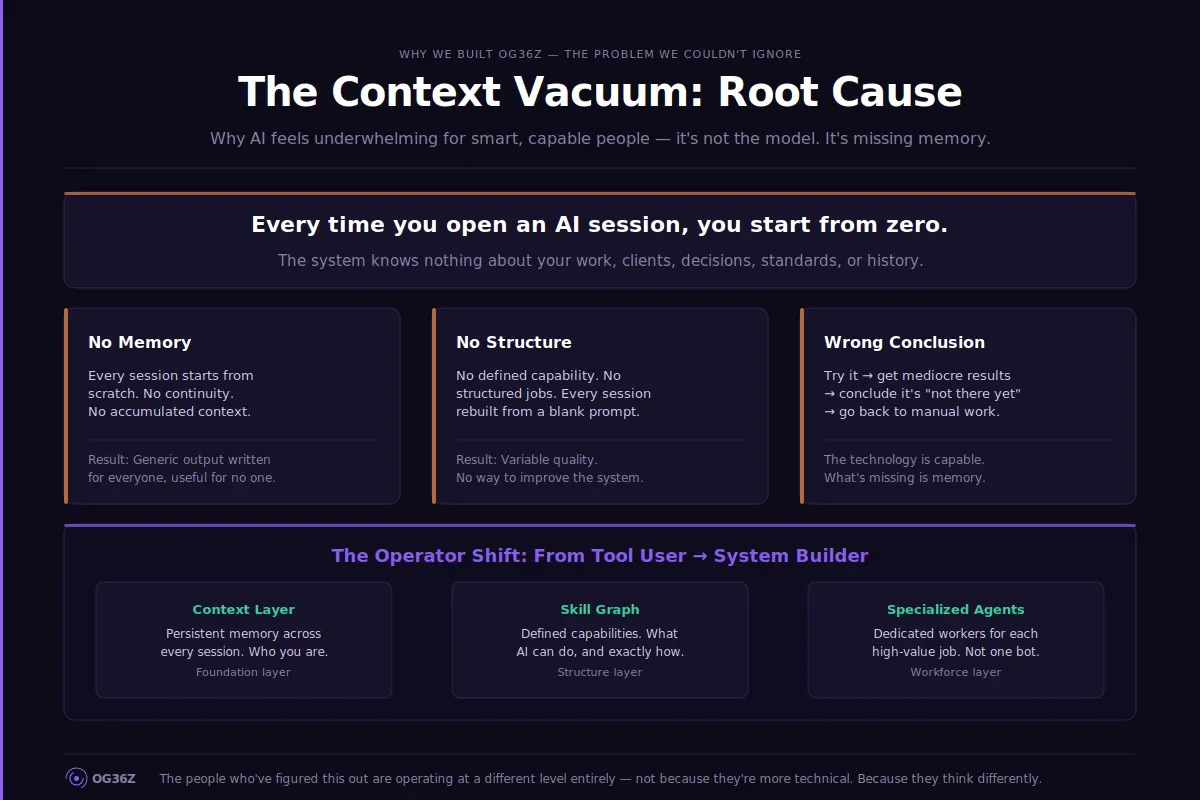
Every time you open an AI session, you start from zero. The system knows nothing about your work, your clients, your decisions, your standards, your history. So it gives you the most generic output it can — advice written for everyone, useful for no one in particular.
We call this the Context Vacuum. And it's the root cause of the most common AI experience: try it, get mediocre results, conclude it's "not there yet," go back to doing things manually.
Except it is there. The technology is more than capable. What's missing isn't intelligence — it's memory. Structure. A persistent layer of context that makes AI output specific, relevant, and actually worth using.
The people who've figured this out — who've built context systems, specialized agents, and outcome workflows — are operating at a different level entirely. Not because they're more technical. Because they think differently about what AI is for.
They stopped asking "how do I use this tool?" and started asking "what job should this system do for me?"
That mental shift is everything. And almost no one is teaching it.
Why a Cohort — Not a Course
There are thousands of AI courses. We could have built another one. Record some videos, sell lifetime access, move on.
We didn't. Here's why.
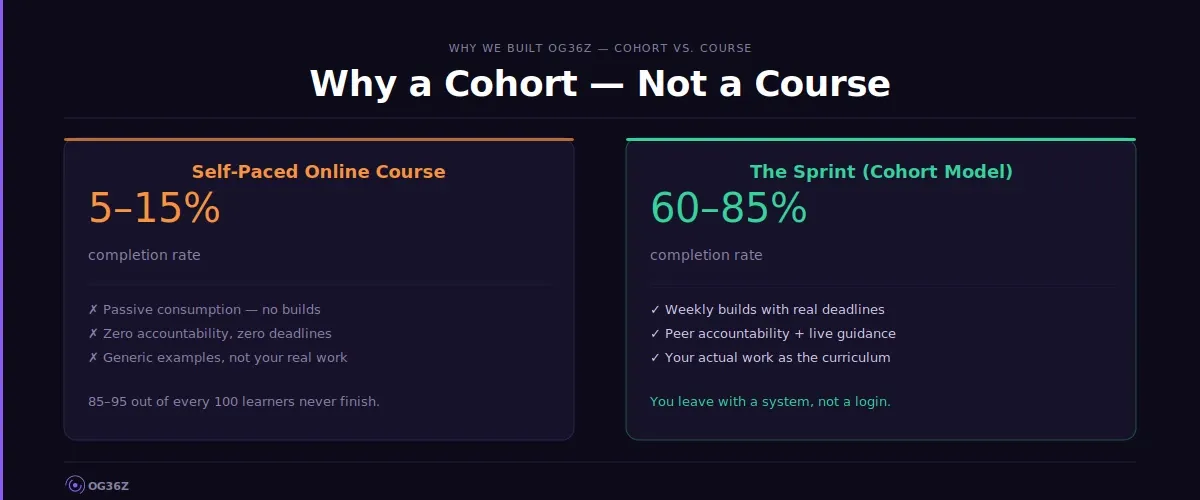
The completion rate for self-paced online courses is 5-15%. That means for every 100 people who buy a course about AI, 85 to 95 of them never finish it. They don't build anything. They don't change how they work. They just have a login they feel guilty about.
Cohort-based programs change the math. With peer accountability, live sessions, weekly builds, and real deadlines, completion rates jump to 60-85%. More importantly, the outcome changes. You don't just "learn about AI." You leave with working systems that run on your actual work.
We chose the cohort model because we're not selling information. Information is free. It's everywhere. You can read about AI-native workflows all day and still go back to copy-pasting into ChatGPT tomorrow.
What we're selling is transformation. A structured environment where you build real systems, with real accountability, using your real work — and you walk out six weeks later operating differently than when you walked in.
That requires a container. Not a playlist.
What We Actually Believe
These are the convictions behind everything we build at og36z:
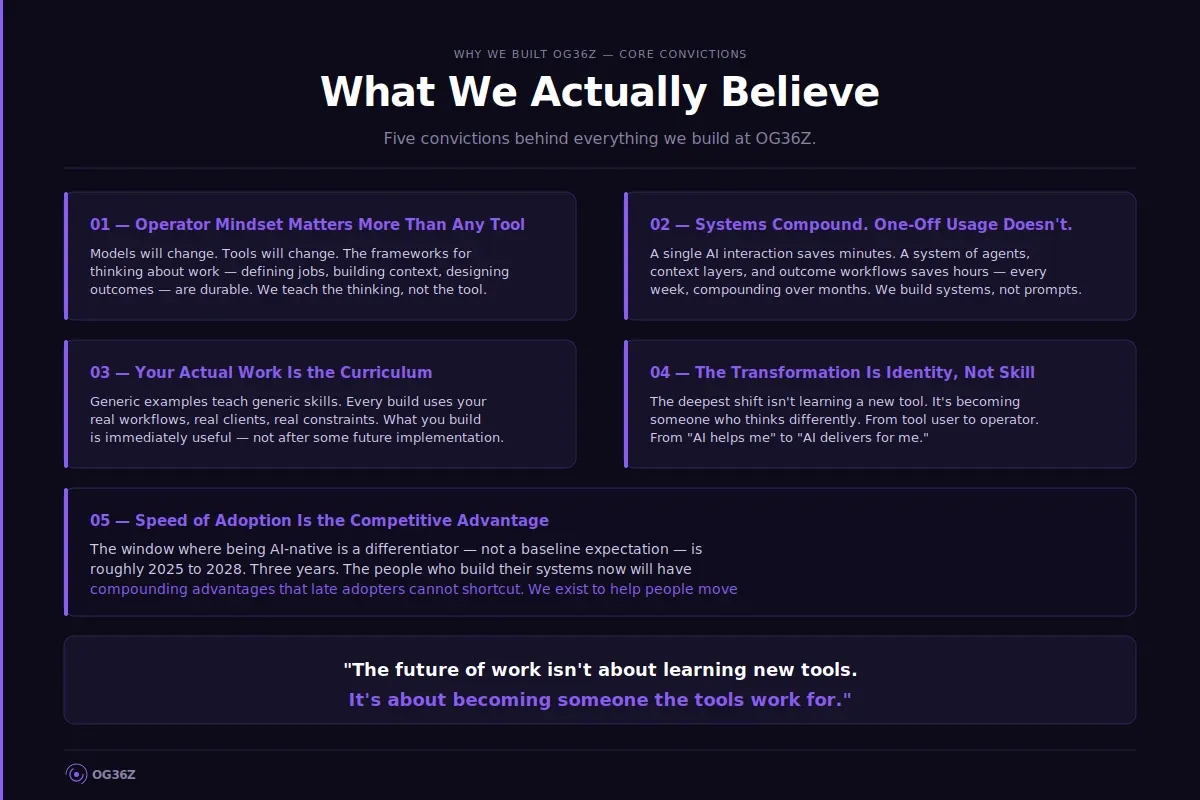
The operator mindset matters more than any tool. Models will change. Tools will change. The frameworks for thinking about work — defining jobs, building context, designing outcomes — are durable. We teach the thinking, not the tool.
Systems compound. One-off usage doesn't. A single AI interaction saves minutes. A system of agents, context layers, and outcome workflows saves hours — every week, compounding over months. We build systems, not prompts.
Your actual work is the curriculum. Generic examples teach generic skills. Every build in the cohort uses your real workflows, your real clients, your real constraints. What you build is immediately useful — not after some future implementation phase. Now.
The transformation is identity, not skill. The deepest shift isn't learning a new tool. It's becoming someone who thinks differently about how work gets done. From tool user to operator. From "AI helps me" to "AI delivers for me." That identity shift changes everything downstream.
Speed of adoption is the competitive advantage. The window where being AI-native is a differentiator — not a baseline expectation — is roughly 2025 to 2028. Three years. The people who build their systems now will have compounding advantages that late adopters cannot shortcut. We exist to help people move through that window while it's still open.
Transparency builds trust. We publish our frameworks. We share our research. We show the math. We tell you exactly what you'll build, how long it takes, and what outcomes to expect. If the cohort isn't right for you, we'd rather you know that upfront than find out in Week 3.
The Name
og36z. People ask what it means.
It's a forward-looking marker. The horizon we're building toward: 2026 through 2030. The period where AI transforms from novelty to infrastructure. From "I tried ChatGPT" to "my practice runs on AI systems."
The OG is intentional. Original. First movers. The people who build now, while the playbook is still being written.
We don't have all the answers. Nobody does — the landscape is moving too fast for anyone to claim certainty. But we have a framework, a community, and a conviction that the people who build systems today will define how knowledge work operates tomorrow.
Who This Is For
og36z is for people who are already good at what they do. Consultants, operators, strategists, builders, founders — professionals who deliver real value and know they're leaving capacity on the table.
You've used AI. You know it's powerful. But you also know that the way you're using it — sporadic, sessionless, starting from scratch every time — isn't the full picture.
You're not looking for a tutorial. You're looking for a system. A structured path from "I use AI sometimes" to "AI runs core parts of my workflow."
That's what we build here.
The Commitment We Make
When you subscribe to The Signal, you get one sharp insight per week. No filler. No hype cycles. One shift in thinking, one move you can make, one proof point from someone who's done it.
When you join a cohort, you get six weeks of structured building. Live sessions, office hours, peer accountability, and a documented operating system you own forever. Not theory. Not videos. Builds.
When you join the Inner Circle, you get ongoing access to a community of operators who are continuously refining their systems — because AI-native isn't a destination, it's an evolving practice.
Everything we publish, teach, and build points toward one outcome: you operating at a level that wasn't possible eighteen months ago, using systems that compound every week you use them.
The Long View
We're not building a course company. We're building the operating system for a new era of knowledge work.
The $4.6 trillion services market is being restructured. Solo practitioners will deliver what teams used to. Small firms will operate at enterprise scale. The constraint will no longer be headcount — it will be how well you orchestrate the systems that do the work.
og36z exists to make sure the people who want to be on the right side of that shift have a path to get there. Clear, structured, accountable, and built on real work — not hype.
The future of work isn't about learning new tools.
It's about becoming someone the tools work for.
That's why we built this. That's why we show up every week. And that's the invitation.
Welcome to og36z. Welcome to The Signal. Let's build.