
What Is a Skill Graph? How Operators Map AI Capabilities Into Systems
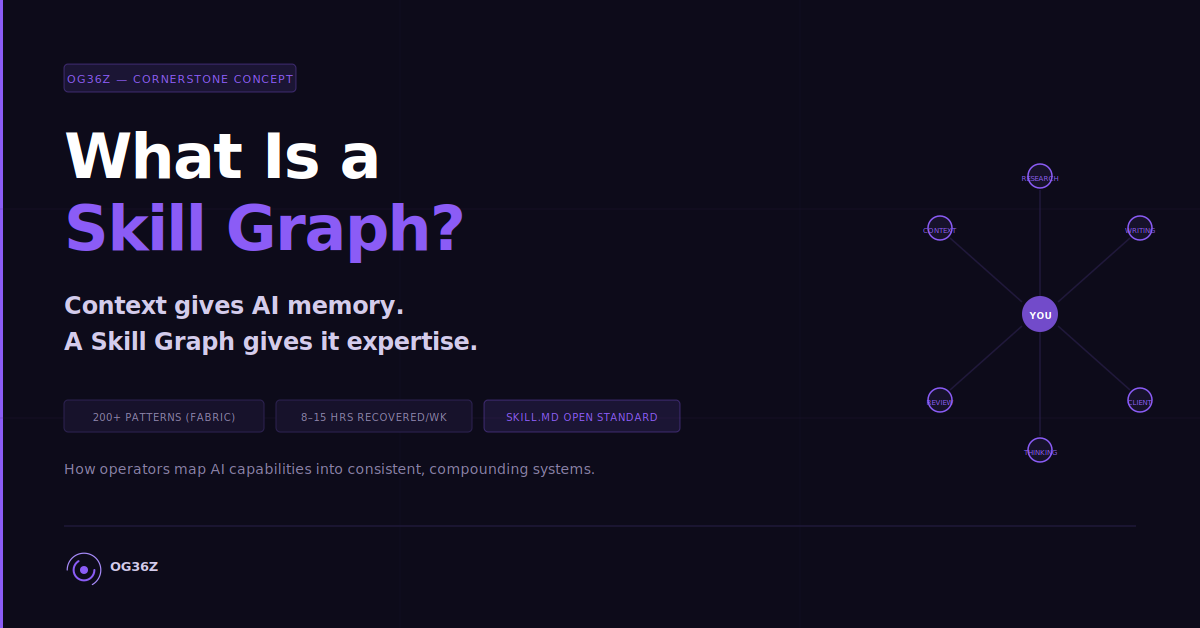
A Skill Graph is a map of procedural AI capabilities — the structured definition of what your AI operating system can do and how those capabilities relate.
Key Takeaways
- A Skill Graph maps the procedural AI capabilities you've built—the distinct jobs AI can do and how they chain into workflows
- Daniel Miessler's fabric: 200+ patterns. Anthropic's 2025 Agent Skills spec spans Microsoft, GitHub, Figma, and Atlassian
- Professionals who build Skill Graphs recover 8–15 hours per week by removing ambiguity from every AI task definition
- Context layers give AI memory; Skill Graphs give AI expertise — together they turn a chatbot into an operating system
What is a Skill Graph and how does it work?
A Skill Graph is a structured map of the procedural capabilities built for an AI operating system — the distinct jobs AI can do, organized to show how they connect, depend on each other, and build into workflows.
Unlike a context layer, which tells AI who you are, a Skill Graph tells AI what it can do for you. Anthropic's 2025 Agent Skills specification formalizes the structure as a SKILL.md file for each capability, composable and portable across any model.
CORE COMPONENTS:
- Skill Nodes — individual AI tasks defined with explicit standards and constraints
- Skill Clusters — related skills grouped by job type (context, research, writing, thinking, client work)
- Workflow Chains — the sequence in which skills compose into reusable outcome pipelines
- Skill Specs — one-paragraph definitions stating inputs, outputs, standards, and never-dos per job
- Context Layer — the memory foundation that tells AI who you are, on which the Skill Graph builds
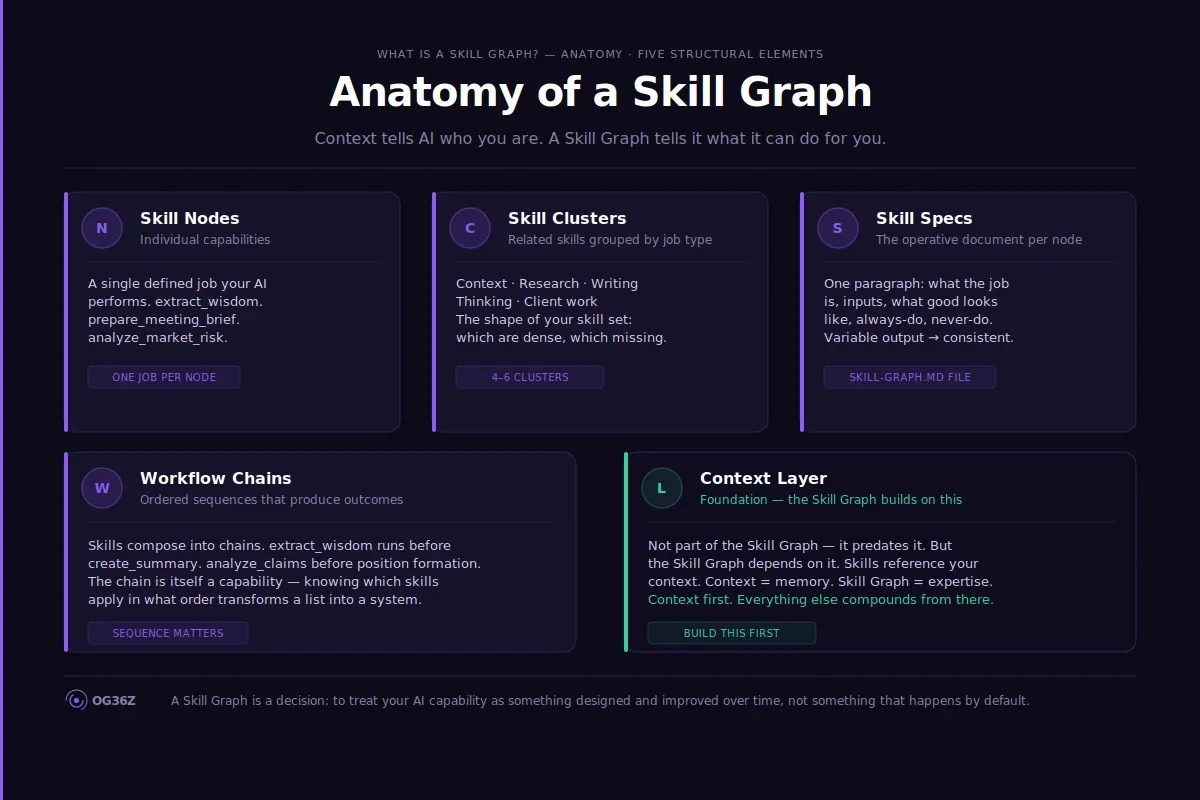
A Skill Graph is a structured map of the procedural capabilities you have built for your AI operating system — the distinct jobs your AI can do, organized to show how they connect, depend on each other, and build into workflows.
Context tells AI who you are. A Skill Graph tells it what it can do for you.
Without one, your AI is capable but undefined — producing output that varies in quality every time you ask it to do the same job.
Most professionals who use AI every day have built neither. The result is predictable: AI that is useful occasionally and inconsistent always.
What Is a Skill Graph?
A Skill Graph is a map of procedural AI capabilities — the structured definition of what your AI operating system can do and how those capabilities relate.
Each node in the graph is a skill: a specific job your AI performs, defined with enough precision that it produces consistent, high-quality output every time.
The graph is the structure that shows how those skills connect — which ones chain into workflows, which ones depend on each other, and which ones build toward outcomes.
The concept is distinct from a context layer. A context layer is memory — it tells AI who you are, what you're working on, what you've decided, and what good work looks like in your world. A Skill Graph is expertise — it tells AI what procedural capabilities it has available and exactly how to execute each one.
Think of it as the difference between a consultant who knows your business and a consultant who knows your business and has a defined methodology for every engagement type. The first is better than nothing. The second is a system.
Why Doesn't Context Alone Cut It?
Context is the foundation layer of an AI operating system. Without it, AI starts every session from zero — no knowledge of who you are, what you're building, what you've decided, or what standards you hold. The Context Vacuum is the term for that gap, and closing it is the first move.
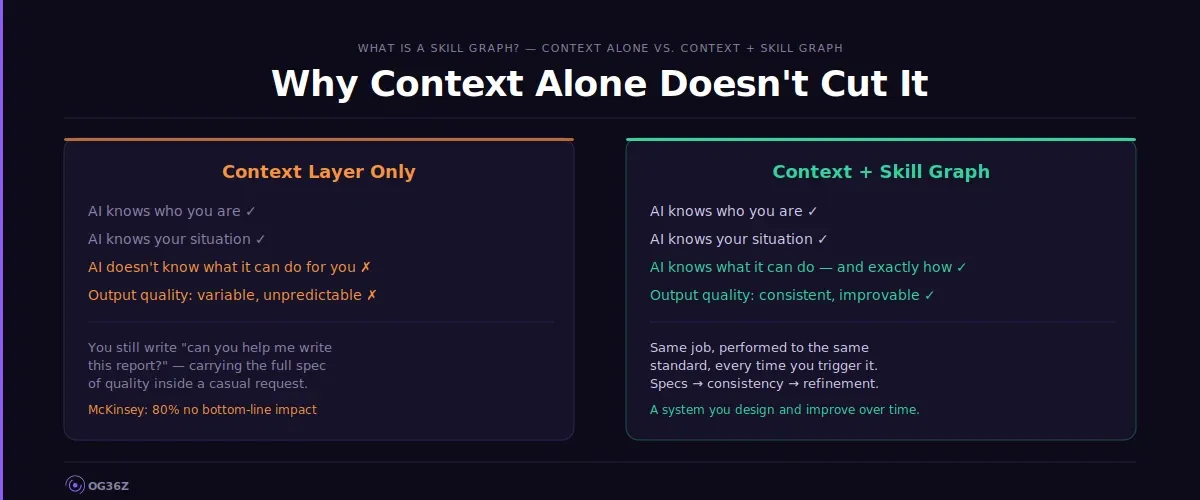
But context answers one question: who you are. It doesn't answer a second, equally important question: what can AI do for you, and how should it do it?
This is what context alone produces in practice: better outputs than default, but still undefined capability. You open a session, AI knows your situation, and you still write "can you help me write this report?" — carrying the full specification of quality inside a casual request. The AI produces something reasonable. It may produce something excellent. It may produce something generic. You cannot predict which, because you have never defined what "good" looks like for that specific job.
A Skill Graph closes this gap. It defines the jobs AI performs for you with enough precision that quality is consistent rather than variable. The same job, performed to the same standard, every time you trigger it.
McKinsey's most recent research on AI adoption found that 80% of companies using gen AI report no significant bottom-line impact. That is not a context problem alone — it is a capability definition problem. Organizations have given AI access to their data. They have not told it how to do the work.
What Are the Core Components of a Skill Graph?
A Skill Graph has five structural elements, each one serving a distinct purpose in the system.
Skill Nodes A skill node is a single, defined capability — one job your AI performs. extract_wisdom pulls key insights from any content. prepare_meeting_brief produces a structured prep document from attendee names and agenda topics. analyze_market_risk stress-tests a business assumption against named competitor data. Each node is a job with a definition. Without the definition, it is just a task.
Skill Clusters Related skills group into clusters by job type. A useful starting taxonomy for knowledge workers and consultants:
- Context skills — jobs that create or update your context layer (weekly review, project brief, decision log update)
- Research skills — jobs that gather and synthesize information (topic research, competitor analysis, claim checking)
- Writing skills — jobs that produce drafts and documents (proposal drafting, email writing, report structure)
- Thinking skills — jobs that analyze, critique, or stress-test (argument analysis, risk review, feedback synthesis)
- Client skills — jobs specific to client-facing work (meeting prep, deliverable review, briefing creation)
Skill Specs The skill spec is the operative document for each node — typically one paragraph stating: what the job is, what inputs trigger it, what good output looks like, what the AI should always do, and what it should never do. This is the document that turns variable output into consistent capability.
Workflow Chains Individual skills compose into chains — ordered sequences that produce outcomes from inputs. extract_wisdom runs before create_summary. analyze_claims runs before forming a position. The chain is itself a capability: knowing which skills apply in what order transforms a collection of skills into a system.
Context Layer The context layer is the foundation on which the Skill Graph builds. It is not part of the Skill Graph — it predates it — but the Skill Graph depends on it. Skills reference your context. Meeting prep skills reference your decision log. Research skills reference your current projects. Remove the context layer and the Skill Graph loses its precision.
How Do You Build Your First Skill Graph?
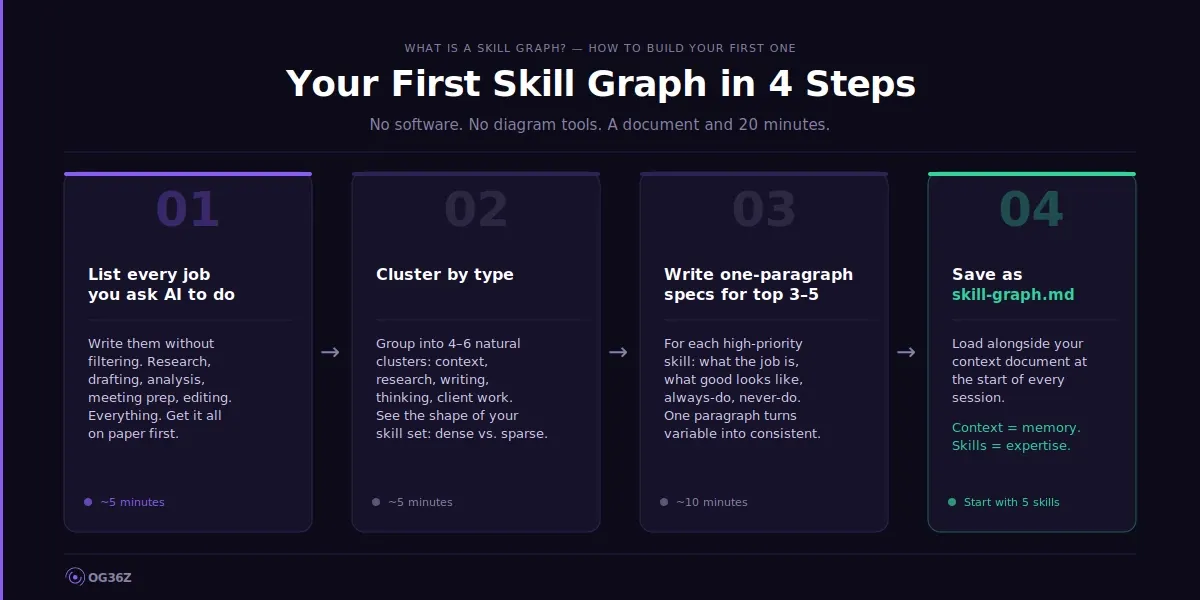
Building a Skill Graph requires a document and 20 minutes. No software. No diagram tools.
Step 1: List every job you currently ask AI to do.
Write them down without filtering. Research, drafting, editing, analysis, client communication, meeting prep, brainstorming, summarization, feedback review, proposal writing — get everything on paper. The list should feel slightly overwhelming. That is normal. You are mapping the full range of what you actually ask AI to do, most of which has never been defined.
Step 2: Cluster by type.
Group your list into 4–6 natural clusters — context, research, writing, thinking, client work — or whatever categories fit your actual work pattern. The goal is to see the shape of your skill set: which clusters are dense, which are sparse, which are missing entirely.
Step 3: For your top 3–5 skills, write a one-paragraph spec.
For each high-priority skill, write: what the job is, what good output looks like, what AI should always do, and what it should never do. This is the skill definition — the document that turns variable output into consistent capability.
Example spec for a "Meeting Prep" skill:
When I give you a meeting brief (attendee names, topics, context), prepare a structured prep document with: background on each attendee from what I've shared previously, key questions to drive the agenda, potential objections or tensions to watch for, and one-sentence goals for each agenda item. Always reference my decision log for relevant history. Never suggest questions I'd be embarrassed to have overheard.
One paragraph. Saves 20 minutes of prompt-building every time you use it. Compounds across every meeting, every week.
Step 4: Save it as skill-graph.md and load it alongside your purpose document.
Your context document is your memory. Your skill-graph.md is your expertise. Together, they give every session a defined starting point — the one most professionals never build.
What Does a Real-World Skill Graph Look Like in Practice?
Daniel Miessler's fabric is the most thorough public example of a mature skill graph in production.
Fabric is an open-source system for augmenting humans using AI. Its core architectural claim: AI capability is not about the model — it is about the patterns you bring to it. Fabric contains over 200 individual skill patterns, each one tested in real work, each one a precise definition of how AI should approach a specific job. extract_wisdom pulls the most important insights from any content. analyze_claims stress-tests assertions for logical validity. create_summary produces structured, scannable output from raw material. find_logical_fallacies examines reasoning for structural errors.
What makes fabric instructive — even for people who never install the software — is the graph structure. Miessler's skills relate to each other. extract_wisdom runs before create_summary. analyze_claims runs before position formation. The sequence in which skills apply is itself a capability. That is the graph: not just what your AI can do, but how those capabilities compose into workflows.
The same principle is now formalized as an open standard. In December 2025, Anthropic released the Agent Skills specification — an open-source format defining AI skills as portable, composable packages. Microsoft, GitHub, Figma, Atlassian, and Cursor adopted it at launch. Skill packages from Canva, Stripe, and Notion are publicly available. The SKILL.md format — a file containing a skill name, description, and structured instructions — is simple enough to adopt immediately.
The industrialization of Skill Graphs is underway. Individual operators are building the same architecture in their personal systems that enterprises are deploying at scale.
Which Tools Should You Use to Build Your Skill Graph?
Daniel Miessler's fabric is the most complete reference implementation available.
Browse the skills library to see what 200+ skill patterns look like in practice. The structure is consistent across every pattern: a system prompt that defines the job, the output format, the standards, and the constraints. Pick 2–3 patterns that match your highest-value work. Adapt the format for your own spec. The architecture is model-agnostic — these patterns run on Claude, GPT-4, Gemini, or any capable model.
agentskills.io has the full Anthropic Agent Skills specification, including partner skill packages from Notion, Canva, Stripe, and others. The SKILL.md format is the emerging open standard — if you are building skills you want to share or compose with other systems, this is the format to adopt.
Your own skill-graph.md is the starting point. No external tools required. A flat file loaded alongside your context document at the start of every session. The skills library and the SKILL.md standard are references — the thing that actually makes you more capable is the spec you write for your own highest-value jobs.
Why Is the Operator Advantage Compounding Now?
The professionals building Skill Graphs now are not just better at AI tasks. They are building systems that improve over time.
Each skill you define makes that job consistent. Each consistent job produces better outputs. Better outputs create a feedback loop: you refine the spec, the next run is better, the run after that is better still. The Skill Graph compounds in a way that ad-hoc prompting cannot — because there is nothing to refine, nothing to improve, nothing to build on.
The professionals still working without a Skill Graph are starting from zero every time. They ask AI to do the same jobs with the same vague prompts, get variable results, and have no way to improve the system because there is no system. They are prompting. Operators are operating.
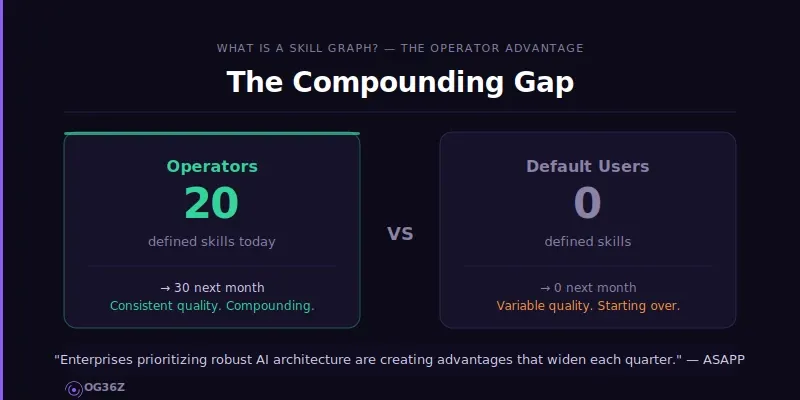
ASAPP research found that enterprises prioritizing robust AI architecture — memory and capability definition combined — are creating advantages that widen each quarter. The gap between structured operators and default AI users is not narrowing. It is compounding in both directions simultaneously.
"Enterprises that prioritize robust, adaptive memory management in their AI agent investments today will gain an unprecedented edge." — ASAPP
The same dynamic holds at the individual level. The operator who has 20 defined skills today will have 30 next month. Their AI produces consistent, high-quality output for all 20 jobs. The colleague without a Skill Graph produces the same variable output they produced last year. Two professionals with access to identical models. Compounding returns on opposite sides of the same architectural decision.
Start Here
A Skill Graph is not a diagram. It is a decision: to treat your AI capability as something designed and improved over time, rather than something that happens by default.
The starting point is your context layer. If you have not built it yet, Signal #1 covers the structure: mission, goals, current projects, decision log, standards, and constraints. Build that first — the Skill Graph depends on it.
If your context layer is in place, the next step is a list. Every job you currently ask AI to do. Written down. Clustered. Then defined — one paragraph per high-priority skill, saved as skill-graph.md, loaded at the start of every session.
Start with five skills. You already know which five. They are the jobs you ask AI to do most, the ones where quality matters most, the ones where a precise definition would make the most difference.
Define them once. Refine them over time. Watch your AI stop guessing what you mean.
Share This Post
If you work with someone building their AI operating system — a consultant, a founder, an operator — a Skill Graph is the step most people skip. Context first, then capability. Forward this if they're at that stage. They can subscribe free at og36z.com