
The Sprint by og36z: 6 Weeks to Build Your AI Operating System
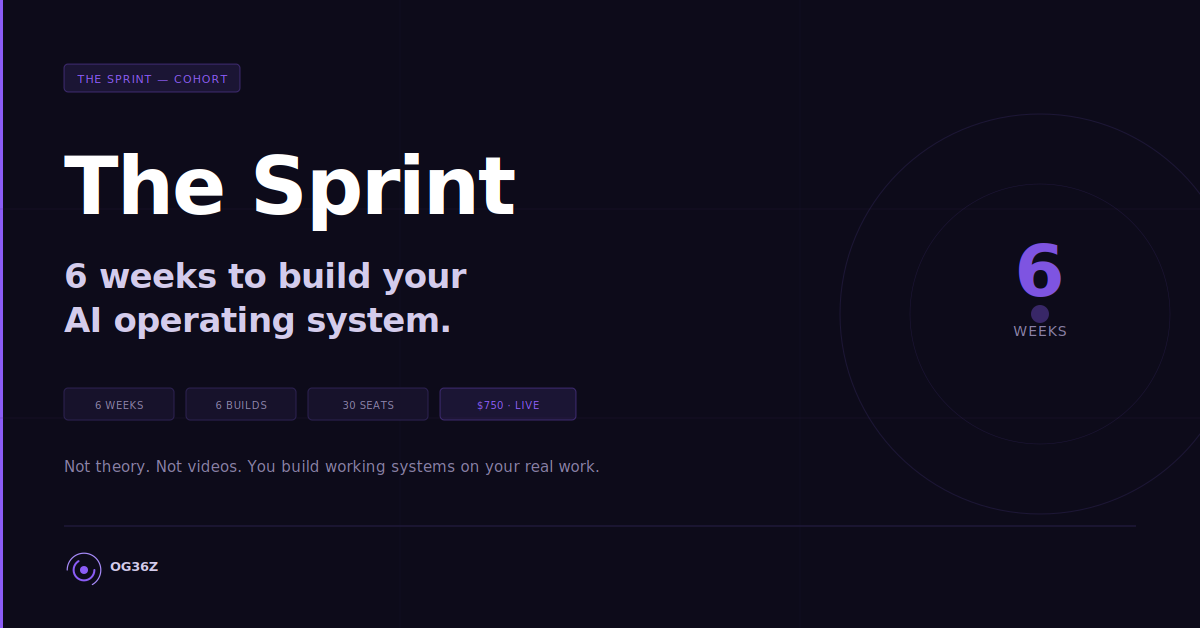
The Sprint is a six-week live cohort where you build a complete AI operating system for your work. Not in theory. Not with hypothetical examples. Using your actual workflows, your actual clients, your actual constraints.
There are two ways to become an AI-native operator.
The first is to figure it out on your own. Read the newsletters. Watch the tutorials. Try things in ChatGPT. Bookmark frameworks you'll never use. Spend six months piecing together a system through trial and error, context-switching between your actual work and "learning AI" on the side.
Some people make this work. Most don't. Not because they lack ability — because the feedback loop is too slow and the accountability is zero.
The second way is to build your system in six weeks, with structure, live guidance, peer accountability, and your real work as the raw material.
That's The Sprint.
What The Sprit by og36z Actually Is
The Sprint is a six-week live cohort where you build a complete AI operating system for your work. Not in theory. Not with hypothetical examples. Using your actual workflows, your actual clients, your actual constraints.
Each week follows the same rhythm:
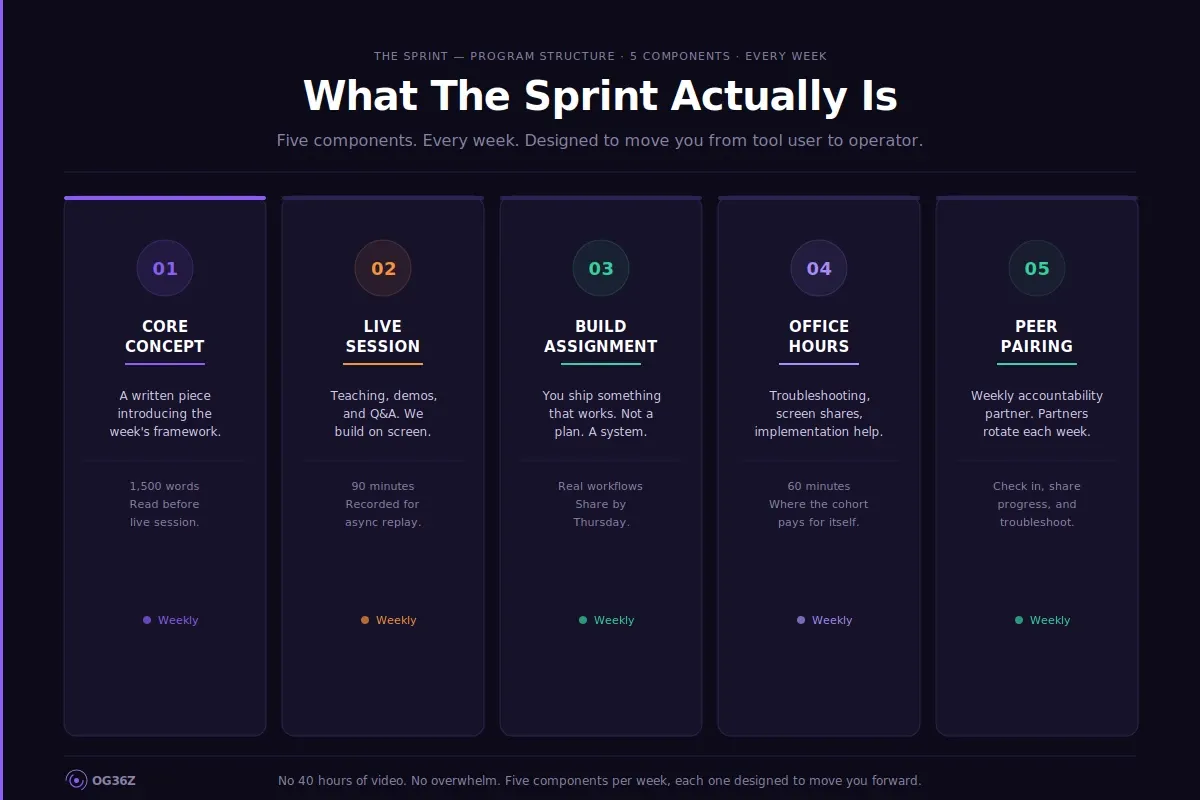
One core concept — a written piece that introduces the week's framework. You read it before the live session. It's 1,500 words or less because we respect your time.
One live session (90 minutes) — teaching, live demos, and Q&A. We build things on screen. You see exactly how concepts become working systems. Every session is recorded for async replay.
One build assignment — the real work. Each week, you ship something that works. Not a plan. Not a draft. A working system that runs on your actual workflows. You share it in the community by Thursday.
One office hours session (60 minutes) — troubleshooting, screen shares, and implementation help. This is where the cohort pays for itself. The moment you're stuck, someone who's seen that exact problem before helps you through it.
One peer pairing — a weekly accountability partner. You check in, share progress, troubleshoot together. Partners rotate each week so you learn from different perspectives and never go stale.
That's it. No 40 hours of video content. No bonus modules. No overwhelm. Five components per week, each one designed to move you forward.
The Six Builds inside The Sprint by og36z
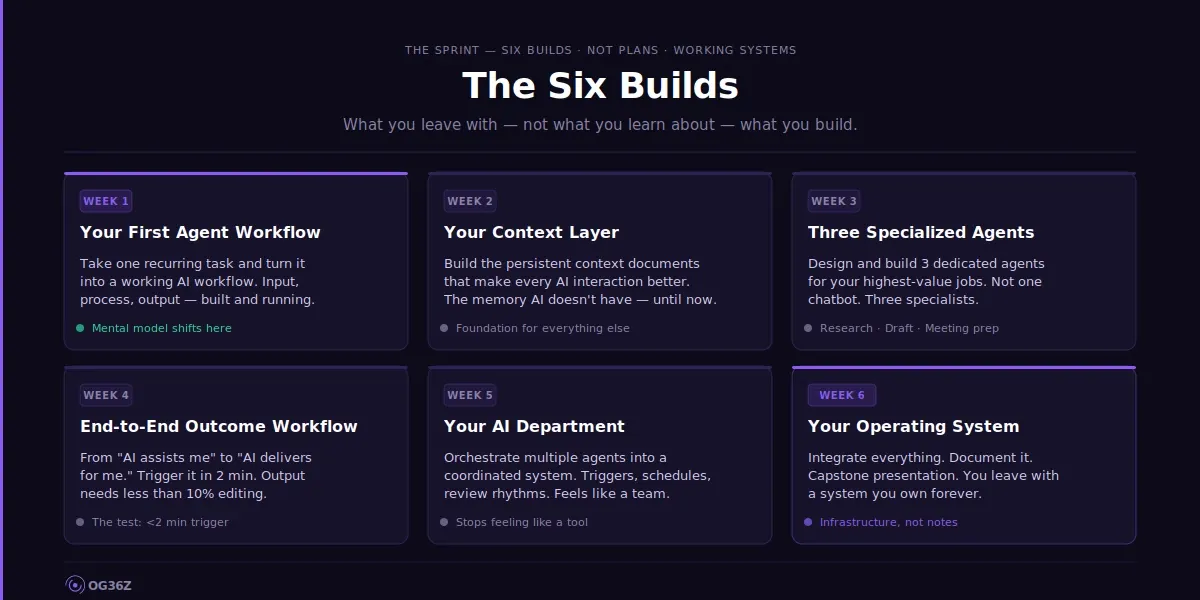
Here's what you leave with. Not what you learn about — what you build.
Week 1 — Your First Agent Workflow. You take one recurring task from your work and turn it into a working AI workflow. Input, process, output — defined, built, and running on real work by Thursday. This is where the mental model shifts. You stop thinking about tools and start thinking about jobs.
Week 2 — Your Context Layer. You build the persistent context documents that make every AI interaction dramatically better. Who you are, how you work, what good looks like, what you've decided, what matters. This is the memory that AI doesn't have — and when you give it that memory, the quality of everything changes.
Week 3 — Three Specialized Agents. You design and build dedicated agents for your three highest-value jobs. Not one general-purpose chatbot. Three specialists — each with a defined role, context, constraints, and output format. A research agent, a drafting agent, a meeting prep agent — whatever your work demands.
Week 4 — One End-to-End Outcome Workflow. You move from "AI assists me" to "AI delivers for me." You design a workflow where you define the outcome, and the system handles execution. The test: can you trigger it in under two minutes and get output that requires less than 10% editing?
Week 5 — Your AI Department. You orchestrate multiple agents into a coordinated system that handles recurring work. Triggers, schedules, review rhythms. This is where it stops feeling like using a tool and starts feeling like managing a team.
Week 6 — Your Documented Operating System. You integrate everything. Document it. Present your transformation to the cohort in a five-minute capstone. What you built, what changed, what's next. You leave with a system you own forever.
Six weeks. Six builds. Each one requires and extends the previous one. By the end, you don't have notes — you have infrastructure.
Why 6 Weeks
Shorter than six weeks and you don't have time for the builds to compound. You'd learn concepts but not internalize them through use.
Longer than six weeks and momentum dies. Research on behavioral change shows that six weeks is the threshold where new practices start to feel like defaults rather than experiments. It's long enough to build real systems. Short enough to maintain intensity.
The cohort isn't designed around content delivery. It's designed around transformation speed. Everything that doesn't accelerate your path from tool user to operator has been removed.
The Honest Math around The Sprint by og36z
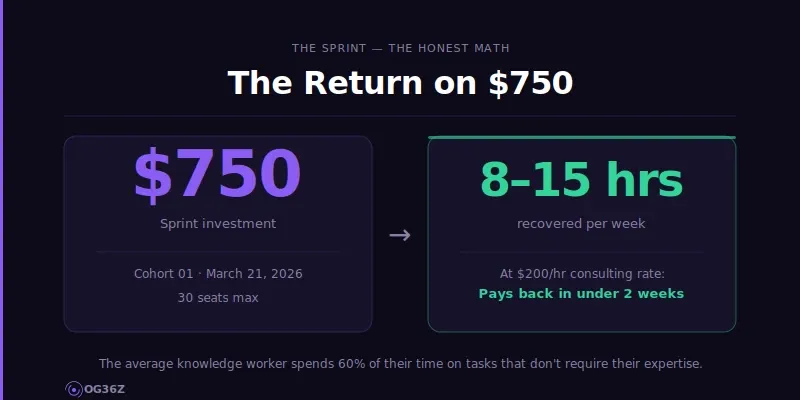
The Sprint costs $750.
Here's what we anchor that against — not to manipulate, but because the math is genuinely worth examining.
The average knowledge worker spends 60% of their time on tasks that don't require their expertise. At a $75K salary, that's $45,000 a year in low-leverage work. At a $200/hour consulting rate, it's significantly more.
Cohort graduates report recovering 8 to 15 hours per week through the systems they build. At any professional rate, the $750 pays back within the first two weeks of using your system.
We're not asking you to take our word for this. We're asking you to run the math on your own time. Track one week. Add up the hours you spend on work that doesn't require your judgment. Multiply by your rate. That's the number.
If the number is small, the cohort probably isn't for you right now. If the number makes you uncomfortable, it probably is.
What We Don't Do at The Sprint by og36z
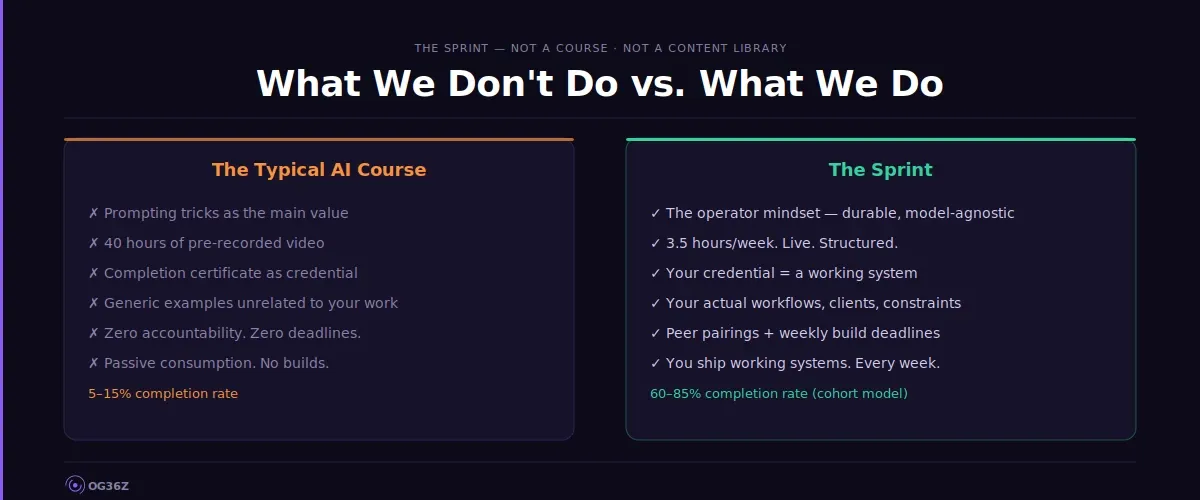
We don't teach prompting. Prompting is a tactic. We teach the operating model that makes any tactic work better.
We don't optimize for completion certificates. There is no certificate. Your credential is a working system that runs on your real work. That's harder to earn and infinitely more valuable.
We don't sell recordings as a standalone product. The live cohort — the accountability, the peer pairing, the real-time troubleshooting — is the product. Recordings exist so you can revisit, not so you can consume passively.
We don't promise magic. Building an AI operating system takes work. Three and a half hours per week, minimum. If you're not willing to carve out that time, we'd rather tell you now. The cohort works because the people in it show up and build. We provide the structure. You provide the effort.
Who The Sprint by og36z Is For
The Sprint is for professionals who meet three criteria:
You're already good at what you do. The cohort doesn't teach your domain. It gives you leverage within it. You need to know your work well enough to identify which parts should be delegated to AI and which parts require your judgment.
You've used AI but don't have a system. You've tried ChatGPT, Claude, or similar tools. You've gotten value from individual sessions. But you don't have anything persistent — no context layer, no specialized agents, no workflows that compound. Every session still starts from scratch.
You can commit 3.5 hours per week for six weeks. One live session (90 min), one office hours (60 min), and build time (~60-90 min). This is non-negotiable. The cohort works because people build. If you're browsing for information, The Signal is a better fit.
If that's you — and you know it's you — the cohort is designed to take you from where you are to operating at a level most professionals won't reach for another 12 to 18 months.
Why only 30 Seats?
Each cohort is capped at 30. This isn't artificial scarcity. It's the number where live sessions stay interactive, peer pairings work, and office hours have enough time for real troubleshooting.
At 30, you get seen. At 100, you get content. We chose 30.
Cohorts run multiple times a year. If this one fills and the timing doesn't work, there will be another. We'd rather you join the right cohort than rush into the wrong one.
But the people who join sooner build sooner. And systems that start compounding in March look very different from systems that start compounding in July.
The window for early-mover advantage in AI-native work is 2025 to 2028. Every month you wait isn't neutral. It's compounding time you don't get back.