Hello OG's - You Don't Need to Learn AI
You need to become someone AI works for.
Every week a new AI tool launches. Every week someone tells you to learn it. New model. New feature. New prompting technique. New course. New certification. New thing you're already behind on. You open ChatGPT. You type a question. You get an answer that's fine but not quite right. You edit it. You close the tab. You do this 4 times a day and call it "using AI." Here's the problem: you're learning AI the way someone learns a drill by studying drill bits. You're focused on the tool. You should be focused on the hole.
The Tool User Trap
Most people who "use AI" are tool users. They open an app, type a question, get a response, and move on. Every session starts from zero. The AI doesn't know what they care about, what they've decided, what good looks like for them, or what they're trying to build.
It's like hiring a brilliant consultant — and giving them amnesia between every conversation.
Tool users:
- Re-explain their situation every time
- Get generic output that needs heavy editing
- Use AI for one-off tasks instead of recurring workflows
- Spend more time prompting than the task would take manually
- Never build anything that compounds
This isn't a skill problem. It's a framing problem. The question "how do I use AI better?" keeps you stuck as a tool user. It's the wrong question entirely.
The Right Question
Stop asking: How do I use AI?
Start asking: What jobs should AI do for me?
One question makes you a better user of someone else's tool. The other makes you an operator — someone who defines outcomes and directs systems to deliver them.
An operator doesn't open ChatGPT and hope for a good answer. An operator has built systems where AI already knows the context, already understands the constraints, and delivers outcomes — not drafts.
The difference looks like this:
| Tool User | Operator |
|---|---|
| Opens AI, re-explains context | AI already has persistent context |
| Gets a draft, edits for 30 minutes | Gets output that's 90% done |
| Uses AI for random tasks | Has specialized agents for specific jobs |
| Each session starts from scratch | Each session builds on the last |
| "AI saves me a few minutes" | "AI runs entire workflows for me" |
Same tools. Same models. Completely different outcomes.
Why "Learning AI" Is a Trap
The AI landscape changes every 3 months ( sometimes weeks now) the model/trick/ technology you learned last quarter is already outdate. The prompting technique you perfected is already obsolete. The tool you mastered just added 40 new features.
If your strategy is "keep learning the latest AI tools," you are on a treadmill. You'll run faster every quarter and never get anywhere.
But operators don't have this problem. Because the operator mindset is tool-agnostic.
When you think in terms of jobs to be done — what outcome you need, what input the system needs, what constraints matter — the specific tool is just an implementation detail. Models change. Jobs don't.
A meeting prep system is still a meeting prep system whether it runs on GPT-5.2, Claude opus 4.6, or whatever ships next week. The context layer you build for your clients doesn't expire when a new model drops. The workflow you've documented and refined over weeks still works.
Tools are temporary. Systems compound.
The Context Vacuum
Here's the real reason AI feels underwhelming for most people: every conversation starts cold.
You open a session. The AI knows nothing about you. Nothing about your work, your clients, your standards, your past decisions, your preferences. So it gives you the most generic, median response it can. You get output that sounds like it was written for everyone and no one.
We call this the Context Vacuum — and it's the single biggest reason people give up on AI.
The fix isn't better prompts. It's persistent context.
When AI knows who you are, how you work, what you've decided, and what good looks like — everything changes. The output goes from "generic draft I need to rewrite" to "this actually sounds like me." Research goes from "here are some articles" to "here's what matters given your specific situation."
Context turns AI from an assistant into a partner.
What Operators Actually Build
An AI-native operator builds three things:
1. A Context Layer: Persistent documents that capture who you are, how you work, and what matters. Client context. Project context. Personal standards. Decision history. This is the memory that AI doesn't have — and when you give it that memory, the quality of everything else jumps.
2. Specialized Agents: Not one general-purpose chatbot doing everything poorly. Dedicated agents, each designed for one specific job. A research agent that knows your domain. A writing agent that knows your voice. A meeting prep agent that knows your clients. One agent per job. Each one good at that job.
3. Outcome Workflows: End-to-end systems where you define the outcome and the system delivers it. Not "help me draft this" — but "here's the input, here's what done looks like, go." Workflows where AI doesn't assist you. It delivers for you.
Context layer. Specialized agents. Outcome workflows. That's the stack. That's what separates someone who uses AI from someone who operates it.
This Isn't About Technology
The shift from tool user to operator is not a technical upgrade. It's a mental model shift.
You stop thinking about features and start thinking about jobs. You stop asking "what can this tool do?" and start asking "what outcome do I need?" You stop consuming AI content and start building AI systems.
It's the difference between reading about exercise and going to the gym. Between bookmarking recipes and cooking dinner.
The operator mindset is: define the job, build the system, refine it with real work, and let it compound. Repeat.
No certifications. No courses about courses. No prompt libraries. Just systems that do real work, built with your actual workflows, refined over time.
The Signal Newsletter by og36z
This is what we write about here at 📡 The Signal (by og36z).
Not which AI tool is trending. Not which model just shipped. Not prompting tricks.
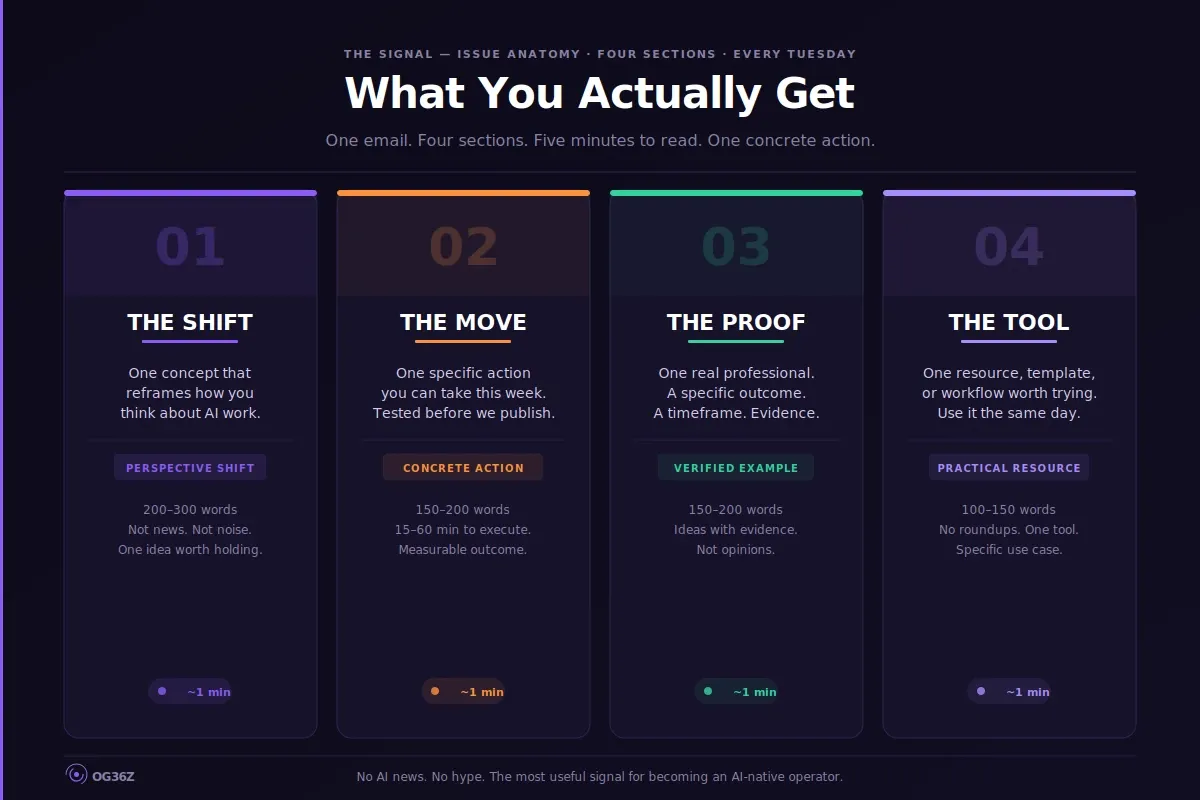
We write about the shift — from tool user to operator. One insight per week. One move you can make immediately. One proof point from someone who's already done it. One concrete tool or template to implement.
If you're here to browse AI content, this isn't the place. There are a thousand newsletters for that.
If you're here to build — to actually change how you work, not just read about it — welcome.
You don't need to learn AI. You need to become someone AI works for.
The tools are just tools. The transformation is in you.