
From Blank Page to Sent Proposal: A Time-Efficient Process for Solo Consultants
An efficient solo consultant proposal process is a five-stage workflow — discovery capture, structural assembly, custom drafting, review and tighten, and send with follow-up protocol
KEY TAKEAWAYS
- Blank-page paralysis in proposal writing is a process failure, not a creativity failure — it resolves by defining five discrete workflow stages.
- A solo consultant with a defined start-to-send workflow completes proposals in 90–120 minutes rather than leaving them in drafts for days.
- The five stages — capture, structure, draft, review, send — each have a specific input and output that eliminate decision stalls.
- Follow-up timing and format after a sent proposal is as important as the proposal itself; a defined follow-up protocol prevents pipeline drag.
What is an efficient solo consultant proposal process?
An efficient solo consultant proposal process is a five-stage workflow — discovery capture, structural assembly, custom drafting, review and tighten, and send with follow-up protocol — where each stage has a defined input and a defined output.
The process eliminates blank-page paralysis by removing open-ended decisions: every stage begins with something specific and ends with something specific.
Solo consultants who map these five stages and work them in sequence move from discovery call notes to a sent proposal in under two hours, compared to three to five days for consultants without a defined workflow.
CORE COMPONENTS:
- Stage 1: Capture — structured discovery intake form completed on the call, not from memory afterward
- Stage 2: Structure — template assembled with scope tier selected and proof blocks identified
- Stage 3: Draft — custom sections written: problem statement, fit argument, and proof selection
- Stage 4: Review — tightening pass focused on problem statement precision and pricing confidence
- Stage 5: Send — delivery with embedded follow-up protocol and specific next-step date
Blank-page paralysis in proposal writing is a process problem, not a creativity problem. Every proposal that sits in drafts for three days is a symptom of a missing workflow, not missing ideas.
Sana has the ideas. She ran a strong discovery call. She knows the client's problem, she has the relevant proof, and she has a scope tier that fits the engagement. What she does not have is a process that converts those inputs into a proposal. So she opens a blank document, stares at the cursor, writes a sentence, deletes it, and returns to client work that feels more tractable. The proposal stays in drafts. The client waits. The pipeline stalls.
The fix is not a better proposal — it is a process that starts with inputs and ends with a sent document, with every step in between defined in advance. A proposal is not a writing project. It is a workflow with five discrete stages, each with a defined input and output. Mapping those stages eliminates the paralysis that kills proposal velocity for solo consultants who have everything they need except the sequence in which to use it.
What are the five stages of an efficient solo consulting proposal workflow?
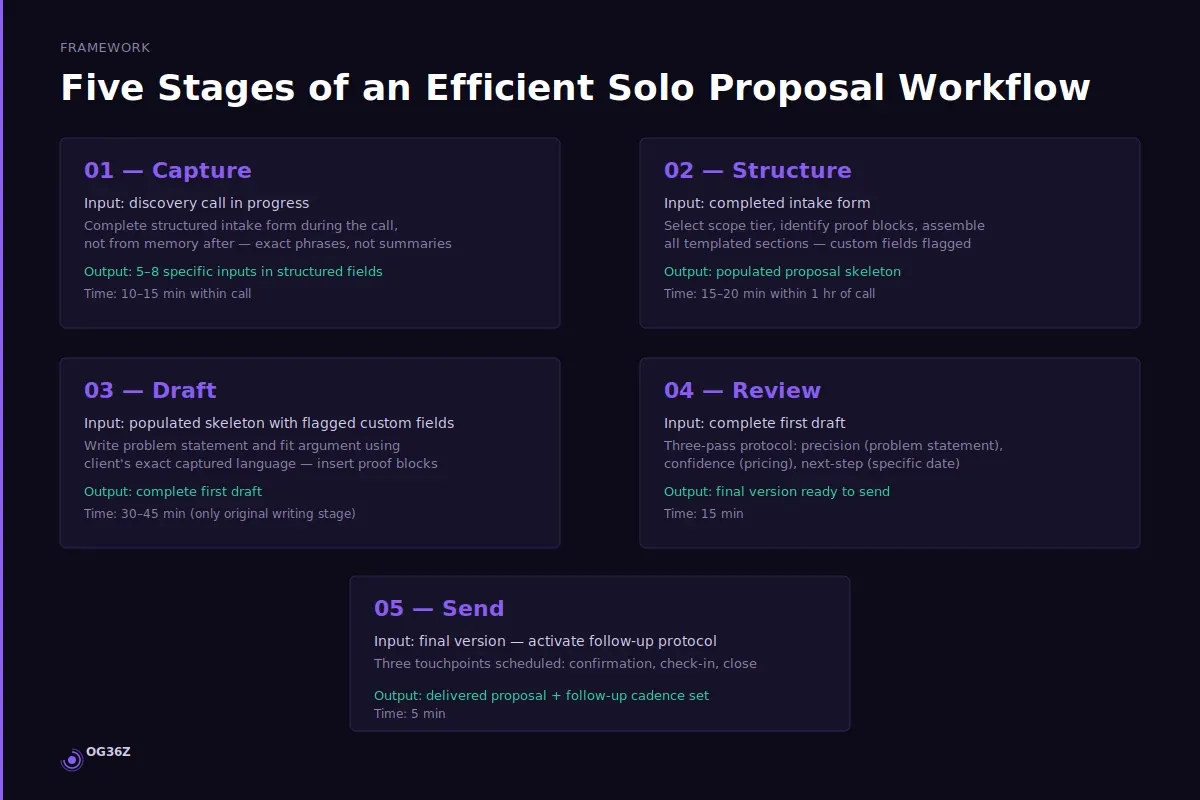
The five stages of an efficient solo consulting proposal workflow are: capture, structure, draft, review, and send. Each stage takes a defined input and produces a defined output. The stages are sequential — each output feeds directly into the next stage's input — and none can be skipped without creating a stall point downstream.
Stage 1: Capture. Input: the discovery call in progress. Output: a completed discovery intake form with the client's exact language, stated goals, urgency drivers, and budget signal. This stage happens during the call, not after it. Post-call capture from memory is less precise and takes longer. The intake form is a structured set of fields — see The Proposal Template That Wins Consulting Engagements for the discovery-to-template mapping — that forces capture of specific phrases rather than summaries.
Stage 2: Structure. Input: the completed intake form. Output: a populated proposal skeleton — scope tier selected, proof blocks identified, pricing filled, and every templated section assembled. This stage takes under twenty minutes when the template and proof library are built. The custom fields are flagged but not yet written — the structure is the scaffold, not the content.
Stage 3: Draft. Input: the populated skeleton with flagged custom fields. Output: a complete first draft. This stage is the only one that requires original writing. The problem statement and fit argument are written using the exact phrases captured in Stage 1. Proof blocks are inserted from the library. The entire custom writing task — for a consultant with a functioning system — takes thirty to forty-five minutes.
Stage 4: Review. Input: the complete first draft. Output: a final version ready to send. This stage has a specific protocol: a precision pass on the problem statement, a confidence pass on the pricing section, and a next-step pass to ensure the call-to-action is specific and dated. Total time: fifteen minutes.
Stage 5: Send. Input: the final version. Output: a delivered proposal with a follow-up protocol activated. The send is not the end of the process — it initiates a defined follow-up sequence with specific timing and format.
Together, the five stages produce a sent proposal in ninety to one hundred twenty minutes from the end of the discovery call. The proposal that sits in drafts for three days is a proposal where Stage 1 was skipped or incomplete — and every subsequent stage stalled because the inputs were missing.
How do you move from a discovery call to a first draft in under 30 minutes?
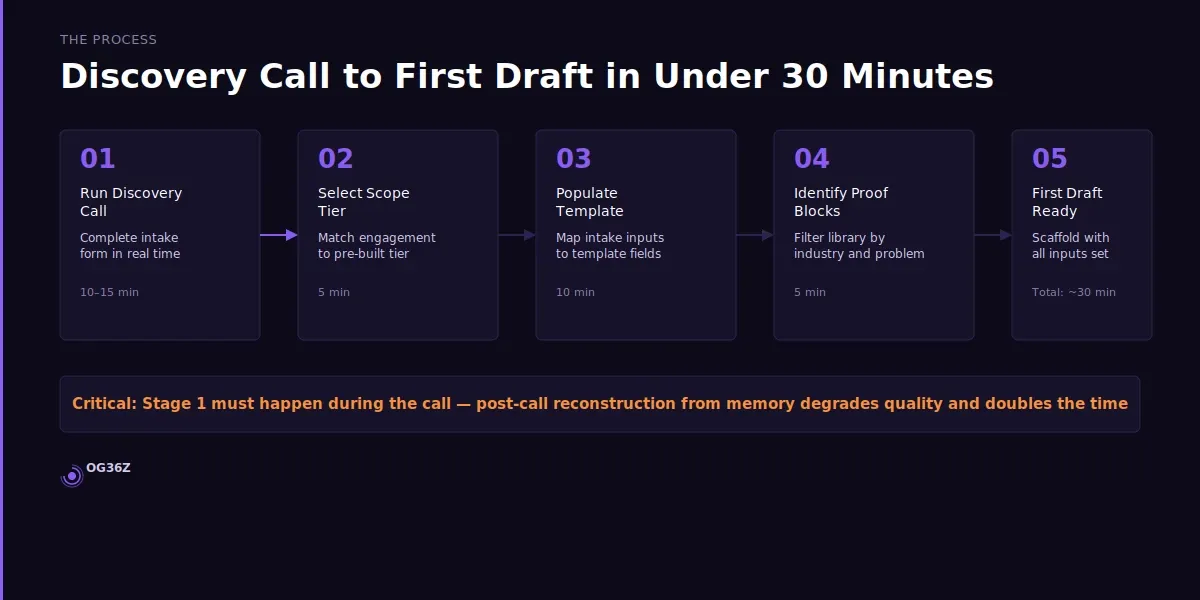
Moving from a discovery call to a first draft in under thirty minutes requires completing Stage 1 during the call and beginning Stage 2 within one hour of the call ending. The window matters: the client's language is most precise and most available immediately after the call. Every hour of delay degrades the quality of the capture and increases the time to complete Stage 2.
The discovery intake form is the mechanism that makes thirty-minute drafting achievable. The form has specific fields — not open-ended prompts — that force capture of the inputs the proposal template requires. The fields include: the client's exact phrase describing the core problem, the business consequence they named if the problem is not resolved, the decision-maker's stated success criteria, the budget signal or range mentioned, and the urgency driver — why now rather than later.
These five inputs are the only ones the custom sections of the proposal require. The problem statement is built from fields one and two. The fit argument is built from fields one and three. The pricing section is informed by field four. The next-step framing uses field five.
Within thirty minutes of the call, Sana has completed the intake form on her laptop during the conversation. She opens the proposal template, selects the scope tier that fits the engagement, and populates the intake-form outputs into the corresponding template fields. The custom fields are now marked with the client's actual language. The templated sections — credentials, process overview, pricing structure, next step — are pre-built and require only the variable inputs: the specific price and the specific next-step date.
At this point, she has a structural draft — a complete proposal skeleton with all sections populated at the structural level. She is not at a blank page. She is at a scaffold with specific, client-sourced inputs in the custom fields and polished, pre-built content in the templated fields. The writing task that remains — the problem statement narrative and the fit argument — begins with everything it needs.
The thirty-minute threshold is achievable only when the discovery intake form is completed during the call. A consultant who takes notes in a general format and then reconstructs the proposal inputs from those notes spends forty-five to sixty minutes on Stage 2 alone, and the quality of the custom language is lower than it would have been from a structured, real-time capture.
What is the fastest way to review and tighten a proposal before sending?
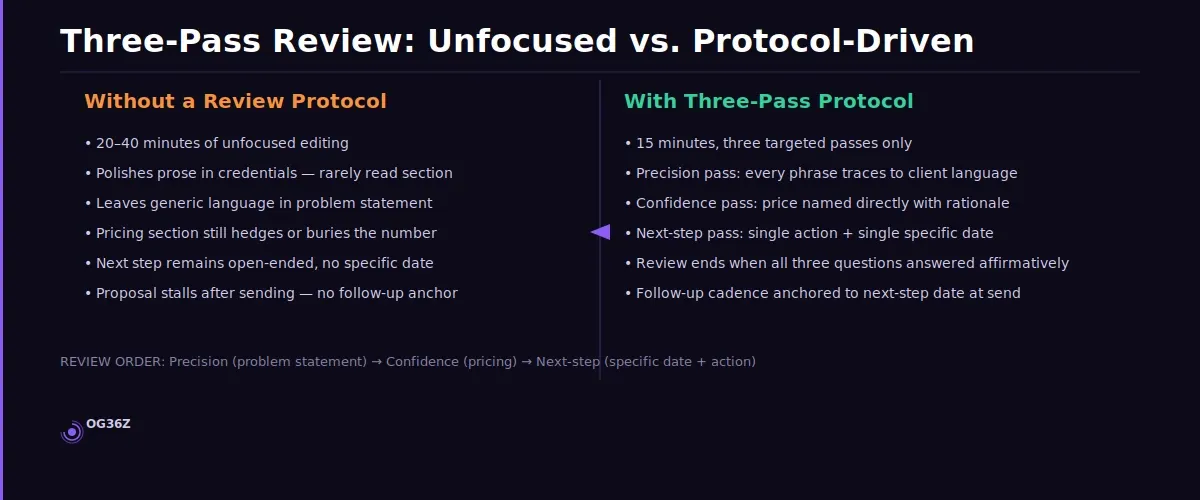
The fastest way to review and tighten a proposal before sending is a three-pass protocol that takes fifteen minutes: a precision pass on the problem statement, a confidence pass on the pricing section, and a next-step pass on the call to action. Each pass has a specific question it is answering, and the review ends when all three questions are answered affirmatively.
The precision pass addresses the most decisive section of the proposal. The question: does every phrase in the problem statement originate from what the client actually said, or has the consultant's interpretive language crept in? Generic phrases — "lack of strategic alignment," "operational inefficiency," "growth challenges" — signal a consultant who heard the category of problem rather than the specific problem. Replace them with the client's exact language captured in Stage 1. A problem statement that reads back the client's own words is more persuasive than a polished paraphrase of them, because it demonstrates precise listening.
The confidence pass addresses the section most consultants under-write. The question: does the pricing section name the number directly, explain the rationale in one or two sentences, and frame the value without apologizing? A pricing section that buries the number, hedges with phrases like "investment options starting from," or omits the value rationale signals inexperience. The price is named once, directly, followed by one sentence explaining what it covers and one sentence framing the value relative to the problem cost.
The next-step pass addresses the section that determines what happens after the proposal is sent. The question: is there a single, specific action named with a single, specific date? "Please review and let me know your thoughts" is not a next step — it is an open-ended wait that stalls deals. "Please sign and return by [specific date] to confirm your March 17 start date" is a next step. See How Independent Consultants Can Write Proposals in Half the Time for the full template architecture that enforces this standard.
The review ends when all three passes return affirmative answers. Total time: fifteen minutes for a consultant who knows what they are looking for. A consultant reviewing their own proposal without a protocol spends twenty to forty minutes on unfocused edits that rarely improve the sections that matter most.
How do you follow up on a sent proposal without losing momentum?
Following up on a sent proposal without losing momentum requires a defined follow-up protocol with specific timing, specific format, and a specific decision point — activated the moment the proposal is sent, not when the consultant remembers to check in.
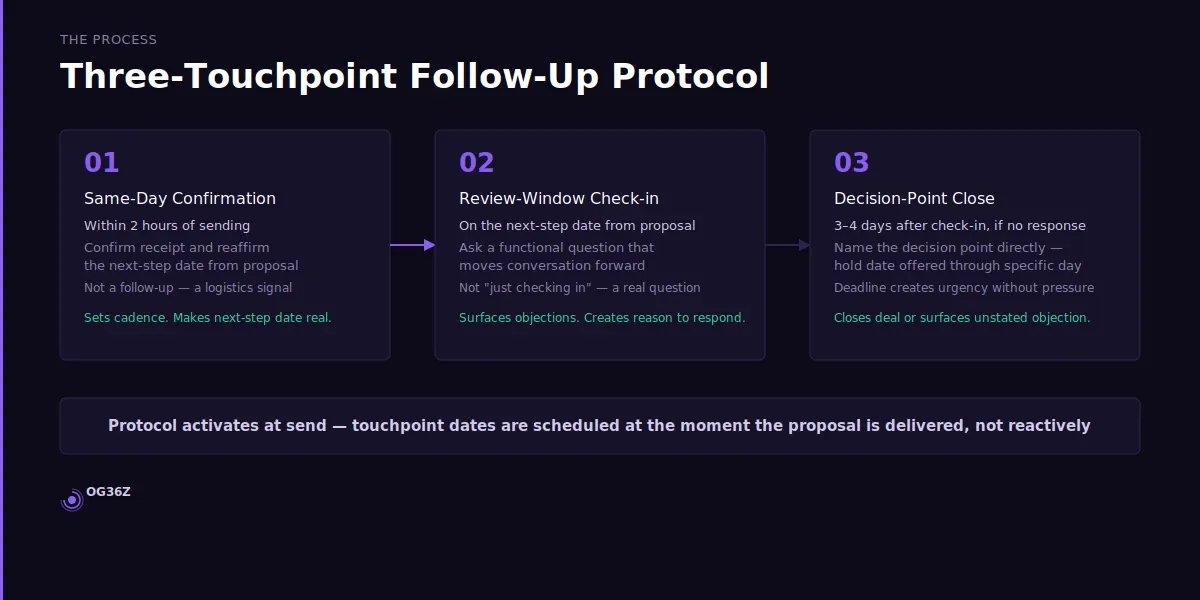
The follow-up protocol has three touchpoints:
Touchpoint 1: Same-day confirmation. Within two hours of sending, a brief message confirms receipt and reaffirms the next-step date from the proposal. This is not a follow-up — it is a logistics confirmation. "Sent over the proposal — please let me know once you have had a chance to review, and I will be in touch [specific day] as we discussed." This sets the cadence and signals that the next-step date is real.
Touchpoint 2: Review-window check-in. On the specific date named in the proposal's next-step section — typically two to three business days after sending — a brief check-in asks a question that moves the conversation forward without applying pressure. Not "just checking in" — that is noise. Instead: "Do you have any questions about the scope or the approach I should address before we confirm the start date?" This is a functional question that serves the prospect and creates a reason to respond.
Touchpoint 3: Decision-point close. If no response by the review-window check-in, a single follow-up three to four business days later names the decision point directly: "I want to hold your March 17 start date — I can do so through [specific date]. Happy to discuss anything that would help you move forward." This creates a deadline without being coercive, and it surfaces any unstated objections that are blocking the decision.
A follow-up protocol that is defined in advance — with dates set at the moment of sending, not determined reactively — keeps the pipeline moving without requiring the consultant to track multiple open proposals manually. A shared calendar event or a simple task in a tool like HoneyBook or Notion is sufficient to activate each touchpoint at the right time. The consultant who follows up consistently and with a functional question at each touchpoint closes a meaningfully higher percentage of sent proposals than the consultant who follows up reactively or not at all.
What does a full proposal process look like from blank page to client signature?
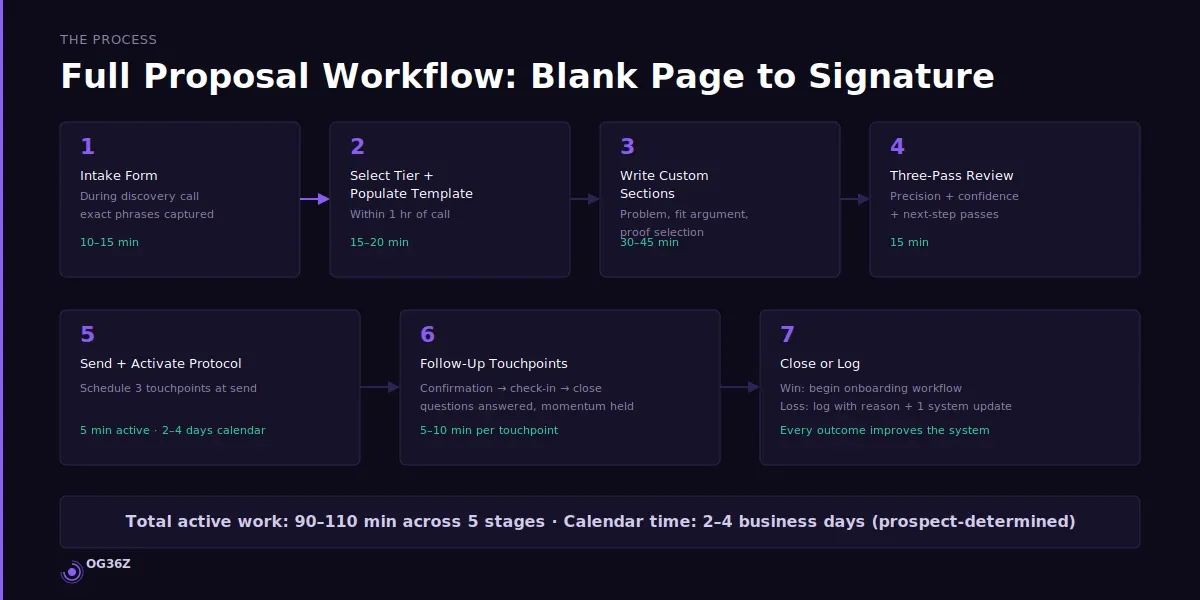
A full proposal process from blank page to client signature has seven steps across five stages and spans approximately ninety minutes of active work, spread over two to four business days. The elapsed calendar time is a function of the prospect's review schedule — the active work time is fixed by the system.
The full sequence in order:
Step 1: Complete the discovery intake form during the call. Active time: ten to fifteen minutes within the call itself. Output: five to eight specific inputs in structured fields.
Step 2: Select scope tier and populate template within one hour of call. Active time: fifteen to twenty minutes. Output: populated proposal skeleton with all templated sections complete and custom fields flagged with client language.
Step 3: Write custom sections — problem statement, fit argument, proof selection. Active time: thirty to forty-five minutes. Output: complete first draft.
Step 4: Run three-pass review — precision, confidence, next-step. Active time: fifteen minutes. Output: final version ready to send.
Step 5: Send proposal and activate follow-up protocol. Active time: five minutes. Output: delivered proposal, three follow-up touchpoints scheduled with specific dates.
Step 6: Respond to review-window check-in. Active time: five to ten minutes depending on questions received. Output: prospect's questions answered, decision momentum maintained.
Step 7: Close or log. If the prospect signs: deliver the onboarding workflow from The Client Onboarding Workflow Every Independent Consultant Needs. If the proposal closes as a loss: log it in the win/loss record with the stated reason and one system improvement note.
Total active work: ninety to one hundred ten minutes across the five stages. Total calendar time: two to four business days. The proposal that takes three to five days of active work — leaving drafts open, rewriting sections repeatedly, re-doing research — is a proposal without a workflow. With the workflow mapped and the system built, the constraint shifts from consultant time to prospect decision time — which is the correct constraint for a solo practice with a full pipeline.
[VISUAL: content/posts/solo-consultant-proposal-process/visuals/what-a-full-proposal-process-looks-like-from-blank-page-to-signature-process-flow.svg]
Summary
A solo consulting proposal process is a five-stage workflow — capture, structure, draft, review, send — where each stage has a defined input and output.
The blank-page problem is a Stage 1 failure: without a structured discovery intake form completed during the call, every subsequent stage starts without the inputs it needs. With the workflow mapped, a complete proposal takes ninety to one hundred twenty minutes of active work.
The review protocol — three passes covering problem statement precision, pricing confidence, and next-step specificity — takes fifteen minutes and addresses only the sections that drive close decisions.
The follow-up protocol — three touchpoints with specific timing and functional questions — activates at the moment of sending and maintains pipeline momentum through to signature.
The solo consultant who maps these five stages stops writing proposals and starts deploying a process.