
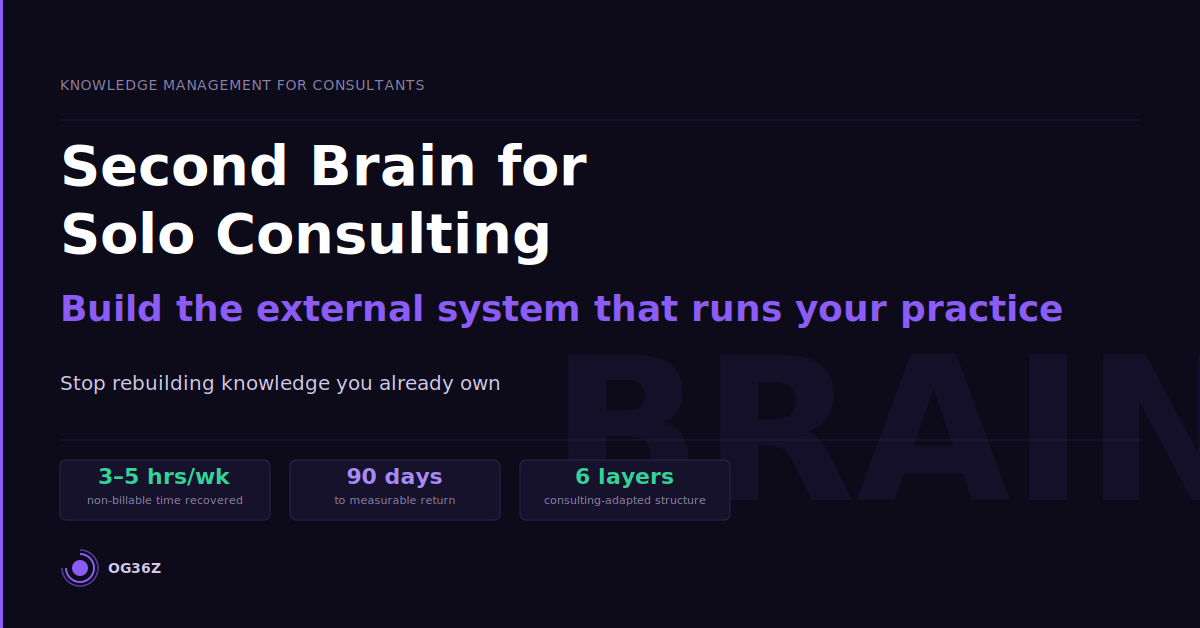
Second Brain for Solo Consulting: Build the External System That Runs Your Practice
A Second Brain is an external storage and retrieval system for ideas, knowledge, and projects — offloading cognitive burden from your biological memory to a trusted digital system.
KEY TAKEAWAYS
- A consulting Second Brain is fundamentally different from a personal one — it must support client delivery, not just personal growth
- The PARA method needs a consulting-specific adaptation: Projects, Areas, Resources, Archives — with client work as its own layer
- What stays out of a consulting Second Brain is as important as what goes in — client documents belong in client folders, not your KM system
- A functioning Second Brain reduces non-billable research time by an estimated 3-5 hours per week within 90 days of consistent use
What is a Second Brain and how does it apply to solo consulting?
A Second Brain is a personal external knowledge management system — a trusted place outside your head where you capture, organize, and retrieve information you need to think and work effectively. For independent consultants, it applies as the operational infrastructure that stores frameworks, client context, domain expertise, and process documentation so that knowledge compounds across engagements rather than disappearing between them.
CORE TERMS:
- Second Brain — a personal external system for storing, organizing, and retrieving knowledge
- PARA — Projects, Areas, Resources, Archives — Forte's organization framework
- Progressive summarization — a technique for distilling captured notes to their essential value
- Bidirectional linking — connections between notes that reveal relationships (native in Obsidian)
- Evergreen notes — notes refined over time until they represent durable, reusable knowledge
- Note inbox — the capture zone before processing and organizing
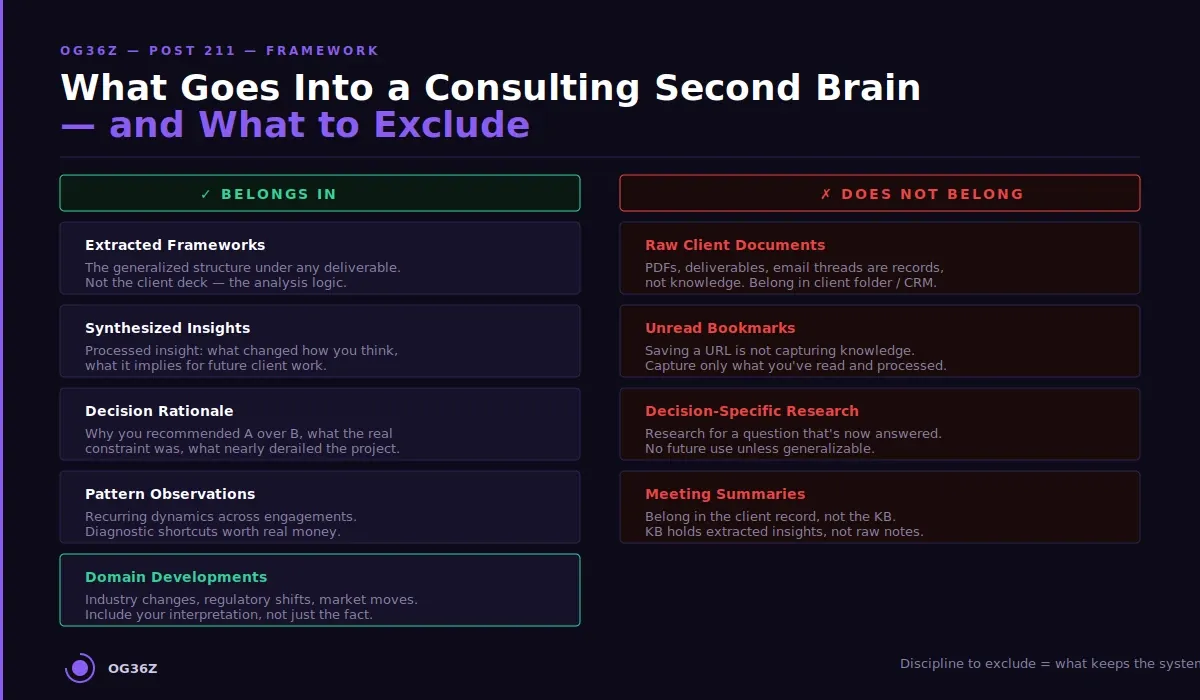
The average independent consultant rebuilds 30-40% of their intellectual work from scratch on every new engagement. Not the client-specific parts — the underlying frameworks, the research, the diagnostic logic they have used a dozen times before. This is not inefficiency. It is the absence of infrastructure.
A Second Brain is that infrastructure. Not a note-taking app, not a filing system — a living external system that makes your thinking accessible to your future self. For solo consultants operating across multiple client contexts simultaneously, it is the difference between expertise that compounds and expertise that evaporates.
The concept was formalized by Tiago Forte in his work on Personal Knowledge Management. The consulting adaptation requires meaningful modifications. This article builds that adaptation from first principles.
What is a Second Brain and how does it apply to independent consulting?
A Second Brain, in Forte's formulation, is an external storage and retrieval system for ideas, knowledge, and projects — offloading cognitive burden from your biological memory to a trusted digital system. The core insight is that your brain is for generating ideas, not storing them. When you stop storing information in your head, you free cognitive capacity for the actual thinking.
For independent consultants, this applies with particular force. You carry client context across three to five simultaneous relationships. You develop expertise that should transfer between engagements but often does not. You make decisions whose rationale disappears within a week. You build frameworks that get rebuilt from scratch each time. Your biological memory is doing work that a system should be doing.
The consulting adaptation of a Second Brain differs from the personal version in three fundamental ways. First, it is performance-oriented, not curiosity-oriented. A personal Second Brain captures what is interesting to you. A consulting Second Brain captures what makes you faster, better, and more precise in client delivery. The filter is not "is this interesting?" but "will this compound my consulting value?"
Second, it is client-context-aware. A personal Second Brain rarely needs to track relationships, political dynamics, and organizational contexts. A consulting Second Brain must hold all of these — organized so you can pull up any client's full context in under 60 seconds.
Third, it is proposal and positioning-aware. Over time, your Second Brain becomes the database of what works in sales conversations — what objections come up, what analogies land, what pricing approaches succeed. This is revenue intelligence, not just knowledge management.
The minimum viable consulting Second Brain has four components: an inbox for unprocessed captures, a client context layer, a knowledge library of frameworks and domain expertise, and a process documentation layer. Build these four and you have the foundation.
How do you organize a consulting Second Brain differently from a personal one?
Forte's PARA system — Projects, Areas, Resources, Archives — is the standard organizing framework for Second Brains. It works for personal knowledge management. For consulting, it requires two significant adaptations.
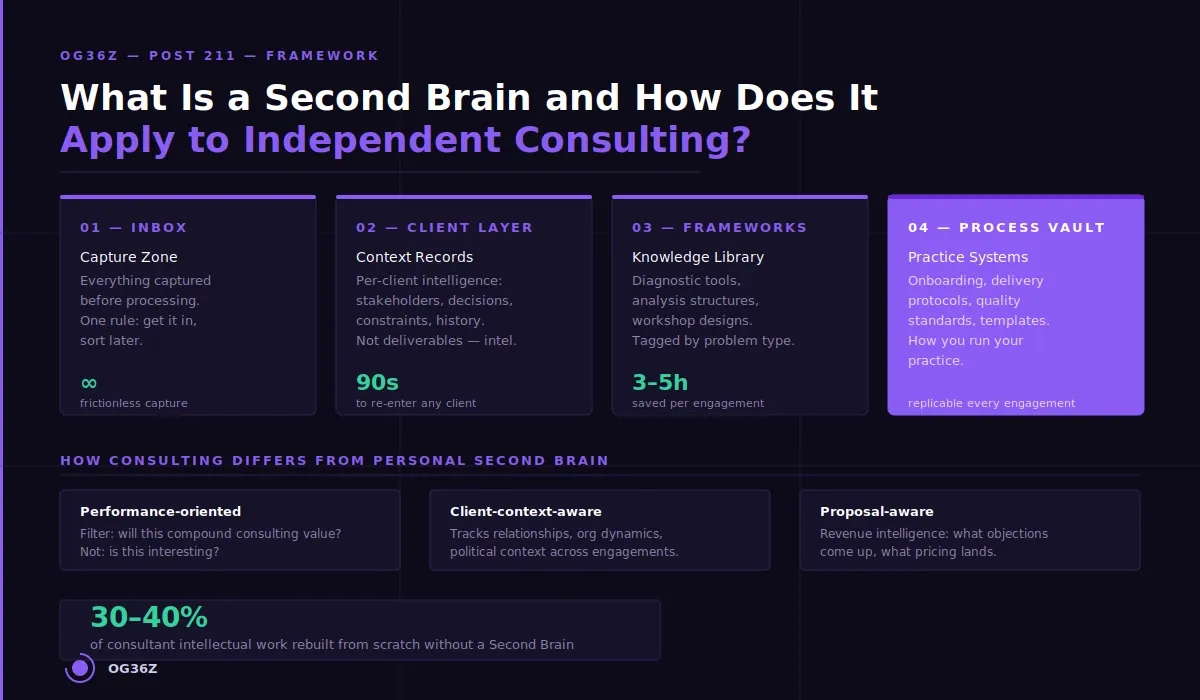
The first adaptation is separating active client work from personal knowledge. In standard PARA, client projects live alongside personal projects in the Projects section. For a consultant, this conflation creates two problems: client documents end up in the knowledge base (where they do not belong), and the knowledge base ends up in client folders (where it cannot be found systematically). The solution is a parallel structure: client work lives in a CRM or client folder system; the consulting Second Brain holds only the extracted, reusable knowledge from that work.
The second adaptation is expanding the Resources layer. In a personal PARA system, Resources holds references and materials by topic. In a consulting Second Brain, Resources needs to be structured as a database with multiple dimensions: problem type, industry, client size, solution approach, and confidence level. This turns a filing system into a retrieval engine.
The recommended consulting Second Brain structure:
Inbox — everything captured but not yet processed. The only rule: get it in, sort it later. Weekly review empties the inbox.
Client Layer (separate from the knowledge base proper) — per-client knowledge records: context, stakeholders, decisions, history. Not the deliverables — just the intelligence you need to re-enter the engagement.
Frameworks Library — every diagnostic tool, analysis structure, workshop design, and decision framework you have built or adapted. Tagged by problem type, sector, and engagement context.
Domain Expertise — sector knowledge, regulatory context, market intelligence, and competitive landscape data organized by industry or topic.
Proposals Archive — debrief notes from every proposal: what worked, what failed, what you would change. This builds over 18-24 months into a precision positioning tool.
Process Vault — how you run your practice: onboarding, delivery protocols, quality standards, templates.
The personal PARA's Archives layer applies here too: anything that is no longer active but might be useful sits in Archives rather than getting deleted.
What goes into a consulting Second Brain and what should be excluded?
Getting the inclusion criteria right is the difference between a knowledge base that compounds and one that collapses under its own weight within six months. The hardest discipline in Second Brain management is exclusion.
What belongs in a consulting Second Brain:
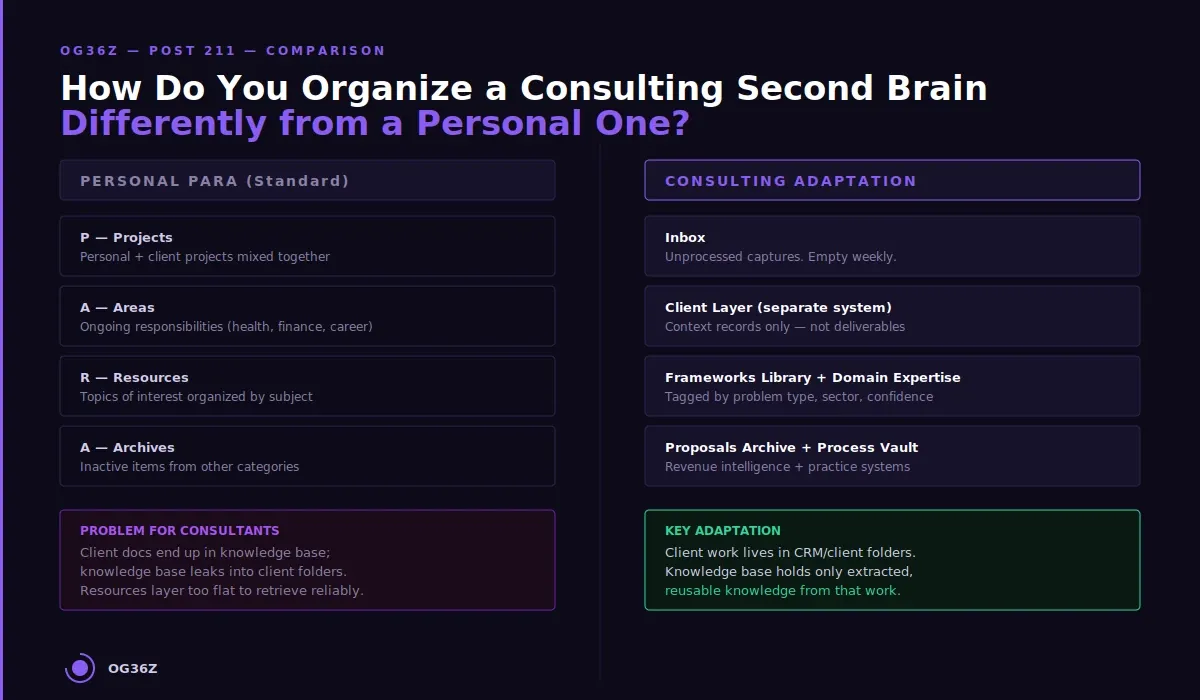
Extracted frameworks — the generalized structure underneath any deliverable. Not the client deck; the analysis logic. Not the workshop output; the facilitation design. Every deliverable contains a reusable pattern. Extract it before you send, tag it for future retrieval.
Synthesized insights — not raw notes from a call or article, but the processed insight: what changed how you think, what principle it illustrates, what it implies for future client work. Forte's progressive summarization technique applies here: capture first, then distill to the most valuable 10-20%.
Decision rationale — why you recommended approach A over B, what the client's real constraint was, what edge case nearly derailed the project. This is the knowledge that disappears fastest and is worth the most next time.
Pattern observations — recurring dynamics across client engagements. The organization that always has alignment problems. The budget conversation that always comes up at week three. The stakeholder type that signals project risk. These patterns become diagnostic shortcuts worth real money.
Domain developments — industry changes, new regulatory requirements, emerging competitive dynamics, market shifts. Captures here should include your interpretation, not just the fact.
What does not belong:
Raw client documents — those belong in a client folder or CRM, not the knowledge base. Client PDFs, deliverables, and email threads are not knowledge — they are records.
Unread bookmarks — saving a URL is not capturing knowledge. Capture only what you have read and can articulate value from.
Decision-specific research — research you conducted to answer a specific question that is now answered. Once the question is closed, the research has no future use case unless you can generalize it.
Meeting summaries — these belong in the client record, not the knowledge base. The knowledge base holds extracted insights, not raw summaries.
For the full playbook on capturing and reusing institutional knowledge, see Post 213 on institutional knowledge for consultants.
How do you use Notion or Obsidian to build a consulting-specific Second Brain?
Both tools can support a consulting Second Brain. The choice depends on how you think and how you work, not on which has more features.
Building in Notion:
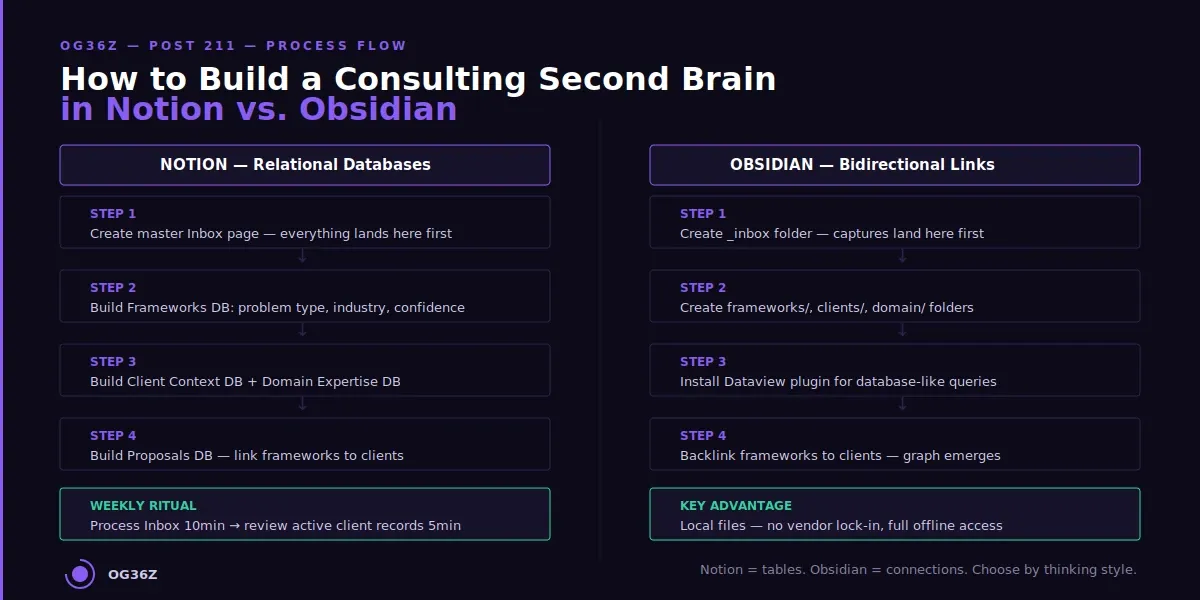
Notion's strength is relational databases. The consulting Second Brain in Notion is built around linked databases: a Frameworks database linked to an Industries database, linked to a Problems database. When you open a framework, you can see which industries it applies to and which client problems it has solved.
Setup sequence for Notion:
- Create a master Inbox page — this is where everything lands before sorting.
- Build a Frameworks database with properties: Name, Problem Type (multi-select), Industry (multi-select), Confidence Level (select), Last Used (date), and a Notes field.
- Build a Client Context database with properties: Client Name, Status, Industry, Key Stakeholders (text), Constraints (text), and a Linked Engagements field.
- Build a Domain Expertise database organized by industry or topic.
- Build a Proposals database with properties: Client, Outcome (Won/Lost/No decision), Key Signal (text), and Date.
- Link them: a Framework entry can link to relevant Client Context records where it was deployed.
The weekly ritual: process the Inbox (10 min), review active client records (5 min), and promote any captures that represent durable knowledge.
Building in Obsidian:
Obsidian's strength is bidirectional linking and the knowledge graph. For consultants who think in concepts more than tables, Obsidian surfaces unexpected connections between ideas that a database structure would not reveal.
Setup sequence for Obsidian:
- Create an
_inboxfolder — captures land here first. - Create a
frameworksfolder — one note per framework, tagged by problem type and sector. - Create a
clientsfolder — one note per client with a standard template. - Create a
domainfolder — organized by industry. - Install the Dataview plugin — this gives you database-like queries over your markdown notes.
- Create a
proposalsfolder with notes using a consistent template.
The key Obsidian practice is backlinking: when you note that a framework worked for a specific client, link to both the framework note and the client note. Over time, your graph shows you which frameworks are most versatile and which client types use them.
Tool parity note: neither Notion nor Obsidian is objectively better for consulting. Notion wins on structure and collaboration; Obsidian wins on speed, privacy (local files), and knowledge network. Pick based on whether you think in tables or in connections. For a full comparison including Airtable, see Post 226.
How does a Second Brain reduce non-billable research and rework time?
The return on a functioning consulting Second Brain is measurable and front-loaded — most of the recovery happens in the first three months of consistent use, as the system becomes populated enough to reliably surface relevant knowledge.
The primary mechanisms of time recovery:
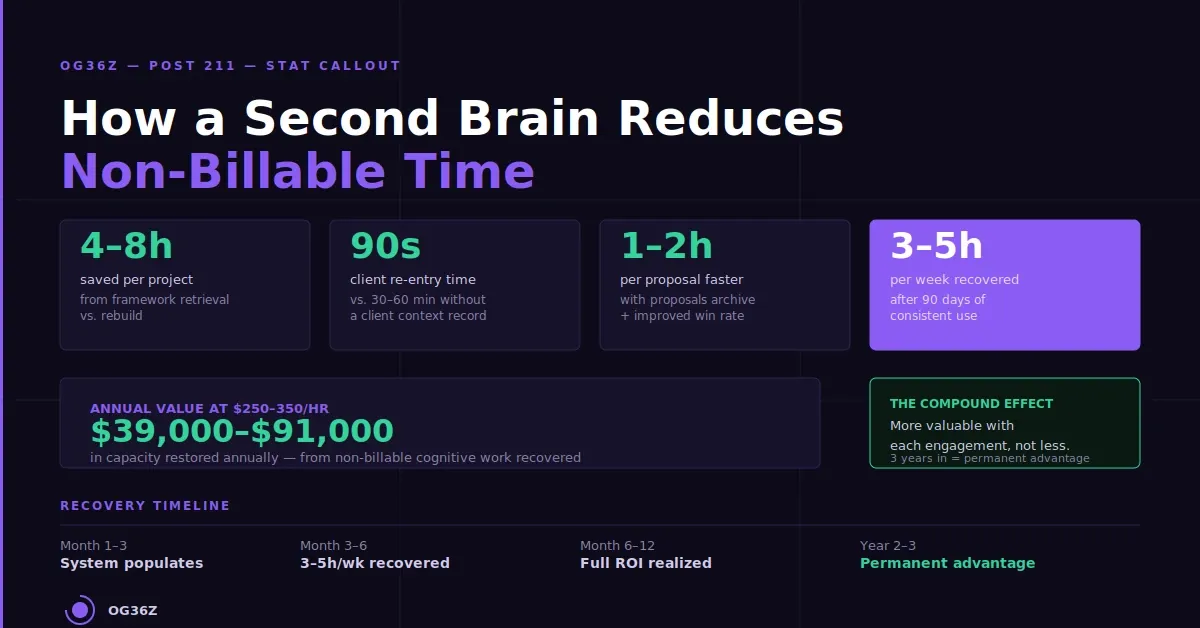
Framework retrieval instead of rebuild. Without a Second Brain, you rebuild analytical frameworks on each engagement — not from scratch, but from a half-remembered version of what you built last time. With a populated framework library, retrieval takes 2-3 minutes instead of 45-90 minutes of reconstruction. For a consultant running 6-8 major frameworks per engagement, this recovers 4-8 hours per project.
Client context re-entry. Returning to a client after two weeks of working primarily with other clients typically costs 30-60 minutes of context reconstruction — re-reading emails, recalling stakeholder dynamics, remembering the last decision's rationale. A current client knowledge record reduces this to 5-10 minutes.
Research de-duplication. Independent consultants re-research the same topics repeatedly — market size for a sector, regulatory framework for an industry, best practices for a problem type. A populated domain expertise layer means that research is done once and retrieved repeatedly.
Proposal acceleration. A proposals database with 20+ debrief entries means you can write a proposal that precisely addresses the objections you know are coming, use the framing that historically lands, and price with intelligence. Time savings: 1-2 hours per proposal, plus meaningful win-rate improvement.
The aggregate number from survey data and practitioner reports: consultants with mature Second Brain systems (populated over 6-12 months) report saving 3-5 hours per week on non-billable cognitive work. At $250-$350/hr in unbilled time, that is $39,000-$91,000 per year in capacity restored to billable work or personal time.
The compound effect: a Second Brain gets more valuable with each engagement, not less. A consultant three years into consistent Second Brain practice has a system that makes them materially faster and better than a competitor who has been practicing for the same amount of time without one. This is the permanent competitive advantage that knowledge management creates — not the tool, but the accumulated, organized, retrievable expertise inside it.
For the knowledge management foundation that supports this system, start with Post 210.
Summary
A Second Brain for solo consulting is not a productivity hack — it is the operational infrastructure that determines whether your expertise appreciates or depreciates over time. The personal version captures what is interesting; the consulting version captures what makes you faster, more precise, and more valuable in client delivery.
The consulting-specific organization adapts PARA to separate active client work from the knowledge base, expands the Resources layer into a tagged, multi-dimensional retrieval database, and adds a Proposals Archive that builds into pricing and positioning intelligence over 18-24 months.
The inclusion criteria are strict: extracted frameworks, synthesized insights, decision rationale, pattern observations, and domain developments — not raw documents, unread bookmarks, or meeting summaries. The discipline to exclude is what keeps the system usable.
Built in Notion or Obsidian, the structure is the same. The choice between them is a thinking-style question: tables and relationships favor Notion; concepts and networks favor Obsidian. Either one, used consistently, produces a 3-5 hour per week return on non-billable time within 90 days.
Next: build your institutional knowledge capture and reuse system to turn client patterns into permanently accessible intelligence.