
postvisit.ai - A Cardiologist Built an AI Patient Platform in 7 Days. It Placed 3rd Out of 13,000
postvisit.ai is an AI agentic care platform for patients that begins working the moment they leave the doctor's office.
Key Takeaways
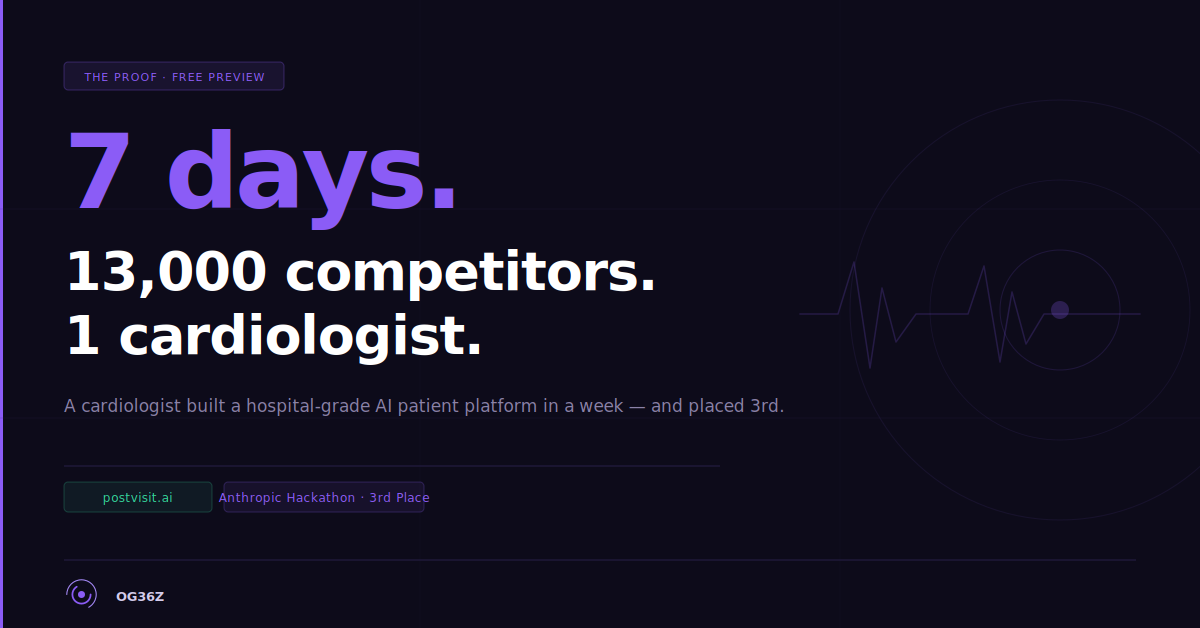
- Michał Nedoszytko MD, a practicing cardiologist, built postvisit.ai in 7 days and placed 3rd at Anthropic's hackathon — out of 13,000 applications
- postvisit.ai is an AI agentic care platform that guides patients from the moment they leave the doctor's office, powered by Claude Opus 4.6's extended context window
- The barrier between "having an idea" and "shipping a working product" no longer requires a software engineering background — it requires domain expertise and the willingness to build
- Operators who understand this shift are compressing timelines that used to take months into days — without compromising quality or depth
What is postvisit.ai and why does it matter?
postvisit.ai is an AI agentic care platform for patients, built by cardiologist Michał Nedoszytko MD in 7 days, that placed 3rd at Anthropic's hackathon out of 13,000 applications.
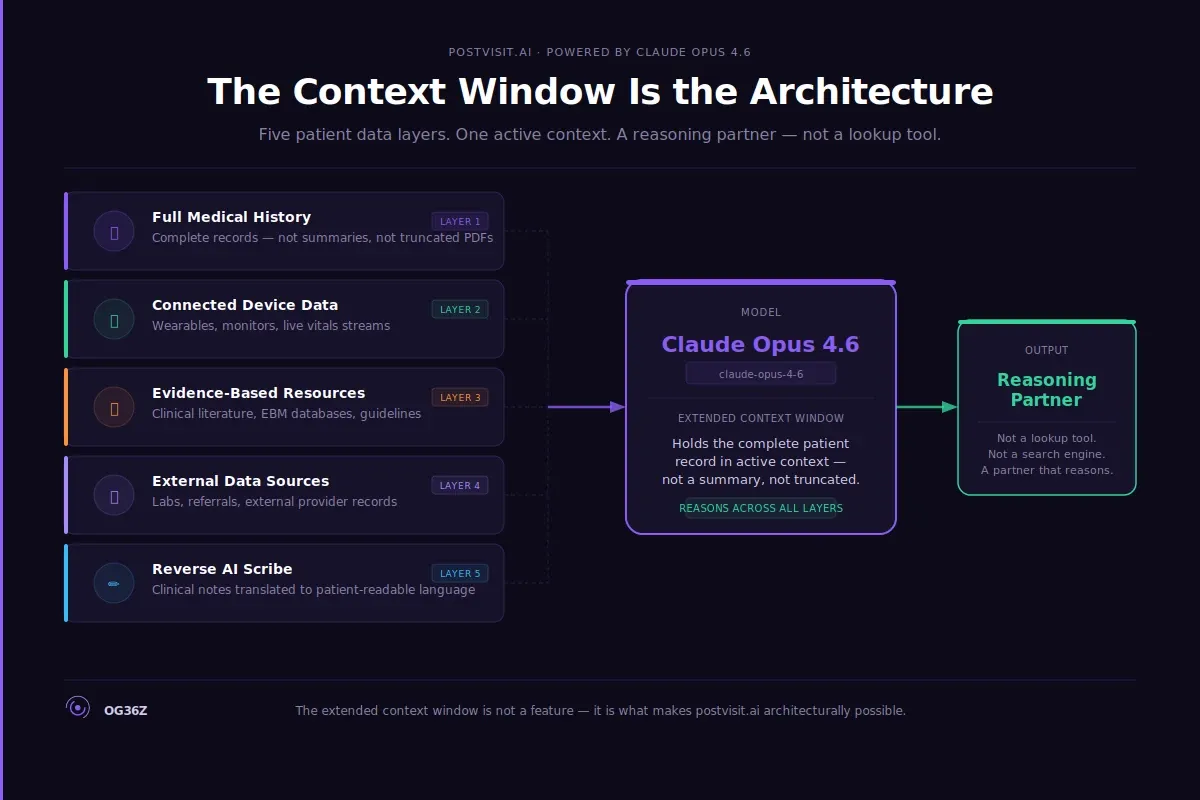
Powered by Claude Opus 4.6's massive context window, it gives patients a single place to explore their full medical history, connected devices, evidence-based resources, and external data sources — starting the moment they leave the doctor's office.
It matters because it proves that domain experts without traditional software backgrounds can now ship professional-grade AI products in a week.
Three years ago, this story could not have happened.
A practicing cardiologist, mid-shift at a hospital, builds a production-grade AI platform in his spare moments — in hospital corridors, in airport lounges, in a window seat on a flight from Brussels to San Francisco. Seven days later, that platform places 3rd out of 13,000 applications at one of the most competitive AI hackathons in the world.
Not a software engineer. Not a YC founder. A cardiologist.
The barrier to entry has not just lowered. For people who know what they are building and why, it has effectively vanished.
What Is postvisit.ai?
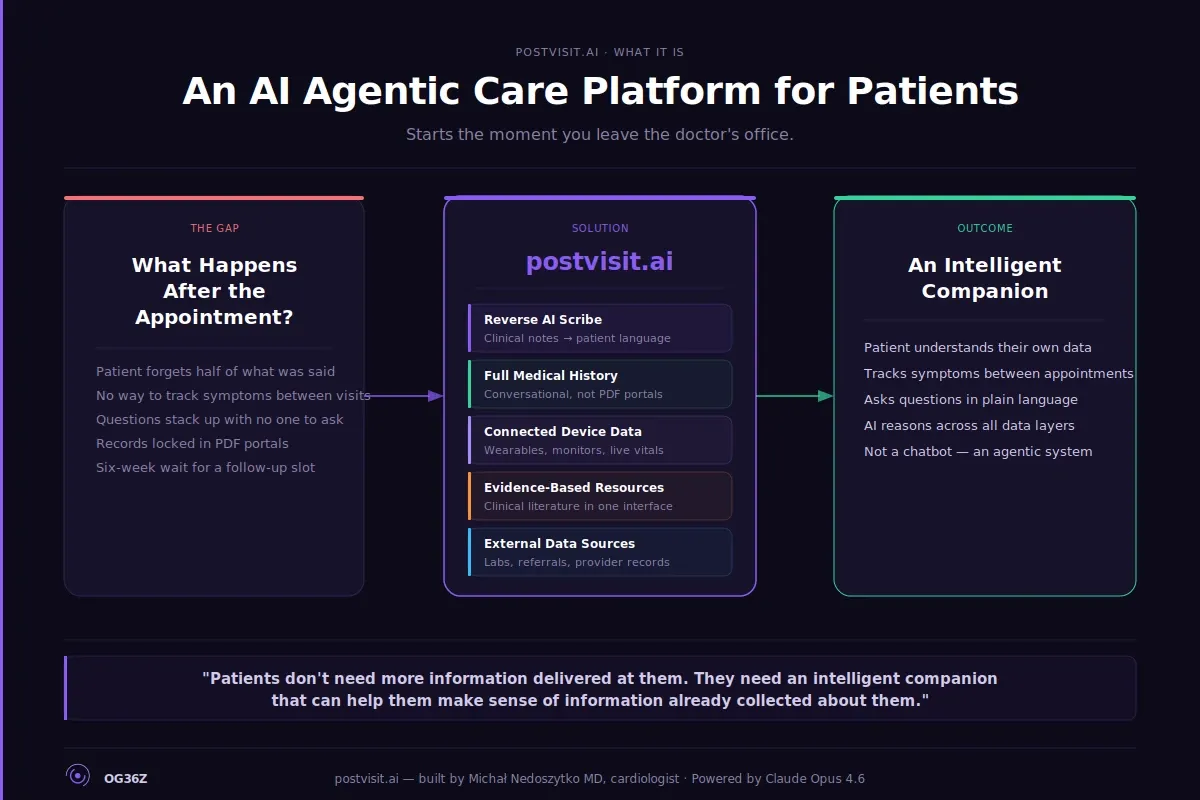
postvisit.ai is an AI agentic care platform for patients that begins working the moment they leave the doctor's office. The platform is built around a single, underserved gap in healthcare: what happens to patients after the appointment ends.
Most medical care is front-loaded. The doctor gives information, instructions, and a follow-up date. The patient leaves. Twenty minutes later, they can't remember half of what was said. Six weeks later, they arrive at a follow-up with questions they forgot to ask and symptoms they forgot to track.
postvisit.ai fills that gap. It includes:
- Reverse AI scribe — instead of the doctor dictating notes for the record, the platform surfaces the record back to the patient in language they can actually use
- Full medical history access — patients can explore their complete history in a conversational interface, not a PDF portal
- Connected device integration — wearables, monitors, and devices feed into a unified patient context
- Evidence-based resource layer — clinical literature and EBM resources are accessible through the same interface, not a separate tab on a different site
- External data source connectivity — lab results, referrals, and external provider data are brought into one place
The core insight driving the design: patients don't need more information delivered at them. They need an intelligent companion that can help them make sense of information already collected about them.
Who Built postvisit.ai and How Long Did It Take?
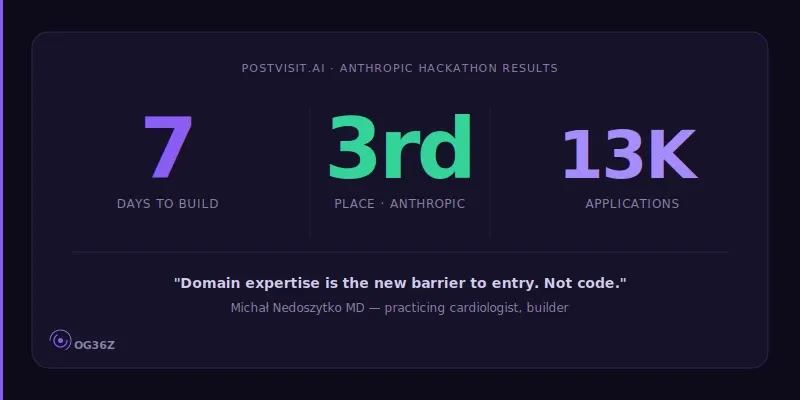
postvisit.ai was built by Michał Nedoszytko MD, a practicing cardiologist, in 7 days. It placed 3rd at Anthropic's hackathon — a competition that received 13,000 applications.
Nedoszytko did not have a co-founder. He did not step back from clinical work. He built while on shift. He built in airport lounges. He built on a transatlantic flight from Brussels to San Francisco, where the hackathon was held.
The timeline is not a rounding error. Seven days is not a sprint that happened to go well. It is a data point about what becomes possible when domain expertise meets capable AI tooling — and the person building knows the problem from the inside.
This is what distinguishes Nedoszytko's build from most healthcare technology: he is not a technologist who researched medicine to build a medical product. He is a cardiologist who learned enough to build the tool his patients needed. The clinical instincts were already there. AI filled the engineering gap.
What Did Michał Nedoszytko Build and Why Does It Work?
postvisit.ai works because it is designed around what actually happens to patients — not around what the healthcare system tracks about them.
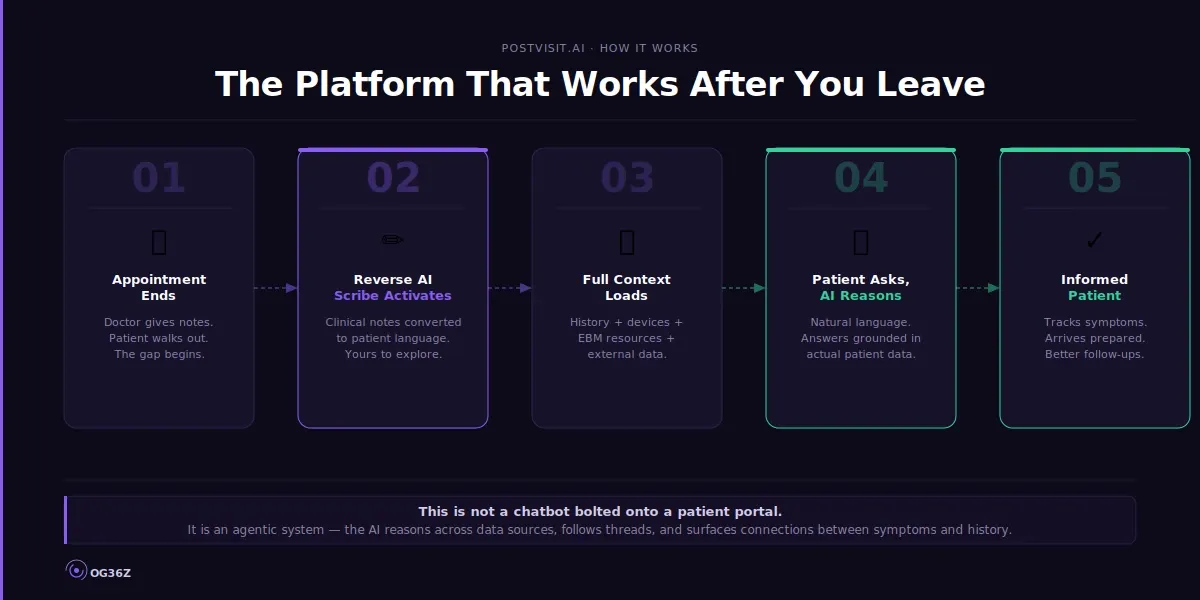
The reverse AI scribe is the most counterintuitive feature. Traditional medical AI scribes are built for the provider: they listen to appointments and generate clinical notes, reducing documentation burden on physicians. Nedoszytko flipped the direction. The scribe works for the patient — taking the clinical record and translating it back into terms the patient can engage with, question, and act on.
This is a structural design choice, not a feature. It signals whose intelligence the platform is amplifying: the patient's.
The platform then surrounds that transcript with context: the patient's history, device data, and clinical evidence — all within a single interface. The question a patient can now answer in minutes ("Does my resting heart rate trend match what my cardiologist said to watch for?") previously required three tabs, a portal login, a Google search, and either luck or health literacy.
postvisit.ai is not a chatbot bolted onto a patient portal. It is an agentic system — the AI can reason across data sources, follow threads, and surface the connection between a symptom today and a note from six months ago.
How Does postvisit.ai Use Claude Opus 4.6?
postvisit.ai is powered by Claude Opus 4.6, Anthropic's most capable model, specifically because of its extended context window.
The extended context window is not a technical footnote — it is what makes the platform architecturally possible. A patient's full medical history, connected device data, clinical literature references, and external data sources do not fit in the context windows that characterized 2023-era AI. They do now.
Claude Opus 4.6 (model ID: claude-opus-4-6) allows postvisit.ai to hold an entire patient record in active context — not a summary, not a truncated version, but the complete history — and reason across it in response to natural language questions. When a patient asks "Am I more tired than usual after starting this medication?" the model can cross-reference the timeline of the prescription, device-logged activity levels, and clinical notes from adjacent appointments, and return an answer grounded in the patient's actual data rather than generic medical information.
This is the difference between AI as a lookup tool and AI as a reasoning partner. The context window is what enables the reasoning.
What Does a Hackathon Win Mean for Non-Developers?
Placing 3rd out of 13,000 applications at Anthropic's hackathon is a signal worth reading carefully — not just as a healthcare story, but as a statement about what the current AI tooling enables.
Hackathon judging at this level is rigorous. Anthropic's criteria include technical depth, product thinking, and real-world applicability. Finishing in the top three is not a "great idea" award. It requires a working, evaluable product.
Nedoszytko shipped a working, evaluable product in 7 days without a team.
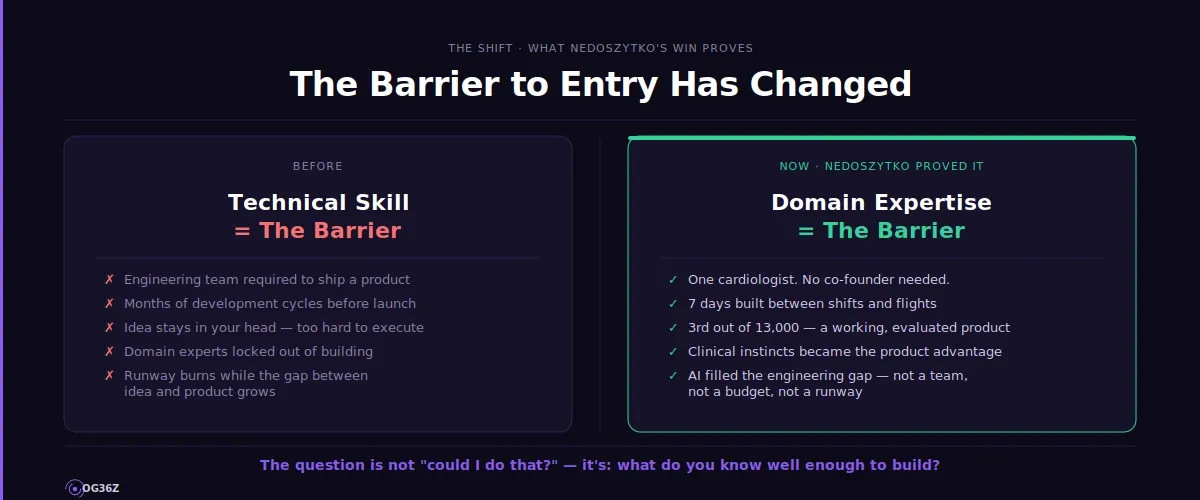
The implication for operators and independent professionals is direct: the constraint on building is no longer primarily technical skill. It is now primarily domain knowledge and clarity of problem. Nedoszytko understood the post-visit gap better than most engineers ever could, because he lives on the provider side of it every day. That understanding became the product.
This is the shift. Software used to be the output of engineering teams. It is becoming the output of domain experts who can now direct capable AI systems to implement what they already know needs to exist.
What Does This Mean for You?
The Nedoszytko story is not primarily about healthcare. It is about the compression of timelines between "I know what this should do" and "I built it."
For independent consultants and operators, that compression is the most significant structural change in professional life right now. A few years ago, the path from insight to product ran through hiring engineers, writing specifications, managing development cycles, and burning runway while the gap between your idea and its implementation grew.
That path still exists. But there is now a faster one — available to anyone with clear domain expertise and the willingness to build.
The people closing that gap fastest share a pattern: they treat AI as infrastructure, not as a search engine. They build context layers that encode what they know, what they are building, and what good looks like. They use agentic systems that can act across data sources rather than respond to single queries. And they move — they build rather than plan to build.
Nedoszytko did not plan to build postvisit.ai when he had more time. He built it in the time he had, in the places he was, because the tooling had become capable enough for that to be sufficient.
The Shift You Are Watching in Real Time
A cardiologist placing 3rd at an AI hackathon against 13,000 applications, in 7 days of parallel building, is not a curiosity. It is a proof point about where we are.
The barrier between knowing what should exist and making it exist has never been lower for people who have genuine domain knowledge. Michał Nedoszytko had 20 years of clinical insight about what patients need after they leave his office. He turned that insight into a deployed, evaluated, prize-winning platform in a week.
The question for every professional watching this is not "could I do that?" The question is: what do you know well enough to build?
Because the technical gap that used to make the answer irrelevant is closing. Fast.
postvisit.ai: postvisit.ai
Original announcement: @trajektoriePL on X
Build video: x.com/i/status/2024774752116658539
Share This Post
If you know a consultant, a physician, a lawyer, or a specialist in any field who thinks building software is something that happens to other people — share this.
The Nedoszytko story is the clearest signal yet that domain expertise is the asset. The code is becoming the detail.
Forward this to them. The professionals who understand this shift earliest will move the fastest. They can subscribe free at og36z.com