
Knowledge Management for Independent Consultants: The System That Pays You Back
Knowledge management for independent consultants is not a nice-to-have. It is the operational system that determines whether your expertise compounds or evaporates between engagements.
KEY TAKEAWAYS
- Every solo consultant is running on a depreciating asset — undocumented expertise that lives only in memory
- The gap between storing and retrieving knowledge is where most KM systems collapse
- A capture habit that takes under 90 seconds per session is the only kind that actually survives
- Tool choice matters far less than structure — the right categories beat the right software every time
What is knowledge management for independent consultants?
Knowledge management for independent consultants is the systematic practice of capturing, organizing, and retrieving the expertise, decisions, frameworks, and client context you generate in your practice — so that knowledge compounds rather than disappears. It is not about filing documents. It is about making your past work fund your future work.
CORE TERMS:
- Knowledge capture — the act of recording what you learn, decide, or produce
- Knowledge retrieval — the ability to find and use that knowledge when needed
- Institutional knowledge — patterns and insights accumulated across client engagements
- Second Brain — a personal external system for storing and connecting knowledge
- PKM (Personal Knowledge Management) — the broader discipline of managing your own information
- Context switching cost — the time lost rebuilding mental models when moving between clients
You finished a complex engagement six months ago. The client is back with a related problem. You know you solved something similar before — you remember the shape of the solution, the stakeholder dynamics, the edge cases that almost derailed it. But you cannot find the notes. The deck is somewhere. The insight is gone.
This is not a memory failure. It is a systems failure. And it costs the average independent consultant 4-6 hours per week in reconstructed thinking.
The consultants who compound knowledge — who get faster and more precise with every engagement — are not smarter. They have built a system that makes their past work retrievable. That system is knowledge management, and it is the highest-leverage operational investment a solo practice can make.
Why do independent consultants keep losing knowledge they have already built?
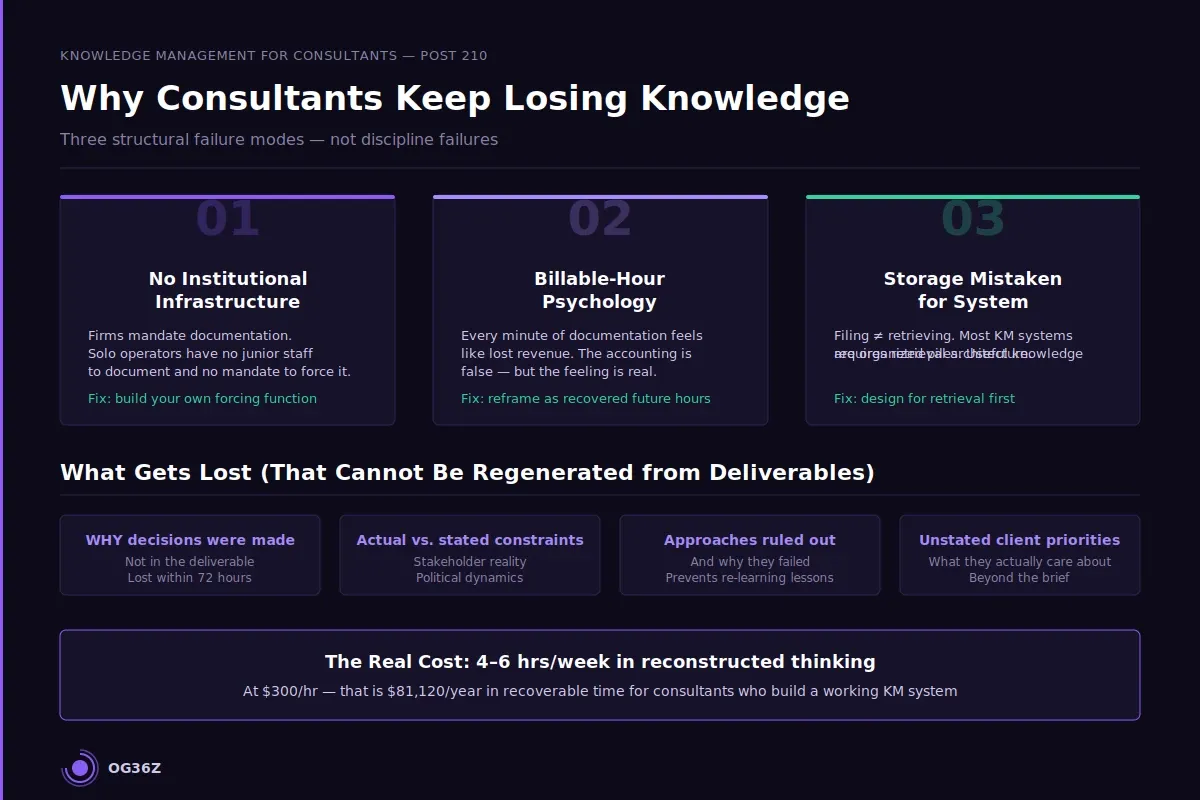
Independent consultants lose knowledge for three specific structural reasons that have nothing to do with intelligence or discipline. First, solo practitioners have no institutional infrastructure to force knowledge capture. In a firm, junior staff document, knowledge management systems are mandated, and tribal knowledge gets encoded in formal training. Alone, none of those forcing functions exist. Whatever gets captured, you have to choose to capture.
Second, the billable-hour frame actively discourages documentation. If you bill $250/hr, every 30 minutes of documentation feels like $125 walking out the door. This accounting is false — the real cost is the 3-hour reconstruction you will pay six months later — but the psychological pressure is real and it shapes behavior.
Third, most consultants mistake storage for system. They save everything to a shared drive, accumulate folders of PDFs, build a Notion workspace that feels organized in week one and becomes a graveyard by week eight. The problem is not volume. The problem is that storage without retrieval architecture is just a bigger pile.
The knowledge that disappears fastest is the contextual kind: why a decision was made, what the client's actual constraint was (not the stated one), which approach you ruled out and why, what the stakeholder cared about that was never in the brief. This is the knowledge that makes the difference between a competent consultant and a trusted one. It cannot be regenerated from the deliverable alone.
A 2023 survey of independent knowledge workers found that professionals who actively managed their personal knowledge bases reported saving an average of 5.2 hours per week on research and rework. For a consultant billing $300/hr, that is $1,560 per week in recovered time — or $81,120 per year. The math makes knowledge management one of the highest-return investments in your practice, not a distraction from billable work.
The fix is not more discipline. It is a system with minimal friction, specific structure, and a capture habit that survives the reality of a full consulting week.
What is the difference between storing knowledge and making it retrievable?
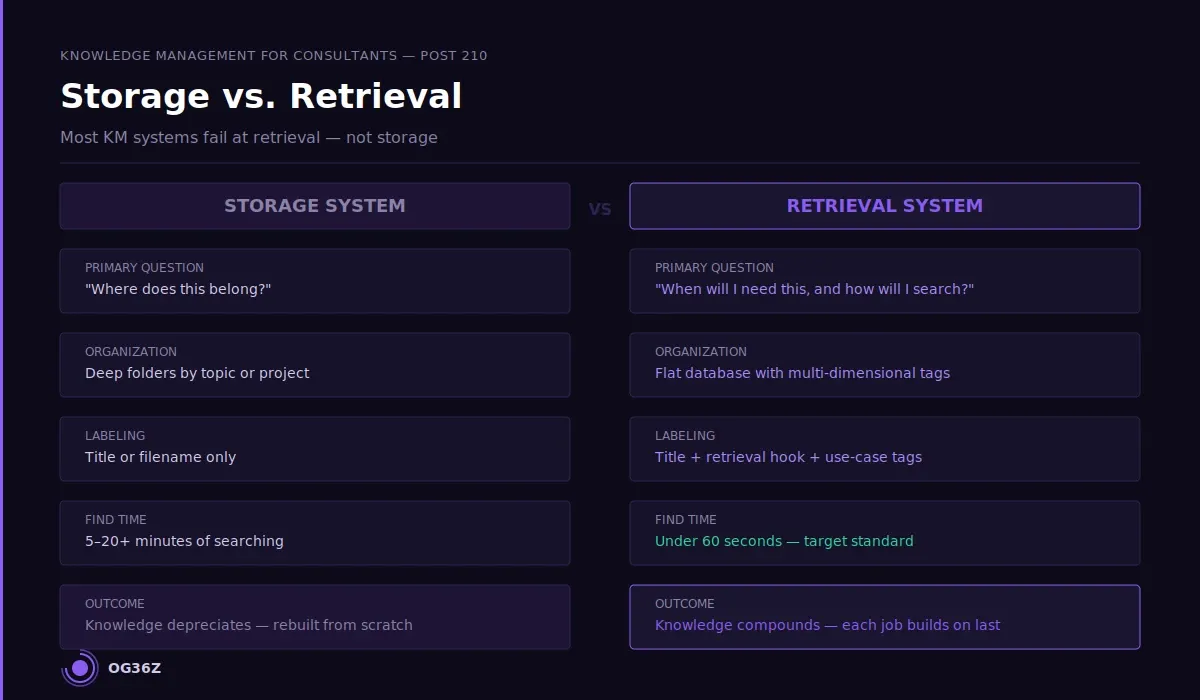
Storage is passive. You put something somewhere. Retrieval is active — it requires that when you need something, you can find it in under 60 seconds without reconstructing context from scratch.
Most solo consultant knowledge systems fail at retrieval, not storage. They have too much or too little. Too much: everything is captured but nothing is organized, so finding anything requires a full-text search lottery. Too little: only formal deliverables are saved, and all the decision logic and context is lost.
Retrieval-first design flips the question. Instead of asking "where should I put this?" you ask "when will I need this, and how will I be searching for it?" That question changes what you capture and how you label it.
Retrieval-ready knowledge has four properties. It is tagged by use case, not just topic — so a framework gets tagged for "stakeholder mapping" and "complex enterprise projects" and "tech sector," not just "frameworks." It includes a retrieval hook — a one-line summary of what problem it solves. It is stored where you will actually look, not where it logically belongs. And it is structured consistently enough that you can scan it quickly without re-reading it in full.
The practical test: can you find any piece of knowledge in your system within 60 seconds of thinking of it? If no, your system has a retrieval problem, not a storage problem. Adding more content will make it worse.
The most effective retrieval architecture for solo consultants is a flat, tagged structure over a deep hierarchical one. Deeply nested folders feel organized but break down when a piece of knowledge is relevant to multiple categories. Flat databases with multi-dimensional tags — client, industry, problem type, solution approach — are faster and more flexible.
Tools like Notion databases, Obsidian with the Dataview plugin, and Tana all support this pattern. The tool matters less than the decision to design for retrieval from day one.
What should a solo consultant's knowledge management system capture?
Not everything. That is the first answer. A knowledge management system that captures everything becomes unusable within 90 days. The capture criteria matter as much as the capture habit.
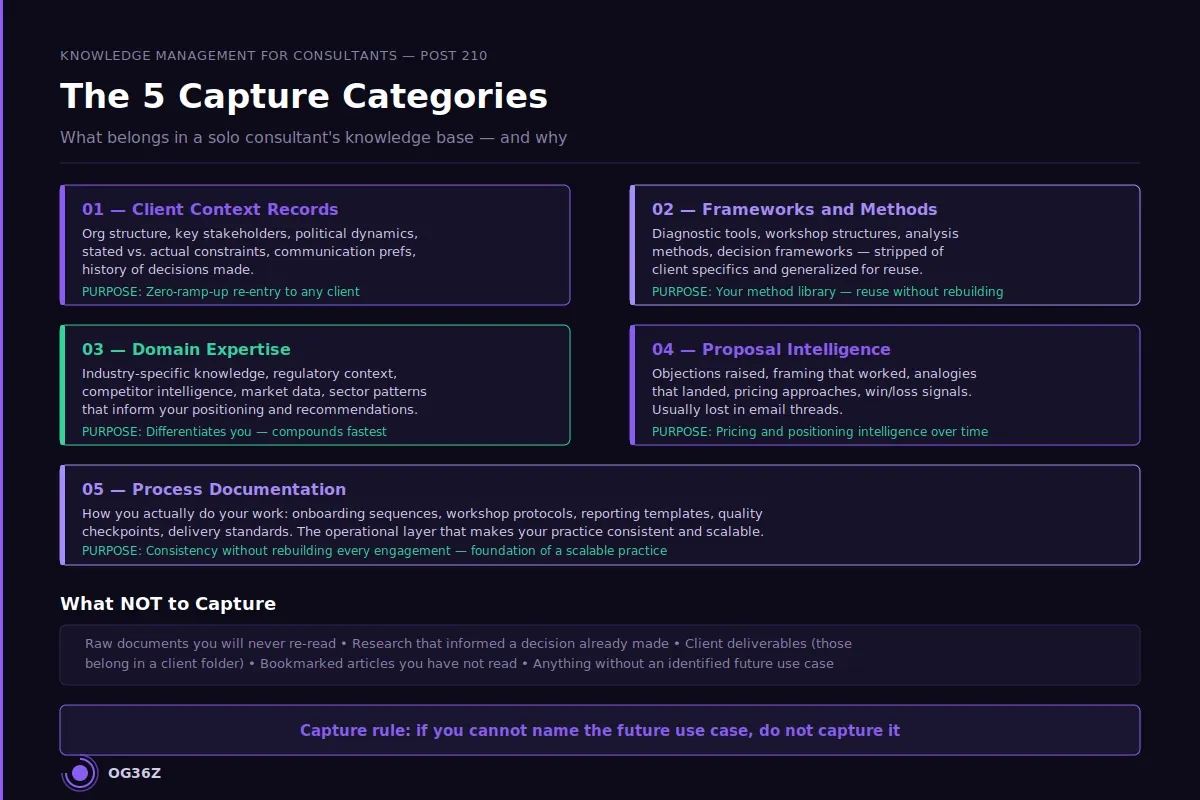
A solo consultant's KM system should capture five categories of knowledge, each with a different purpose:
1. Client context records. Everything you need to re-enter a client engagement with zero ramp-up: their org structure, key stakeholders, political dynamics, stated objectives vs. actual constraints, communication preferences, and history of decisions made. This is per-client knowledge. See Post 212 for the full client knowledge system structure.
2. Frameworks and methods. The conceptual tools you use repeatedly — diagnostic frameworks, workshop structures, analysis methods, decision frameworks. Every time you build or adapt something for a client, the generalized version belongs here. Not the client deliverable — the underlying structure.
3. Domain expertise. Industry-specific knowledge, regulatory context, competitor intelligence, market data, and sector patterns that inform your work. This compounds fastest and differentiates you most over time.
4. Proposal and pitch intelligence. What objections came up, what framing worked, what analogies landed, what pricing approaches succeeded or failed. Most consultants lose this entirely because it lives in email threads.
5. Process documentation. How you actually do your work — onboarding sequences, workshop protocols, reporting templates, quality checkpoints. This is the operational layer that makes your practice scalable and consistent.
What to exclude: raw documents you will never read again, research that informed a decision already made, client deliverables themselves (those belong in a client folder, not a KM system), and bookmarked articles you have not read. Inbox ≠ knowledge base.
The discipline is the filter: if you cannot articulate the future use case for capturing something, do not capture it. This sounds restrictive but it keeps the system lean enough to actually use.
How do you build a knowledge capture habit that does not require extra time?
The failure mode of most knowledge management systems is not design — it is activation energy. The system works in theory but collapses under the weight of a full consulting week. Capture habits fail when they require a separate workflow from the work itself.
The solution is embedded capture: building knowledge capture into moments that already exist in your workflow, rather than adding a dedicated documentation session.
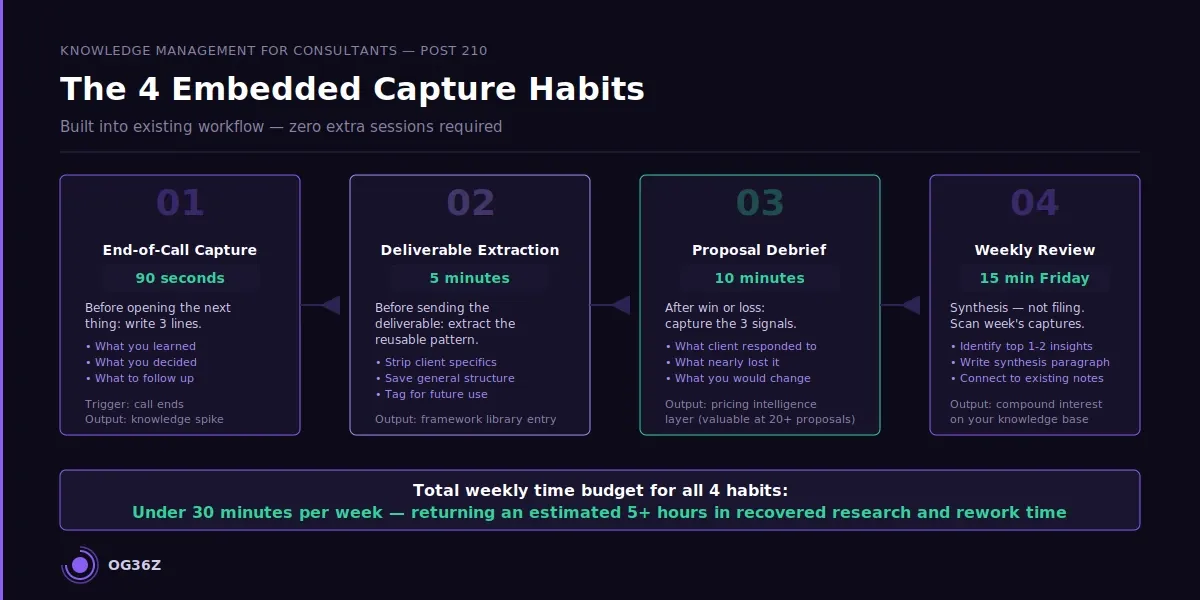
Four embedded capture moments that work reliably:
End-of-call capture (90 seconds). Immediately after a client call ends, before you open the next thing, you write three lines: what you learned, what you decided, and what you need to follow up. This is not a full summary — it is a knowledge spike. The goal is to preserve the insight before it dissolves.
Deliverable extraction (5 minutes at close). When you finish a deliverable, before sending it, you spend five minutes extracting the reusable elements: the framework, the structure, the analysis approach. You strip the client specifics and save the general pattern to your frameworks library.
Proposal debrief (10 minutes post-outcome). When a proposal is accepted or declined, you capture the three most useful signals: what the client responded to, what concern almost lost it, and what you would change. Over 20 proposals, this becomes a pricing and positioning intelligence layer.
Weekly knowledge review (15 minutes, Friday). Not a filing session — a synthesis session. You scan what you captured during the week, identify the one or two things that changed how you think, and write a single paragraph that synthesizes the insight. This is the compound interest of knowledge management.
The total time budget for these four habits is under 30 minutes per week. The return is measured in hours recovered. For consultants building a Second Brain approach, these embedded capture moments feed directly into the broader system architecture.
The habit that fails is the comprehensive one: "at the end of each week I will document everything I learned." That habit requires a separate mental mode, a sustained time block, and a forcing function that does not exist when a client emergency hits on Thursday.
What tools work best for knowledge management in a solo consulting practice?
The honest answer: Notion or Obsidian covers 90% of solo consultant knowledge management needs. The 10% that remains depends on how you think and what you are willing to maintain.
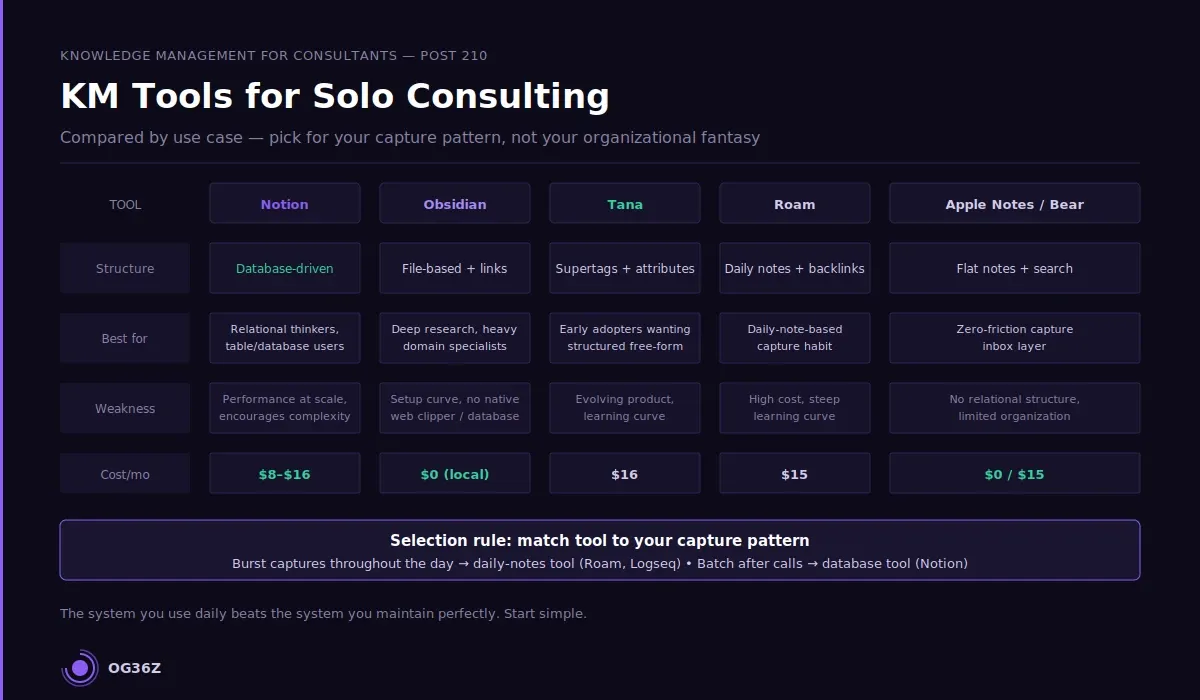
Here is how the primary tools stack up for solo consulting KM:
Notion is the strongest tool for structured, database-driven knowledge management. Its linked databases let you connect client records, frameworks, and projects in a relational structure. The weakness is performance at scale and a design that encourages complexity over usability. Best for consultants who think in tables and relationships.
Obsidian is the strongest tool for networked, concept-driven knowledge management. Its bidirectional linking creates a knowledge graph that surfaces unexpected connections between ideas. The weakness is a steeper setup curve and no native web clipper or database view. Best for consultants who do heavy research and deep domain work.
Tana is an emerging option for consultants who want structured attributes on free-form notes. It bridges the gap between Notion's structure and Obsidian's network model. Best for early adopters comfortable with an evolving tool.
Roam Research remains relevant for daily note-based capture with strong backlinking. The subscription cost and learning curve limit adoption, but its workflow pattern (daily notes as the entry point) is worth borrowing regardless of tool.
Apple Notes + Bear are underrated for consultants who want zero friction capture with solid search. They lack relational structure but excel at speed. Useful as an inbox layer feeding into a more structured system.
The tool selection principle: choose based on your capture pattern, not your organization fantasy. If you capture in short bursts throughout the day, a daily-notes-centered tool (Roam, Logseq) fits better. If you capture in batches after calls and sessions, a database-centered tool (Notion) fits better.
For the full comparison of Notion, Airtable, and Obsidian for consulting knowledge bases, see Post 226 in this hub. For building your client knowledge system, the tool architecture matters less than the data structure inside it.
The system that works is the one you actually use. A $0/month system you use daily beats a $30/month system you use twice. Start simple. Add structure only when the friction of not having it exceeds the friction of adding it.
Summary
Knowledge management for independent consultants is not a nice-to-have. It is the operational system that determines whether your expertise compounds or evaporates between engagements. The problem is not motivation — it is structural. Without institutional forcing functions, documentation gets sacrificed to billable pressure, and the knowledge that makes you valuable exists only in your head.
The path out is three-layered. First, design for retrieval, not storage — the question is always "when will I need this and how will I find it," not "where does this belong." Second, capture the five categories that actually compound: client context, frameworks, domain expertise, proposal intelligence, and process documentation. Third, build embedded capture habits — 90-second post-call spikes, deliverable extractions, proposal debriefs — that survive a real consulting week without requiring a separate workflow.
Tool choice is the last decision, not the first. Notion and Obsidian both work. The difference between a consultant who gets faster every year and one who rebuilds knowledge from scratch every engagement is not intelligence. It is whether their past work is accessible to their future self.
For the next layer, start with building your consulting Second Brain and then build out your client knowledge system. The full knowledge base build and maintenance guide is at Post 214.