
The Proposal Template That Wins Consulting Engagements
A winning consulting proposal is not a document — it is a sales argument structured as a document.
KEY TAKEAWAYS
- A winning consulting proposal is a sales argument structured as a document — every section has a sales function, not just an information function.
- The five essential sections are: problem statement, proposed approach, proof of capability, investment, and next step.
- Most solo consultant proposals fail because at least two sections are absent — commonly the proof section and the explicit next step.
- Proposal length is a function of deal size: $5,000–$25,000 engagements require 2–4 pages; anything longer loses the sale before the prospect reaches the price.
What makes a consulting proposal template work?
A consulting proposal template works by structuring each section as a sales argument rather than an information delivery. The most effective templates follow five sections — problem statement, proposed approach, proof of capability, investment, and next step — and each section performs a specific persuasive function. Templates that contain only generic descriptions, without prompts that demand client-specific content, produce documents that read as boilerplate and close at lower rates than bespoke proposals. The goal is a structure that forces specificity while removing the blank-page problem.
THE FIVE SECTIONS:
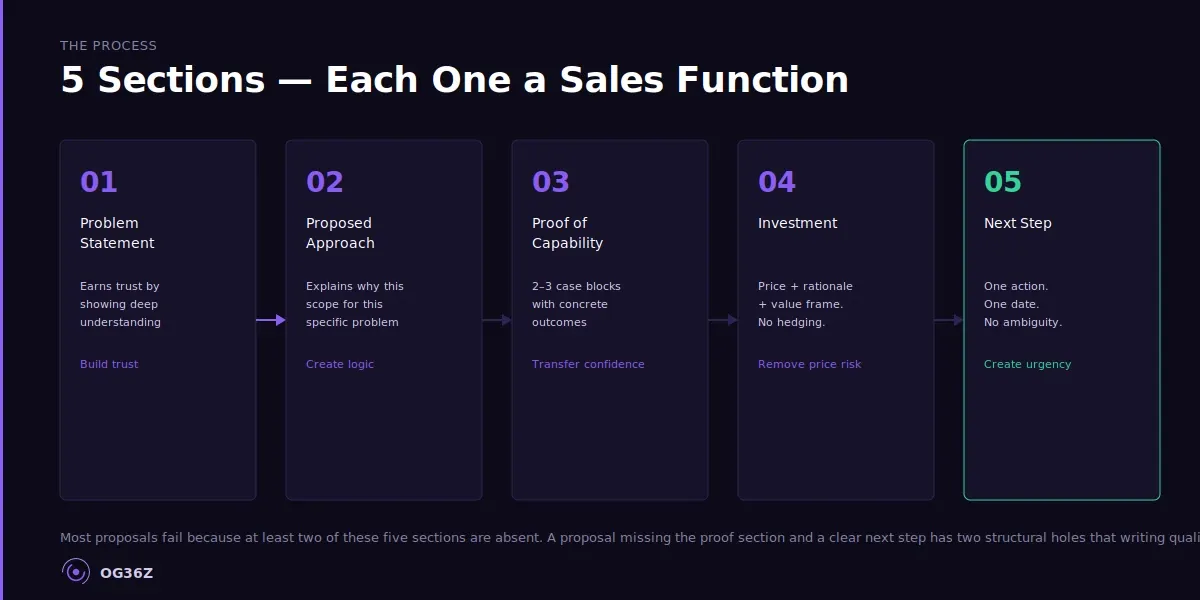
- Problem statement — demonstrates understanding of the prospect's specific situation in their own language
- Proposed approach — explains why the selected scope elements were chosen for this situation
- Proof of capability — two to three case summaries showing the same problem type solved previously
- Investment — price, pricing logic, and value framing without hedging or apology
- Next step — one action, one date, no ambiguity
A winning consulting proposal is not a document — it is a sales argument structured as a document. Every section must do a specific job, and most solo consultant proposals fail because at least two sections are absent or performing the wrong function.
The typical solo consultant proposal contains a bio, a list of services, a scope description, and a price. It answers the question "what do I do and what does it cost" — not the question a prospect is actually asking, which is "why is this the right answer to my specific problem and why is this person the right one to solve it?" Those are different documents. One of them closes work. The other produces polite silence.
The architecture of a proposal that closes follows a specific logic, and every section serves a sales function that can be described precisely.
What makes a consulting proposal template actually win work?
A consulting proposal template wins work by making each section perform a specific persuasive function — not just conveying information about scope and price. The distinction between a proposal that closes and one that stalls is almost always structural: the closing proposal demonstrates understanding, builds confidence, removes risk, and creates urgency through clear next steps. The stalling proposal delivers information without guidance.
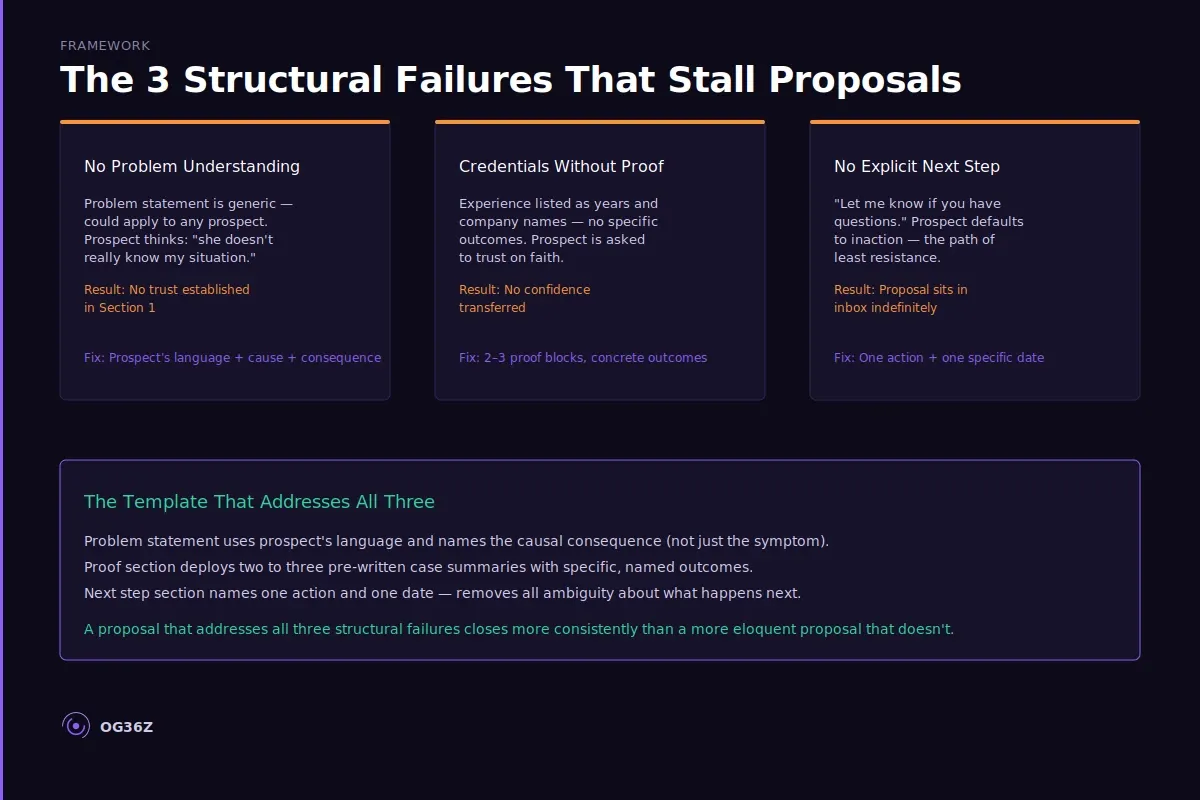
Most proposals fail at the first section. The problem statement — when it exists at all — is written from the consultant's perspective, using the consultant's vocabulary, describing a general category of problem. The prospect reads it and thinks: "this is a generic description that could apply to any company." The first test of a proposal is whether the prospect recognizes their specific situation in the first section. If they do, every section that follows is already more persuasive.
The second common failure is the absence of proof. A solo consultant who has been practicing for five years has solved twenty or thirty client problems. In most proposals, that experience appears only as years-in-practice claims and credential listings. No specific evidence that this particular problem type has been solved before. No outcome to examine. The prospect is asked to trust on faith.
The third failure is the non-existent next step. "Please let me know if you have any questions" is the single most common closing sentence in consulting proposals. It produces the least action. A prospect who has no explicit instruction on what to do next will default to nothing. Inaction is the path of least resistance. A next step with a specific date eliminates that default.
A template that addresses all three failures — forces specificity in the problem statement, deploys actual proof, and requires an explicit next step — consistently outperforms a template that does not, regardless of the quality of writing between sections.
See How to Build a Proposal System That Closes More Work as a Solo Consultant for the full infrastructure that surrounds the template.
What are the five essential sections every consulting proposal must include?
Every consulting proposal must include five sections: problem statement, proposed approach, proof of capability, investment, and next step.
Each section performs a distinct sales function, and removing any one of them weakens the overall argument in a way that reducing the strength of any individual section does not.
Section 1: Problem Statement The problem statement is the section that earns trust. Its job is to demonstrate that the consultant understands the prospect's situation at least as well as the prospect does — and ideally better. A strong problem statement uses the prospect's language, names the specific consequence of the problem (not just the problem itself), and shows a causal understanding of why the problem exists.
The test is simple: if the prospect reads this section and thinks "she gets it — she described my situation better than I could," the proposal is already more than halfway to a yes. If they think "this is generic," the rest of the document is working from a deficit.
Section 2: Proposed Approach The proposed approach translates the selected scope into a client-specific plan. The most common failure in this section is listing what will be delivered without explaining why those specific elements were selected. Prospects do not evaluate deliverables in isolation — they evaluate whether the proposed work is the correct response to the problem described in Section 1. The approach section must close that loop: "Because your situation is X, we are doing Y and Z and not W."
Section 3: Proof of Capability The proof section provides the evidence that the approach described in Section 2 has worked before, in a comparable situation. Two to three proof blocks — 100 to 150 words each — are sufficient. Each block should follow the same structure: the client context (anonymized to preserve confidentiality), the problem they faced, the approach deployed, and the specific outcome. The outcome must be concrete: not "improved communication" but "reduced time-to-decision from three weeks to four days."
Section 4: Investment The investment section presents the price, explains why it is structured the way it is, and frames the cost relative to the outcome. At $200 per hour, a forty-hour engagement is an $8,000 investment. The prospect comparing that to the cost of the problem the proposal described should see a clear return — if they cannot see it, this section failed to frame it. The investment section does not apologize. It presents the economics of the engagement with confidence.
Section 5: Next Step The next step section names exactly one action and exactly one date. "Return the signed agreement by March 14 to hold the April 1 project start date" is a next step. "Let me know if you want to move forward" is not. The next step section creates a concrete path from proposal to engagement, and it creates urgency by attaching a consequence (the project start date) to the timing.
How long should a solo consulting proposal be?
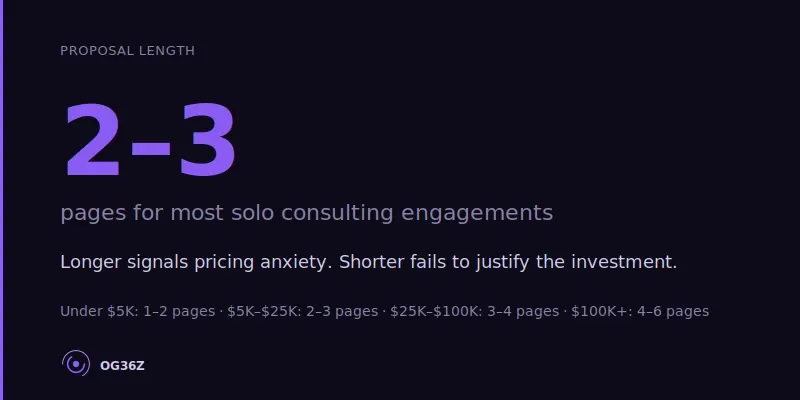
A solo consulting proposal for a $5,000 to $25,000 engagement should be two to four pages. Proposals longer than four pages lose readers before they reach the price. Proposals shorter than two pages fail to provide enough evidence to justify the investment.
Length is a function of two variables: deal size and buyer sophistication. Larger, more complex engagements warrant more detailed proof and approach explanation. Buyers who are unfamiliar with consulting proposals benefit from more context in the problem statement and approach sections. But both of these factors push toward more detail per section — not more sections.
Adding sections beyond the core five does not improve close rate. A bio section before the problem statement shifts the prospect's first impression from "she understands my problem" to "she wants me to read about her background." An appendix with detailed methodology shifts the framing from confident recommendation to hedged justification. Neither addition closes more work.
The practical page count by deal size:
- Under $5,000: One to two pages, occasionally one page for repeat clients or continuing engagements where context is shared
- $5,000–$25,000: Two to three pages — the standard range for solo consulting engagements
- $25,000–$100,000: Three to four pages — more detailed proof section, more thorough scope description
- Over $100,000: Four to six pages, potentially with a separate scope-of-work attachment — but the core five-section structure remains
Length discipline is a signal of confidence. A consultant who sends a twelve-page proposal for a $15,000 engagement is, implicitly, working harder to justify the cost than the work requires. The correct response to pricing anxiety is not more pages — it is better framing in the investment section.
What language converts best in a consulting proposal?
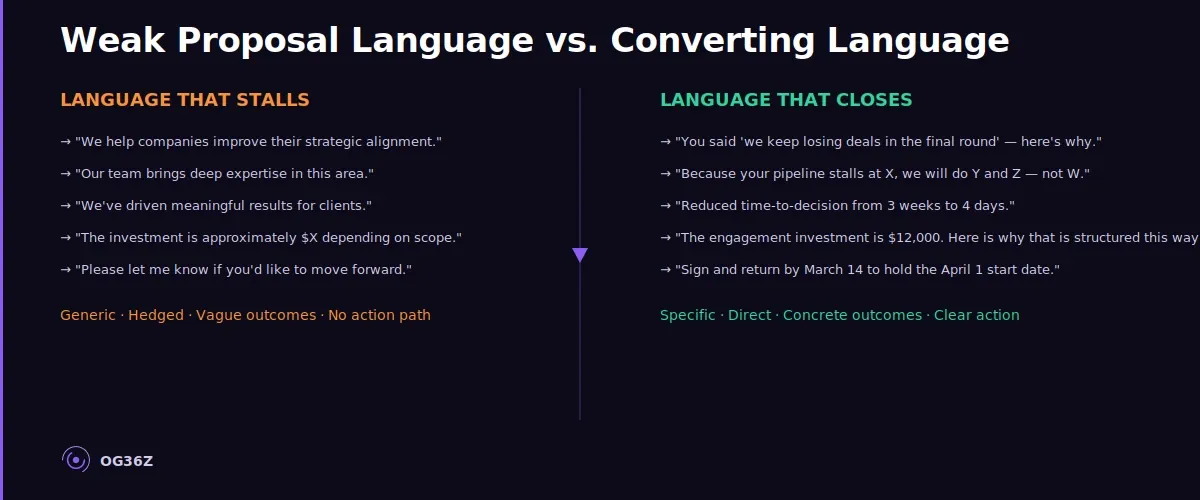
The language that converts best in a consulting proposal is the prospect's own language, applied to a confident and specific structure. Generic consulting vocabulary — "leverage synergies," "strategic alignment," "end-to-end solutions" — performs worse than plain language because it signals to the prospect that the consultant is writing from a template, not from an understanding of their specific situation.
The highest-converting language in each section follows distinct patterns:
Problem statement language: Extract exact phrases from the discovery call transcript or notes. If the prospect said "we keep losing deals in the final round," the problem statement should use those words — not "challenges in the late-stage sales process." Mirroring the prospect's language demonstrates listening and reduces the interpretive distance between the consultant's understanding and the prospect's reality.
Proposed approach language: Use causal connectors. "Because your team is missing..." leads directly to "we will build..." The most effective approach language establishes a one-to-one relationship between each element of the problem and each element of the proposed work. Prospects should not have to infer why something is included.
Proof section language: Concrete outcomes outperform process descriptions. "Reduced time-to-decision from three weeks to four days" outperforms "improved decision-making processes." "Generated $340,000 in new pipeline within 60 days of launch" outperforms "drove meaningful business results." The proof section's job is confidence transfer — vague outcomes transfer no confidence.
Investment language: State the number first, then provide the rationale. Burying the price in paragraph three of the investment section creates the impression that the consultant is hesitant about it. Stating it clearly in the first sentence, then following with the value framing, demonstrates that the pricing is decided and defensible.
Next step language: The imperative voice is appropriate and effective. "Sign and return by Friday" is clearer and more action-driving than "if you'd like to proceed, the next step would be to..." The prospect has spent time reading the proposal; a confident next step respects their time by being unambiguous.
See The Consulting Proposal Process: What to Systemize and What to Keep Custom for how to build language extraction into the discovery-to-proposal workflow so the right language is available when the proposal is being assembled.
How do you customize a template without rebuilding it from scratch each time?
A proposal template is customized without rebuilding by separating the fixed structure from the variable content and limiting customization to five specific fields. The structure — the five sections and their sequence — never changes. The content within each section is drawn from four sources: the discovery call notes, the selected scope tier, the curated proof blocks, and the investment rationale for that tier.
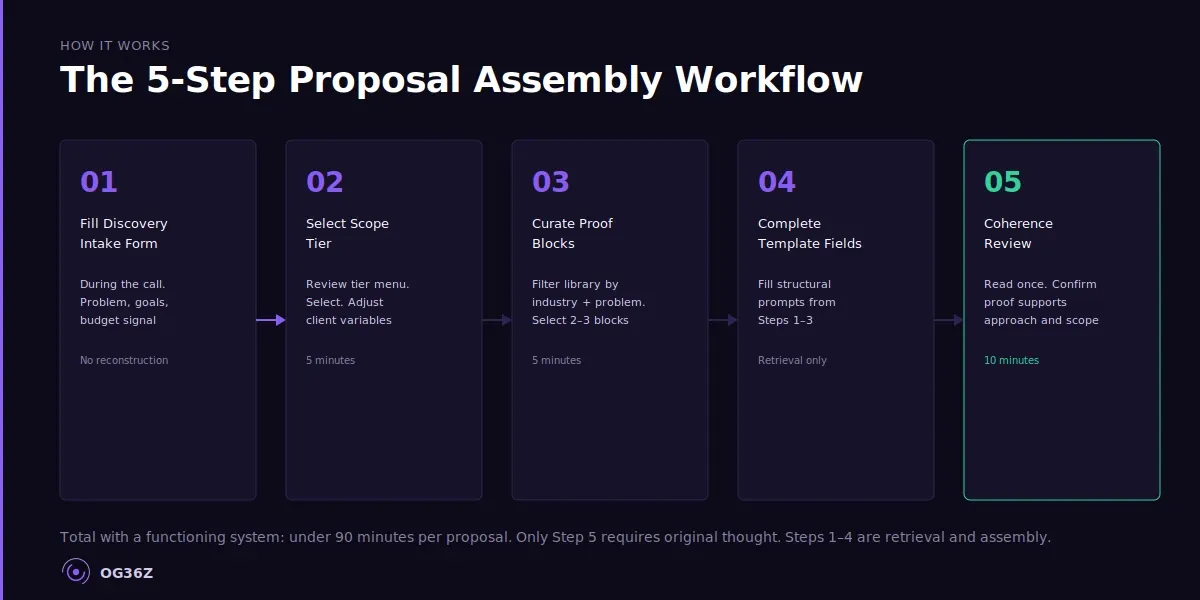
The practical workflow runs in five steps:
Step 1: Fill the discovery intake form during the call. The intake captures the problem statement (in the prospect's language), stated goals, decision criteria, urgency drivers, and budget signal. This form feeds directly into the template — no reconstruction from memory required after the call.
Step 2: Select the scope tier. Review the tier menu, select the tier that best fits the engagement, and note any client-specific adjustments (timing, deliverable format, stakeholder involvement). The tier selection determines the content of Section 2 and Section 4.
Step 3: Curate the proof blocks. Review the proof library, filtered by industry and problem type. Select two or three blocks that most closely match the prospect's situation. Paste them into Section 3 without rewriting. If the blocks require minor adaptation (industry-specific terminology), adjust the minimum necessary text.
Step 4: Complete the template fields. Fill in the structural prompts with content from Steps 1–3. The problem statement prompt: "State the primary problem in the prospect's language." The approach prompt: "Explain why this scope was selected for this problem." The investment prompt: "State the price and the value framing in two to three sentences." The next step prompt: "Name one action and one date."
Step 5: Review for proposal-specific coherence. Read the completed proposal once to confirm that the problem statement, approach, and proof tell a coherent story — that the proof cases directly support the proposed approach, and that the approach directly addresses the stated problem. This review takes ten minutes and catches the gaps that appear when generic proof blocks are dropped into a specific proposal without adjustment.
The total time for Steps 1–5, with a functioning system, is under ninety minutes per proposal. The customization in Step 5 is the only step that requires original thought. Every other step is retrieval and assembly. That is what the template is for. See From Blank Page to Sent Proposal: A Time-Efficient Process for Solo Consultants for the full end-to-end workflow that implements this sequence.
Summary
A winning consulting proposal is a sales argument in five sections: problem statement, proposed approach, proof of capability, investment, and next step.
Each section performs a distinct persuasive function, and the template's job is to enforce the structure while demanding client-specific content in every field.
Proposal length for most solo consulting engagements is two to three pages — longer signals pricing anxiety, not more value.
The language that converts best is the prospect's own language in the problem statement, causal connectors in the approach, concrete outcomes in the proof, direct pricing in the investment, and imperative voice in the next step.
Customization, done correctly, takes under ninety minutes: discovery intake, scope tier selection, proof block curation, template completion, coherence review.
The proposal that closes work is not the most eloquent one — it is the most precisely structured one.