
How to Build a Proposal System That Closes More Work as a Solo Consultant
The consultants who win the most work are not the best writers — they are the best systems builders.
KEY TAKEAWAYS
- A solo consultant rewriting every proposal from scratch burns 4–6 unpaid hours per pitch — at $200/hr, that is $800–$1,200 in unrecovered time per proposal.
- Winning proposals rely on system design, not writing skill: a replicable structure consistently outperforms bespoke prose on close rate.
- A complete proposal system has five components: template, scope tiers, proof library, discovery workflow, and win/loss log.
- Win/loss tracking on as few as five closed deals reveals which sections close work and which create stall points.
What is a consulting proposal system for solo consultants?
A consulting proposal system is a replicable infrastructure — master template, scope tier menu, proof block library, discovery-to-proposal workflow, and win/loss log — that lets a solo consultant produce consistent, professional proposals without rebuilding from scratch each time.
It replaces ad hoc writing with decision infrastructure, so proposal quality depends on the system rather than the energy available on a given afternoon. Solo consultants with a functioning proposal system spend less unpaid time per pitch and close work more predictably than those who write bespoke proposals for every engagement.
CORE COMPONENTS:
- Proposal template — a five-section structure that functions as a sales argument, not an information dump
- Scope tier menu — pre-defined engagement packages that eliminate custom scoping from every pitch
- Proof block library — pre-written case study summaries organized by industry and problem type
- Discovery workflow — a standardized intake that maps discovery call output directly to the template
- Win/loss log — the feedback mechanism that improves every subsequent proposal
The consultants who win the most work are not the best writers — they are the best systems builders. A structured proposal process consistently outperforms bespoke prose because it trains pattern recognition on what closes and removes every repeated decision from the pitch cycle.
Sana, an independent strategy consultant billing $200 per hour, rewrites every proposal from scratch. A single pitch — problem framing, proposed approach, proof of capability, scope, pricing, next step — takes four to six hours. None of those hours bill. At her rate, each proposal costs $800 to $1,200 in unrecovered time before a single dollar of revenue appears. If she sends ten proposals a year and wins six, the four losses represent $3,200 to $4,800 in sunk writing time. The system produced nothing. The writing did.
The fix is not to write better proposals. It is to stop writing proposals and start deploying them.
Why does every proposal feel like starting from scratch?
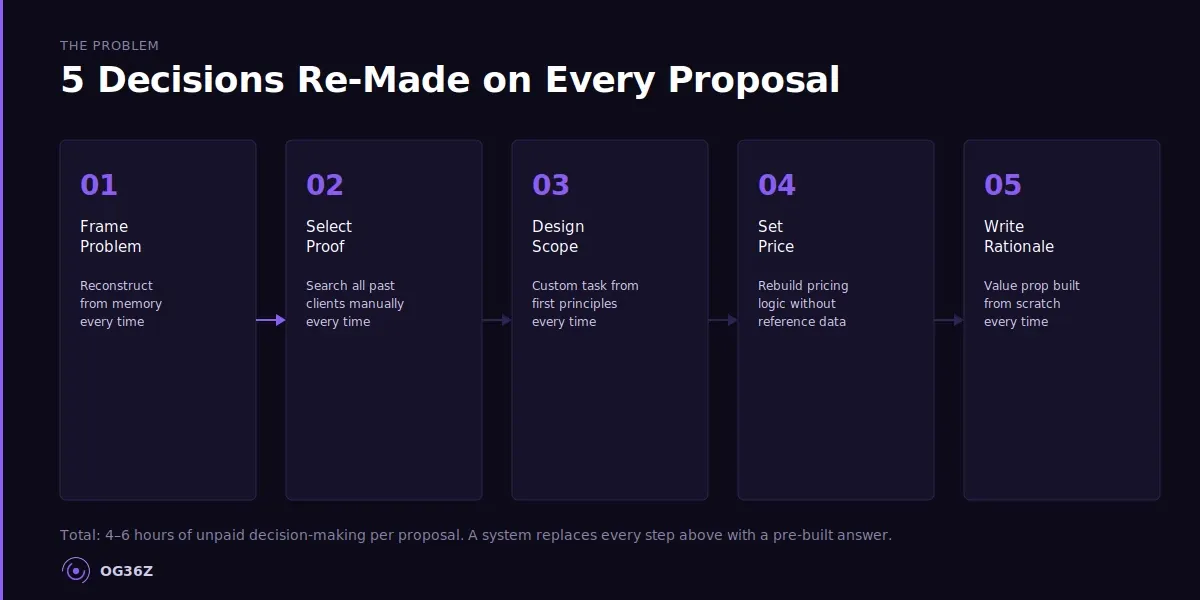
Every consulting proposal feels like starting from scratch because there is no system collecting and reusing the decisions made in every previous proposal. Each new pitch re-solves problems the consultant has already solved — how to frame the problem, which proof points to include, what the scope looks like, how to justify the investment.
This is not a writing problem. It is a decision infrastructure problem.
When Sana finishes a proposal for a manufacturing client, the problem framing she developed — the language that landed, the scope structure that felt right, the proof case that built confidence — exists only in that document. The next client is in healthcare. She starts again. Different industry, different framing, different everything.
Except that is not accurate. The architecture of a winning proposal — the five components that move a prospect from interested to committed — does not change between clients or industries. What changes is the content that fills those components. Bespoke content in a reusable structure is the answer. Without a structure to fill, the consultant rebuilds the structure every time.
The specific drag points in a proposal written from scratch:
Framing the problem. The most credible problem statements are built from the prospect's own language — words from the discovery call, phrases from their documents, challenges they named explicitly. Without a system for capturing this during discovery, Sana reconstructs it from memory and general judgment.
Selecting proof points. Which past client experience is most relevant here? Which result will be most credible to this buyer? Without a proof library organized by industry, problem type, and outcome, this is a search exercise that runs on every pitch.
Scoping the engagement. What belongs in scope? What is excluded? What are the delivery milestones? Without pre-defined scope tiers, every scope is a custom design task.
Pricing the work. What does this engagement cost? Why? Without pricing logic documented and tested, every pricing decision is made from first principles.
Writing the rationale. Why is this consultant the right choice for this specific problem? Without a value proposition written and tested, this is composed anew every time.
Each of these is a decision, not a writing task. Decisions made under time pressure, without reference to prior decisions, produce inconsistency. Inconsistency in proposals produces inconsistent close rates. Inconsistent close rates make revenue unpredictable for a solo practice built on project work.
What does a high-performing solo consulting proposal system actually include?
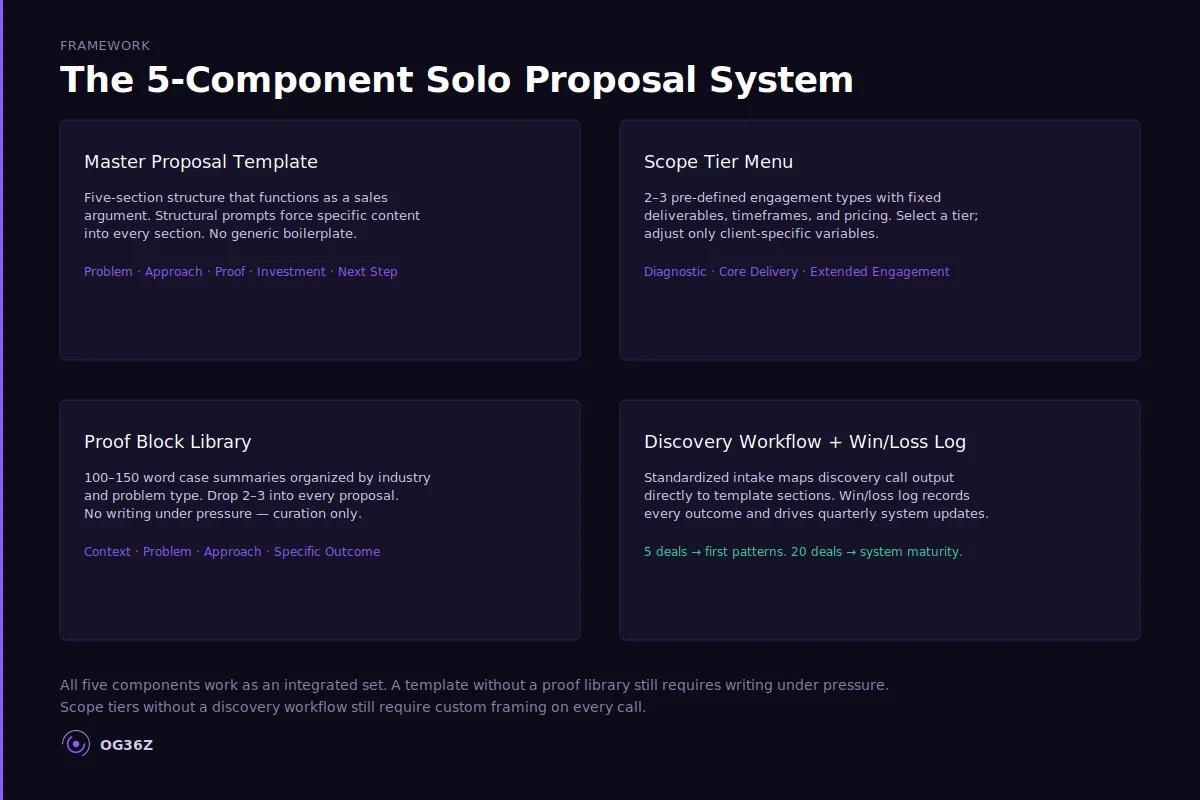
A high-performing solo consulting proposal system includes five components: a master proposal template, a scope tier menu, a proof block library, a discovery-to-proposal workflow, and a win/loss log. These five components remove every repeated decision from the proposal process and replace them with pre-built infrastructure that deploys in under ninety minutes.
Each component handles a specific job:
Master proposal template. The template defines the five-section structure of every proposal: problem statement, proposed approach, proof of capability, investment, and next step. It does not contain generic boilerplate — it contains structural prompts that force specific content into each section. The template is the skeleton. The client-specific content is the flesh. See The Proposal Template That Wins Consulting Engagements for the exact section architecture.
Scope tier menu. A scope tier menu is a pre-defined set of two to three engagement types — typically a diagnostic tier, a core delivery tier, and an extended engagement tier. Each tier has defined deliverables, defined timeframes, and defined pricing. When a prospect is ready for a proposal, Sana selects a tier and adjusts only the client-specific variables. The custom scoping exercise — which can consume two hours of every proposal process — is replaced with a five-minute selection.
Proof block library. Proof blocks are pre-written case study summaries, each 100 to 150 words, organized by industry and problem type. Each block follows the same structure: client context (anonymized), the problem they faced, the approach deployed, and the specific outcome. In a proposal, Sana selects the two or three proof blocks most relevant to the buyer and drops them in. The proof selection and writing exercise is replaced with a five-minute curation. See How to Build a Proposal Library That Makes Every New Proposal Faster for the exact library architecture.
Discovery-to-proposal workflow. A defined workflow captures discovery call output in a standardized format — problem statement, stated goals, decision criteria, urgency drivers, budget signal — and maps it directly to the proposal template sections. The workflow eliminates the gap between discovery and writing. Sana fills out the discovery form during the call. The proposal template sections populate from that input.
Win/loss log. A simple record of every proposal sent — client type, scope tier selected, proof blocks used, and outcome — creates a feedback loop. After five to ten closed deals, patterns appear: specific proof blocks close work in specific industries; particular scope tiers stall at specific price points. The log turns each closed deal into a system improvement.
Without all five components, the system is incomplete. A template without a proof library still requires writing under pressure. Scope tiers without a discovery workflow still require custom framing on every call. The five components work as an integrated set, not as isolated improvements.
How do you structure a proposal template that converts without sounding generic?
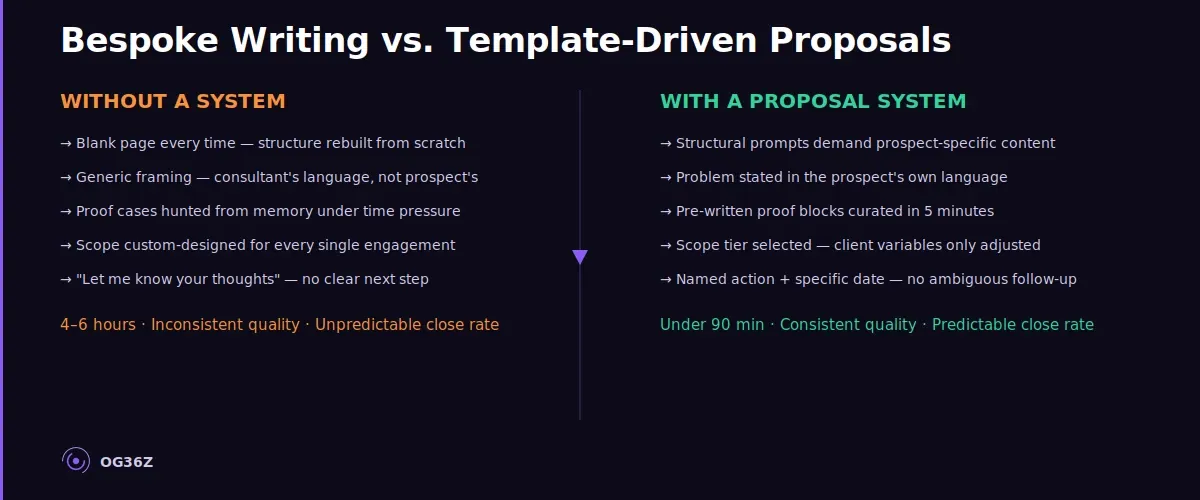
A proposal template converts without sounding generic by separating the fixed structure from the variable content. The structure is always the same — problem, approach, proof, investment, next step. The content is always specific — the prospect's language, their stated goals, the proof case most relevant to their situation.
The failure mode of most template-based proposals is that the template contains the content, not just the structure. Generic framing in the template bleeds into the final document. The result reads like a mail-merge, and experienced buyers recognize it immediately.
The alternative is a template that contains only structural prompts — questions or field labels that force the consultant to inject specific content. Instead of a section that reads "We understand your challenges," the prompt reads: "State the single most important problem this prospect named in discovery, in their own language." The resulting section is always specific because the template demands it.
A converting proposal structure follows five sections, each with a sales function:
Problem statement. This section demonstrates that Sana understands the prospect's situation better than they articulated it in the discovery call. It names the problem, its cause, and its business consequence — using the prospect's language. A prospect who reads this section and thinks "she gets it" is already more than halfway to a yes. Generic consultants describe the problem in their own terms. Systems-driven consultants reflect the problem back in the prospect's terms.
Proposed approach. This section translates the selected scope tier into a client-specific plan. The tier defines what is included; this section explains why those specific elements were selected for this situation. It is not a list of services — it is a reasoned argument connecting their stated problem to the specific approach. The prospect should be able to trace a direct line from their challenge to each deliverable.
Proof of capability. This section deploys two to three proof blocks. Each block confirms that Sana has solved this exact problem type before and produced a specific result. Proof is not a credential claim ("I have fifteen years of experience"). It is an evidence-based confidence transfer: "Here is the specific outcome another organization in your situation achieved."
Investment. This section names the price, explains the pricing logic, and frames the value relative to the cost. It does not apologize, hedge, or bury the number. The prospect knows the cost by the time they reach this section — surfacing it clearly, with a rationale, is more persuasive than obscuring it until page three.
Next step. This section names exactly one action and exactly one date. "Please review and let me know your thoughts" is not a next step. "Sign and return the engagement agreement by Friday to secure your project start date of March 15" is a next step. A template that enforces this structure eliminates the stalled proposal — the proposal that sits in a prospect's inbox waiting for the consultant to follow up.
What tools should solo consultants use to manage and deploy proposals?
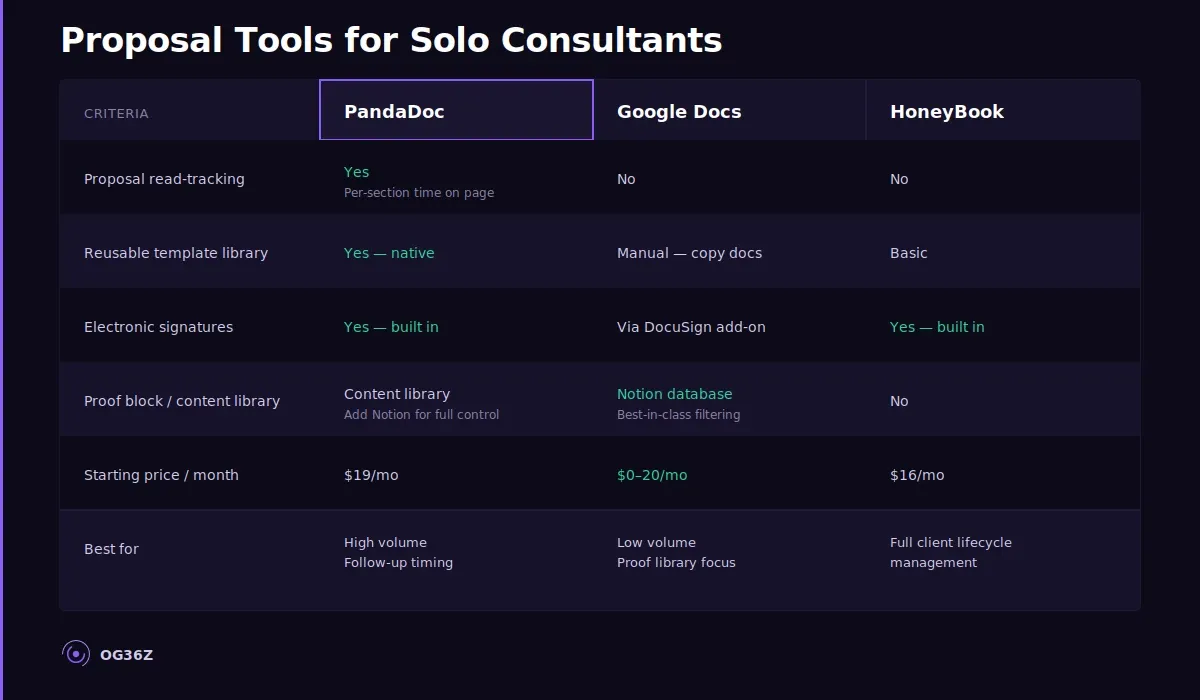
Solo consultants should use tools that match proposal volume and the specific bottleneck in their current process — not the tool with the most features. The three jobs a proposal system needs from its tools are: content storage and retrieval, proposal creation and delivery, and outcome tracking. One tool rarely handles all three well.
The tool landscape for solo consulting proposals breaks into three categories:
Dedicated proposal platforms. PandaDoc and Proposify are built specifically for proposal creation, delivery, and tracking. Both support reusable templates, electronic signatures, and read-tracking — the ability to know when a prospect opened the proposal and how long they spent on each section. For a solo consultant sending more than six proposals per month, read-tracking alone justifies the subscription cost. Knowing when a prospect opened a proposal allows precisely timed follow-up. PandaDoc starts at $19 per month; Proposify at $49 per month. Both offer a proof block equivalent through their content library features.
Document-plus-signature tools. Google Docs combined with DocuSign is the most common setup among solo consultants in the early stages of systematizing. Docs stores the template and allows quick editing; DocuSign handles electronic signatures. This combination works but lacks read-tracking and requires manual management of the proof block library. For consultants sending fewer than six proposals per month, the cost-to-value ratio is favorable. The limitation is that improvement signals — which sections prospects read, where they stop — are invisible.
Practice management platforms. HoneyBook and Dubsado bundle proposals with contracts, invoices, client communication, and project tracking. They are designed for service businesses managing the full client lifecycle from first contact to final payment. The proposal module is less sophisticated than dedicated tools, but if admin overhead across the entire practice is the primary problem, the consolidation value is real. HoneyBook starts at $16 per month.
Knowledge base as proof library. Notion is the most practical tool for maintaining the proof block library and scope tier menu independently of whichever proposal delivery tool is in use. Its database view allows proof blocks to be filtered by industry, problem type, and outcome, making the curation step in a new proposal fast and structured. Obsidian serves the same function for consultants who prefer local, offline storage.
The tool decision follows from proposal volume and the current primary bottleneck. A consultant sending two proposals per month and losing engagements to slow follow-up needs read-tracking first — PandaDoc or Proposify. A consultant sending eight proposals per month and losing time to proof selection and scope design needs a structured Notion database and scope tier menu built before any delivery tool upgrade. See How Independent Consultants Can Write Proposals in Half the Time for the decision-making infrastructure that matters most before tool selection.
How do you improve your proposal system over time using win/loss data?
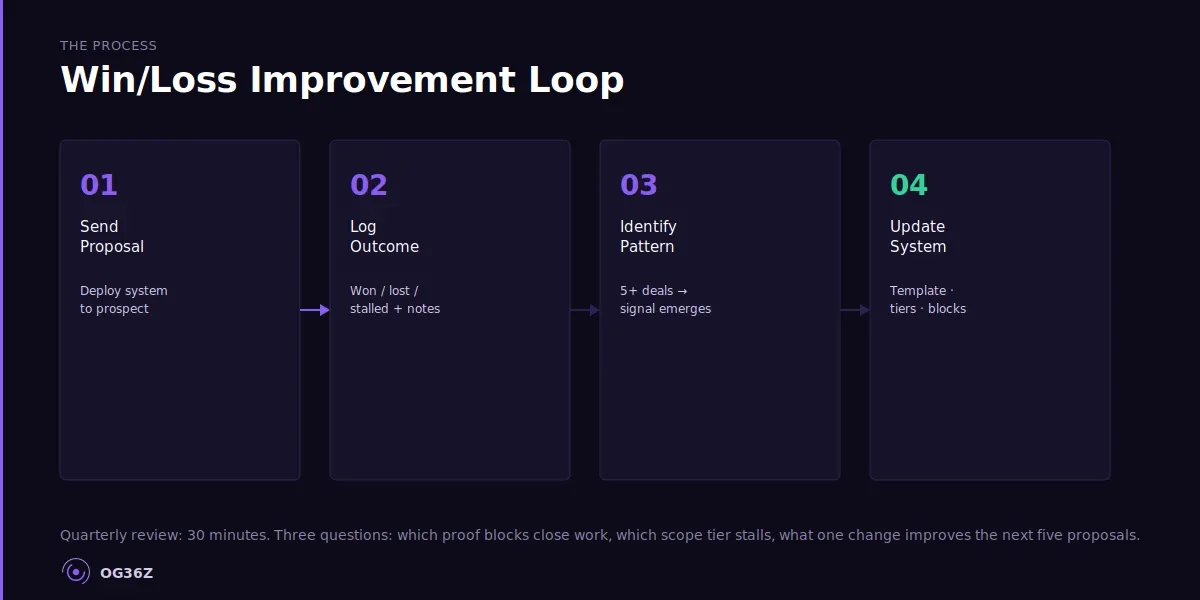
A proposal system improves over time by converting every outcome — won or lost — into a specific system update. The mechanism is a win/loss log: a structured record of every proposal sent, the variables in play, and the result.
A win/loss log does not require sophisticated tooling. A Notion database or a five-column spreadsheet is sufficient:
- Client type — industry, company size, and role of the decision-maker
- Scope tier selected — which pre-defined tier was proposed
- Proof blocks used — which two or three case summaries were included
- Outcome — won, lost, stalled, or withdrawn
- Notes — one sentence capturing the stated reason or the follow-up signal
After five closed deals, the log has enough signal to act on. Common patterns that emerge at this scale:
The same proof block appears in every won proposal for a specific industry type. That block is promoted to default status for that industry — it leads the proof section in every future proposal for that segment.
Proposals for mid-size companies with distributed decision-making consistently stall at scope. The scope tier for that segment is too broad, and no single stakeholder can approve it. A narrower, more specific tier is built for that buyer profile and tested on the next three proposals.
Proposals without a named next-step date close at a fraction of the rate of those with one. The template is updated to require a specific date in the next-step field — not a suggestion, a field that cannot be left blank.
Each system improvement is a direct function of observed behavior, not subjective preference. The win/loss log turns each closed deal into a data point. At fifteen to twenty proposals, the log has enough variance to identify the highest-leverage changes across the entire system.
The discipline that makes win/loss tracking effective is consistency. A log that records every proposal — including the uncomfortable losses — is a system improvement tool. A log updated only on wins is a confidence exercise, not a diagnostic.
Quarterly system reviews — a thirty-minute examination of the win/loss log — are sufficient to keep the system current. Three questions drive each review: Which proof blocks are closing work in which industries? Which scope tier is producing stalls? What single change in the template would produce the most improvement on the next five proposals?
Summary
A consulting proposal system is infrastructure, not writing. It replaces five repeated decisions — problem framing, proof selection, scope design, pricing, and next-step setting — with pre-built components that deploy in under ninety minutes.
The five components are a master template, scope tier menu, proof block library, discovery-to-proposal workflow, and win/loss log.
Tool selection follows from proposal volume and the primary current bottleneck: PandaDoc or Proposify for read-tracking and delivery, Notion for the proof library, HoneyBook or Dubsado for full practice lifecycle management.
The system improves through disciplined win/loss tracking — each closed deal generates one or two system updates, and the improvement compounds with every proposal sent.
The solo consultant who builds this system stops competing on writing quality and starts competing on consistency, speed, and signal.