
The Consulting Proposal Process: What to Systemize and What to Keep Custom
The consultants who close efficiently have identified exactly which twenty percent of their proposal demands original thinking — and locked down the rest.
KEY TAKEAWAYS
- Eighty percent of a winning consulting proposal can be fully templated — only the problem framing and fit argument require original thinking.
- Over-customizing generic sections wastes 3–4 hours per proposal without improving close rates; the waste is identifiable and fixable.
- A modular proposal system separates fixed structure from variable content, so bespoke sections stay sharp and templated sections never stall the process.
- Auditing five closed proposals reveals exactly which sections consumed time and which sections drove the decision — most consultants have it backwards.
What parts of the consulting proposal process should be systemized?
The sections that establish your credibility, pricing logic, and delivery structure are fully systemizable — they change little between clients and demand no original creative work. The sections that win the deal — problem framing and the specific fit argument connecting your approach to the client's situation — must always be written from scratch using discovery call output. The most efficient solo consultants systematize the eighty percent that is predictable and invest original thinking only in the twenty percent that is decisive.
CORE COMPONENTS:
- Templated sections — credentialing, scope structure, pricing logic, process overview, and next-step framework
- Custom sections — problem statement using client language, specific fit argument, and relevant proof selection
- Modular proof library — pre-written blocks selected per engagement, not written per engagement
- Discovery capture form — structured intake that feeds directly into the custom sections
- Audit mechanism — win/loss tracking that identifies which sections drive close decisions
Over-customizing a consulting proposal is as damaging as under-customizing it. The consultants who close efficiently have identified exactly which twenty percent of their proposal demands original thinking — and locked down the rest.
Sana, an independent strategy consultant, spends four to five hours on every proposal. She believes the thoroughness signals seriousness. Her competitors who close faster and at higher rates are not less thorough — they are more precise about where thoroughness pays. The problem framing and the fit argument deserve every hour of original thinking Sana can give them. The credentials section, the process overview, and the pricing structure do not change meaningfully between clients, and rewriting them from scratch every time is a tax Sana pays to feel productive while the hours that actually close work go underfunded.
The insight that drives the most efficient proposal practices is not speed — it is allocation. Understanding which sections clients read, which sections drive decisions, and which sections fulfill a due-diligence function nobody acts on is the foundation of a proposal system that closes work without consuming a consultant's week.
What are the parts of a consulting proposal clients actually read carefully?
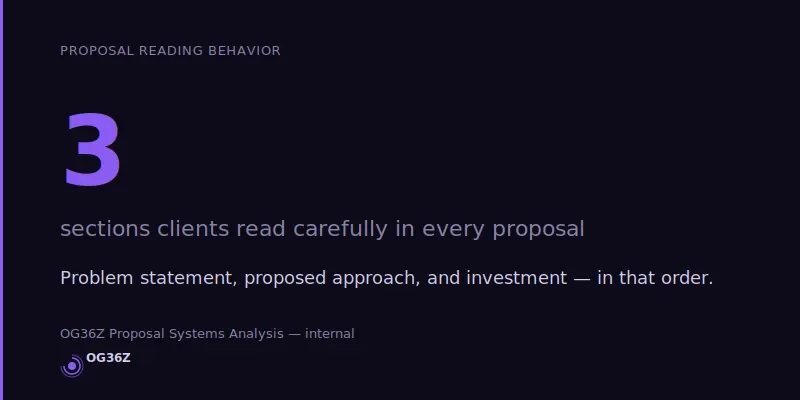
The sections clients read carefully are the problem statement, the proposed approach, and the investment — in that order. Everything else performs a background function: it satisfies due diligence, confirms competence, and prevents the objection that surfaces from incomplete information. It rarely drives the decision.
This ordering has a direct implication for where original thinking pays. The problem statement earns the yes — it demonstrates that the consultant understood the situation precisely enough to describe it better than the client could in the discovery call. A prospect who reads their own situation reflected back with clarity and accuracy has already formed the conviction that this consultant belongs in the room. That conviction is not reinforced by a generic credentials section that follows — it is either held or not held by the time the reader reaches page two.
The proposed approach is read closely because it answers the most important practical question: is this plan actually going to work for my situation? Generic methodology language — "we will conduct a diagnostic phase followed by a recommendations phase" — is scanned and dismissed. Specific language that traces the client's stated problem directly to each deliverable is read and retained.
The investment section is read closely not because the number is unexpected — most prospects have a rough budget in mind — but because the framing around the number answers the implicit question: does this consultant know what this is worth? A direct, confident price with a clear rationale is read as evidence of experience. An apologetic or hedged price signals inexperience.
The credentials section, case studies section, and process overview are scanned. They satisfy threshold questions: has this consultant done this before, roughly how does their process work, are there obvious reasons not to proceed? These sections do not drive decisions. They prevent objections. Preventing objections is important, but it is not the same function as winning commitment, and the two functions require different amounts of original writing.
Which proposal sections should be fully templated?
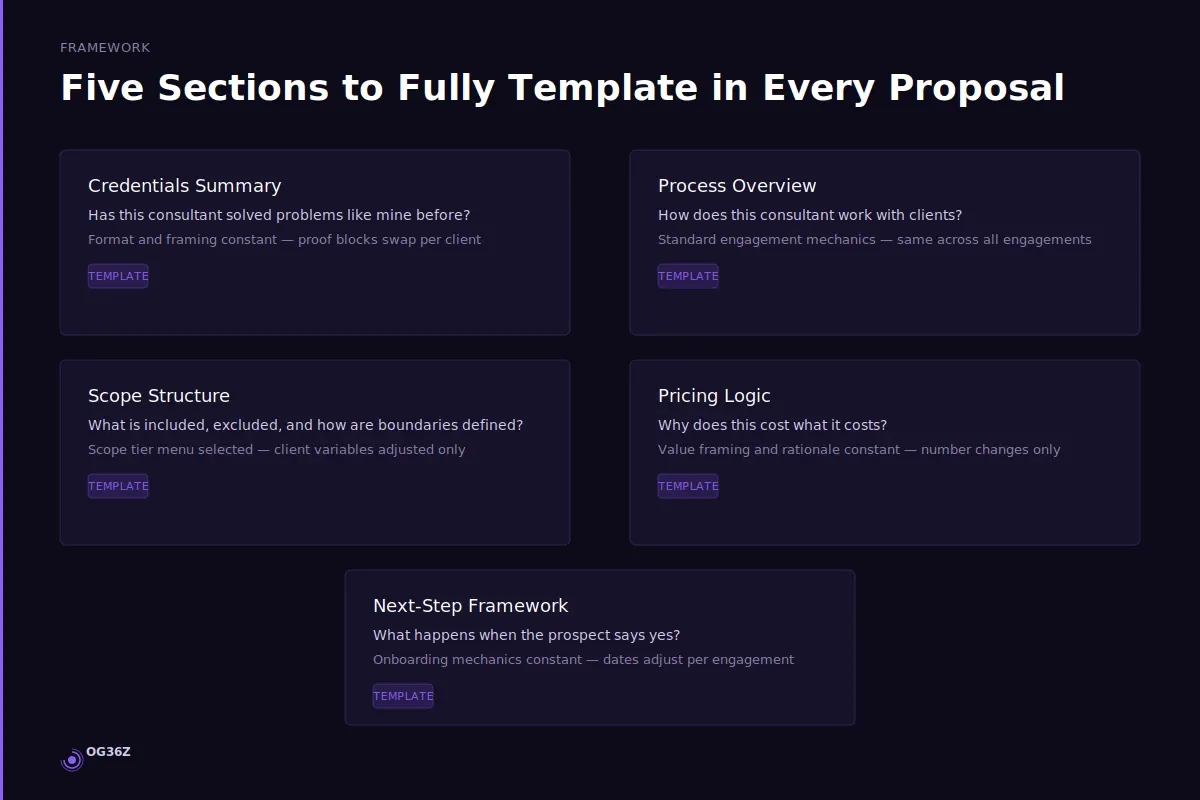
The sections that should be fully templated are every section whose primary function is objection prevention rather than conviction building. These are the credentials summary, the process overview, the scope structure, the pricing logic, and the next-step framework.
Each of these sections performs the same function across every proposal: it answers a threshold question the buyer is asking before they can commit. None of these threshold questions change significantly between clients.
Credentials summary. The buyer is asking: has this person solved problems like mine before? The answer is the same across engagements — the proof blocks change, but the format, structure, and framing logic are constant. See How to Build a Proposal Library That Makes Every New Proposal Faster for the proof block architecture that makes this section fully modular.
Process overview. The buyer is asking: how does this consultant work, and is the process going to create disruption for my team? The answer describes Sana's standard engagement mechanics — kickoff, working sessions, deliverable cadence, review process. This is the same regardless of client. The only variable is which elements of the standard process are most relevant to emphasize given the client's stated concerns about disruption or timeline.
Scope structure. The buyer is asking: what exactly is included, what is excluded, and how are boundaries defined? The scope tier menu — pre-defined engagement packages from How to Build a Proposal System That Closes More Work as a Solo Consultant — handles this entirely. The tier is selected; only the client-specific context variables are adjusted.
Pricing logic. The buyer is asking: why does this cost what it costs? The pricing rationale — the explanation connecting scope to investment, the value framing, the comparison anchors — is the same structural argument every time. The specific number changes; the logic for presenting it does not.
Next-step framework. The buyer is asking: what happens if I say yes? The mechanics of signature, kick-off scheduling, and onboarding are constant. Only the dates change.
Templating these five sections does not make proposals feel generic — provided the custom sections are genuinely custom. The failure mode is templates that bleed into the sections that must be specific. When the problem statement starts to sound like a template, the deal is already at risk.
What must always be custom in a solo consulting proposal?
The sections that must always be custom are the problem statement, the specific fit argument within the proposed approach, and the proof selection. These three elements are the only ones that cannot be pre-built — they depend entirely on what the specific client said in the discovery call and what situation they are actually in.
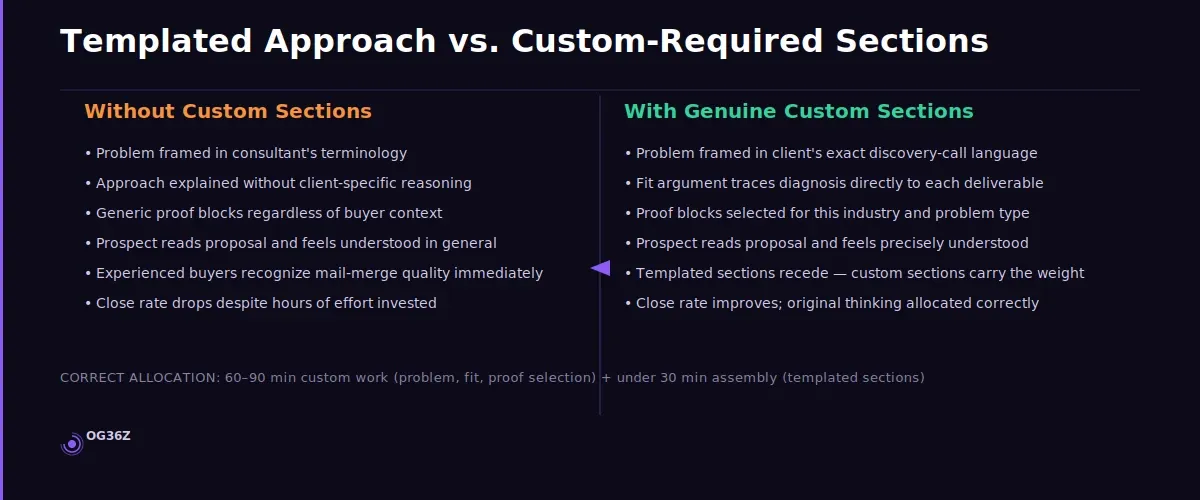
The problem statement is the section that either wins or loses the proposal before the buyer reaches page two. It must use the prospect's own language — the specific phrases, concerns, and goals they expressed in discovery. A problem statement that paraphrases the client in the consultant's preferred terminology creates subtle distance. The prospect senses that the consultant understood the category of problem but not this specific problem. That distance does not close.
The mechanics of writing a precise problem statement: capture exact phrases from the discovery call — not summaries, exact words. "Lack of alignment between regional teams" is better than "coordination challenges." "We're losing deals in the proposal stage" is better than "sales conversion issues." Reflect the language back. Demonstrate that you listened at the level of specific words, not category labels.
The fit argument is the paragraph or two within the proposed approach that explains specifically why this approach is right for this situation. The approach itself — the scope tier — can be templated. The fit argument cannot. It connects the specific diagnosis from the problem statement to the specific elements of the proposed approach, explaining the reasoning chain. "We are proposing a three-week diagnostic phase rather than jumping directly to recommendations because your team's distributed decision-making structure means recommendations without internal alignment will not move past the steering committee" is a fit argument. "We will conduct a diagnostic phase to ensure our recommendations are well-founded" is not.
Proof selection is not a writing task, but it is a custom task. The proof block library contains pre-written blocks ready to deploy. The selection requires judgment: which two or three blocks are most credible to this specific buyer given their industry, their role, and the problem type? A healthcare CFO evaluating a finance transformation proposal needs different proof than a technology VP evaluating an organizational design engagement, even if both are in the same proof library.
These three elements together require sixty to ninety minutes of genuine original work. That is the correct allocation. The remaining sections — templated, structured, and pre-built — should take under thirty minutes to assemble.
How do you create a modular proposal system that feels bespoke?
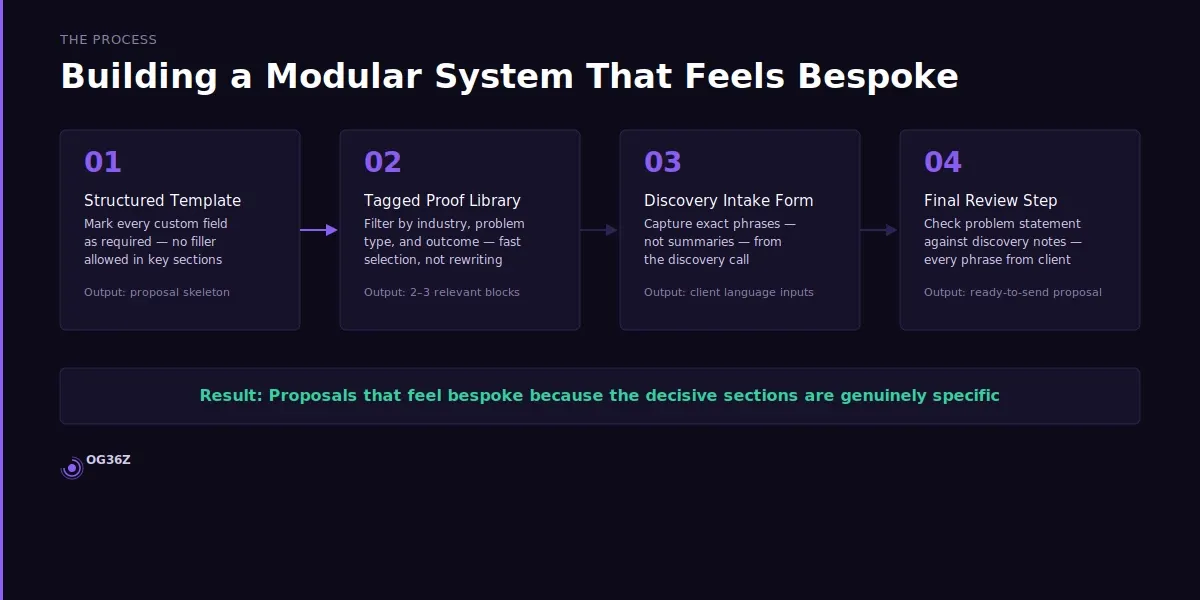
A modular proposal system feels bespoke when the custom sections are genuinely specific and the templated sections are genuinely invisible. The system has four mechanical requirements: a structured template with clearly marked custom fields, a proof library with tagging that enables fast and accurate selection, a discovery intake form that captures the exact inputs needed for the custom sections, and a final review step that checks the custom sections against the discovery notes.
The structured template marks every custom field explicitly — not as a suggestion, but as a structural requirement that cannot be skipped. Fields like "client's exact words for the problem" and "stated goals from discovery call" are not optional fields. They are required inputs. A template that allows generic filler in these fields produces generic proposals. A template that forces specific input produces specific proposals from the same structural skeleton.
The proof library must be searchable by client type, problem type, and outcome type. A library of twenty proof blocks organized in a flat list requires reading every block to find the right ones. A library organized in Notion with filters for industry, problem category, and outcome type reduces proof selection to a three-step filter exercise. The selection is still custom judgment — the system just makes the judgment faster.
The discovery intake form must capture specific phrases and direct quotes, not summaries. The form fields that feed the problem statement should ask: "What exact phrase did the client use to describe the core problem?" and "What consequence did they name if this problem is not resolved?" Summary fields — "describe the client's challenges" — produce the consultant's language, not the client's. The proposal loses specificity before the writing even begins.
The final review step is a two-minute check: read the problem statement against the discovery notes and confirm that every key phrase originated from the client, not from the consultant's interpretation. Read the fit argument and confirm it traces a logical chain from the specific problem to the specific deliverables. This review is the quality gate that separates proposals that feel custom from proposals that feel templated.
When these four mechanics are in place, the system produces proposals that read as deeply specific because the specific sections are deeply specific — and the templated sections recede into professional competence that does not call attention to itself.
How do you audit your current proposal process to find the waste?
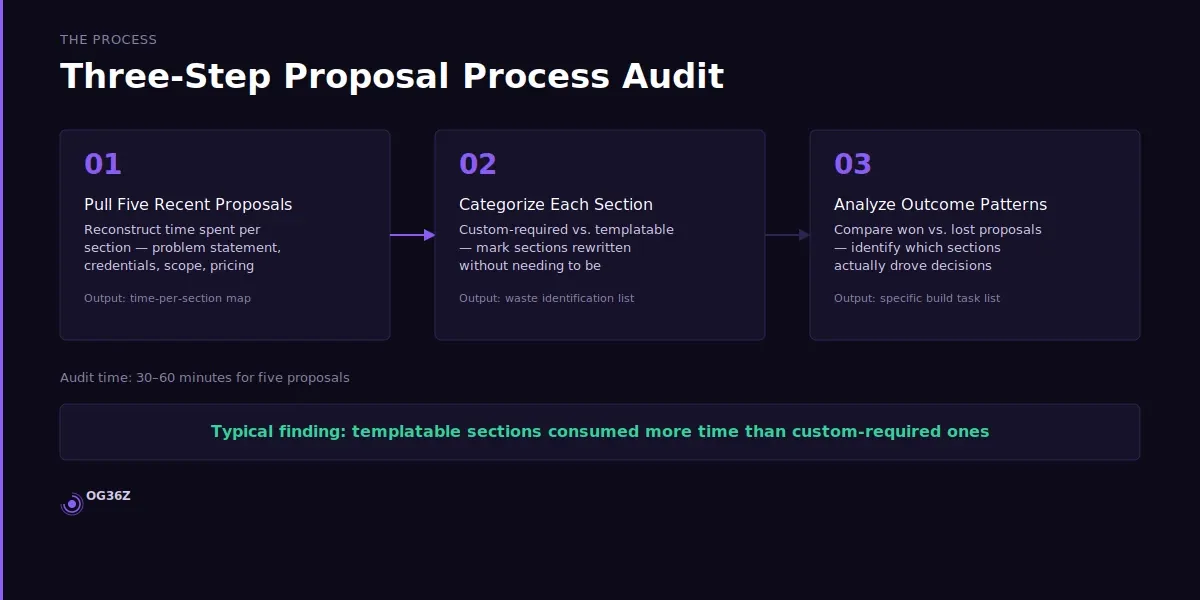
Auditing your current proposal process requires reviewing five recent proposals with a time log and a section-by-section assessment of which sections changed between clients and which were substantially rewritten from scratch without needing to be.
The audit has three steps. Pull five recent proposals. For each proposal, reconstruct where the time went — problem statement, approach section, credentials, scope, pricing, follow-up. Then categorize each section as "custom required" — it must be written from scratch — or "templatable" — it could have been pre-built and assembled in under ten minutes.
The pattern that emerges from this audit is consistent across solo consulting practices: the templatable sections consumed more total time than the custom-required sections. The credentials section was rewritten because it felt stale. The process overview was adjusted because it seemed like the right thing to do. The pricing section was reformatted. None of these consumed time because the client needed something new — they consumed time because there was no system that made them low-effort.
The second part of the audit is outcome analysis: which sections did winning proposals handle differently from losing proposals? In most practices, this analysis reveals that winning proposals had sharper problem statements and more specific fit arguments — not better credentials sections or more polished process overviews. The sections that consumed the most time were not the sections that drove the result.
A complete audit of five proposals takes thirty to sixty minutes and produces a specific task list: which sections to build into a template first, which sections in the proof library need to be written before the next proposal, which fields to add to the discovery intake form. The audit transforms the proposal improvement task from vague aspiration into a specific build list.
The goal is not to make every proposal faster — it is to make the templatable parts nearly effortless, so that every available hour of creative attention goes to the problem statement and the fit argument that actually close work.
Summary
The consulting proposal process divides cleanly into two zones: the eighty percent that can be systemized without reducing proposal quality, and the twenty percent that must be written fresh from discovery call input.
Templatable sections — credentials, scope, pricing logic, process overview, and next-step framework — perform threshold functions and do not drive close decisions. The problem statement, fit argument, and proof selection are the decisive sections and deserve all of the available original thinking.
Building a modular system that separates these zones — with templated structure for the predictable sections and discovery-driven inputs for the custom sections — produces proposals that feel bespoke because they are bespoke where it counts. Auditing five recent proposals reveals exactly where time was spent incorrectly and generates the specific build list to fix it.
The solo consultant who allocates creative work correctly closes more work in less time — not because the proposals are faster, but because the decisive sections are sharper.