
Consulting Client Onboarding Checklist: What to Cover in the First Week
The first week of a consulting engagement is the highest-leverage week for long-term success. A structured checklist converts that week from reactive setup to proactive capital — with specific deliverables for days one through five.
KEY TAKEAWAYS
- The first week of a consulting engagement is the highest-leverage week — gaps here cost multiples in correction later.
- Day one locks in stakeholders and access; days two through five build context, deliverables, and communication rhythm.
- A structured checklist converts the first week from reactive setup to proactive capital for the entire engagement.
- Checklists must be customized by engagement type — strategy, implementation, and advisory each require different day-one priorities.
What is the consulting client onboarding checklist for the first week?
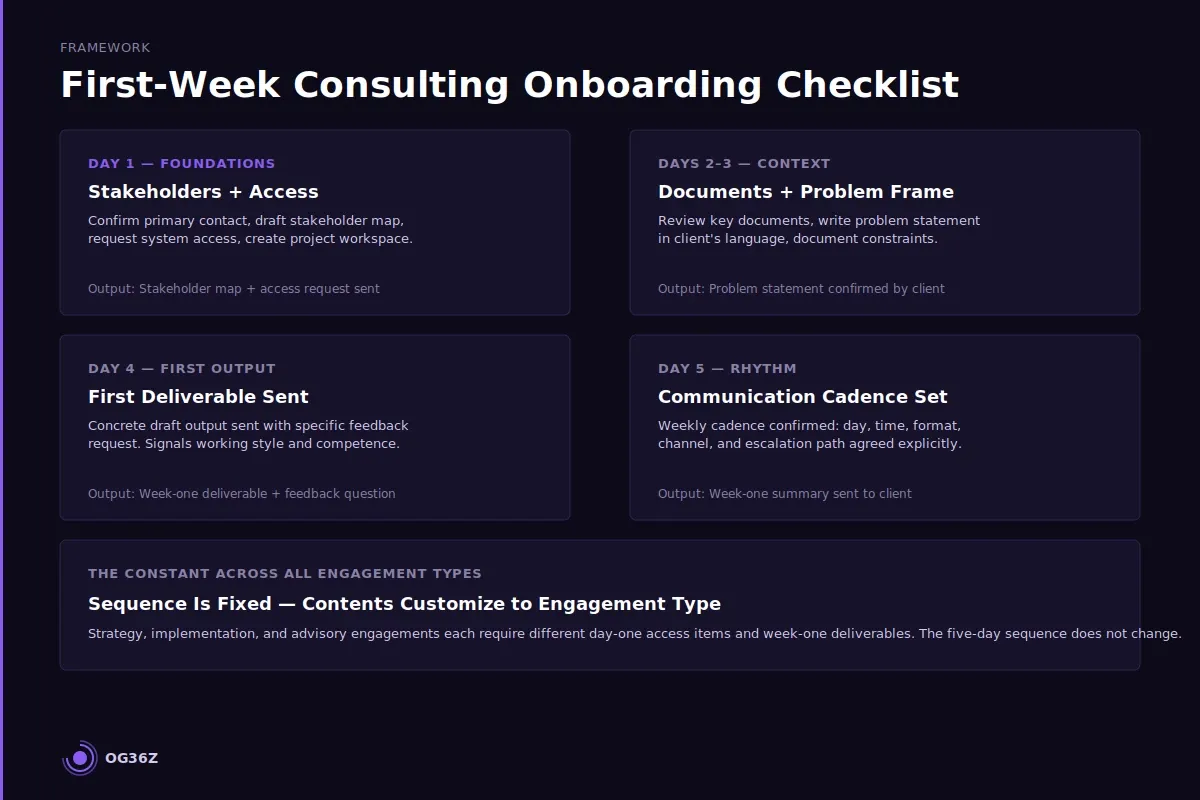
A consulting client onboarding checklist covers five categories across five days: stakeholder and access setup on day one, context capture and document review on days two and three, first deliverable production on day four, and communication cadence confirmation on day five.
The checklist is not a generic to-do list — it is a sequenced set of actions with named outputs and specific completion criteria for each day. Independent consultants who complete all five categories in week one enter week two with full context, established relationships, and a delivered first output that signals competence.
CORE CATEGORIES:
- Stakeholder and access — all contacts confirmed and system credentials received by end of day one
- Context capture — client documents reviewed, problem framed in writing, key constraints documented
- First deliverable — a concrete output delivered by day four that demonstrates immediate value
- Communication rhythm — cadence, channel, and escalation path confirmed before week ends
- Engagement type customization — checklist adapted for strategy, implementation, or advisory scope
The first week of a consulting engagement determines the next twelve. Independent consultants who treat onboarding as a formality will spend the next month correcting first-week gaps.
Sana completes onboarding but misses critical setup items. Access credentials arrive on day eight. The stakeholder map is never built — she discovers who the real decision-makers are during a week-three review meeting. The first deliverable is delayed because two key documents were not shared upfront. None of these failures are catastrophic in isolation. Together, they communicate exactly the wrong thing at exactly the wrong time: that this engagement will require management from the client side.
A structured first-week checklist converts the highest-leverage week of any engagement from reactive setup to proactive capital. Every item on the checklist has a named output and a specific day. Nothing is vague, nothing is aspirational, and nothing carries over to week two.
What is the complete first-week consulting onboarding checklist?
The complete first-week consulting onboarding checklist covers five sequenced categories: stakeholder and access setup, document and context collection, problem framing and analysis setup, first deliverable production, and communication rhythm confirmation. Each category has specific completion criteria — not tasks that can be marked done without a concrete output.
The checklist is organized by day, not by category. Day one is the highest-stakes day. Every item that enables the rest of the week depends on day-one completion.
Day 1: Foundations
- Primary contact confirmed and preferred communication channel established
- Stakeholder map drafted — names, roles, and relationship to primary contact
- System access requested for all required platforms and tools
- Engagement scope reviewed and any ambiguities flagged in writing
- Project workspace created and shared with client
Day 2: Context
- Key documents reviewed — prior reports, strategy decks, data files provided by client
- Problem statement written in client's language, sent to primary contact for confirmation
- Constraints documented — hard deadlines, budget limits, internal approval cycles
- Any missing documents or access items followed up on with specific deadline
Day 3: Analysis Setup
- Research or diagnostic framework selected for the engagement type
- Data sources identified — internal data the client controls plus external benchmarks
- Open questions from document review compiled into a structured list
- First scheduled check-in with primary contact completed
Day 4: First Output
- First concrete deliverable produced and sent to primary contact
- Output framed as a progress signal, not a final product — early delivery, early feedback
- Specific feedback request included: one question the client can answer to improve the next iteration
Day 5: Rhythm Established
- Weekly update cadence confirmed — day, time, format, and channel
- Reporting structure confirmed — who receives updates and in what format
- Escalation path defined — what triggers a call outside the normal cadence
- Week-one summary sent to primary contact: what was completed, what is underway, what is next
See The Client Onboarding Workflow Every Independent Consultant Needs for the full workflow that feeds into this checklist.
What stakeholder and access items must be locked in on day one?
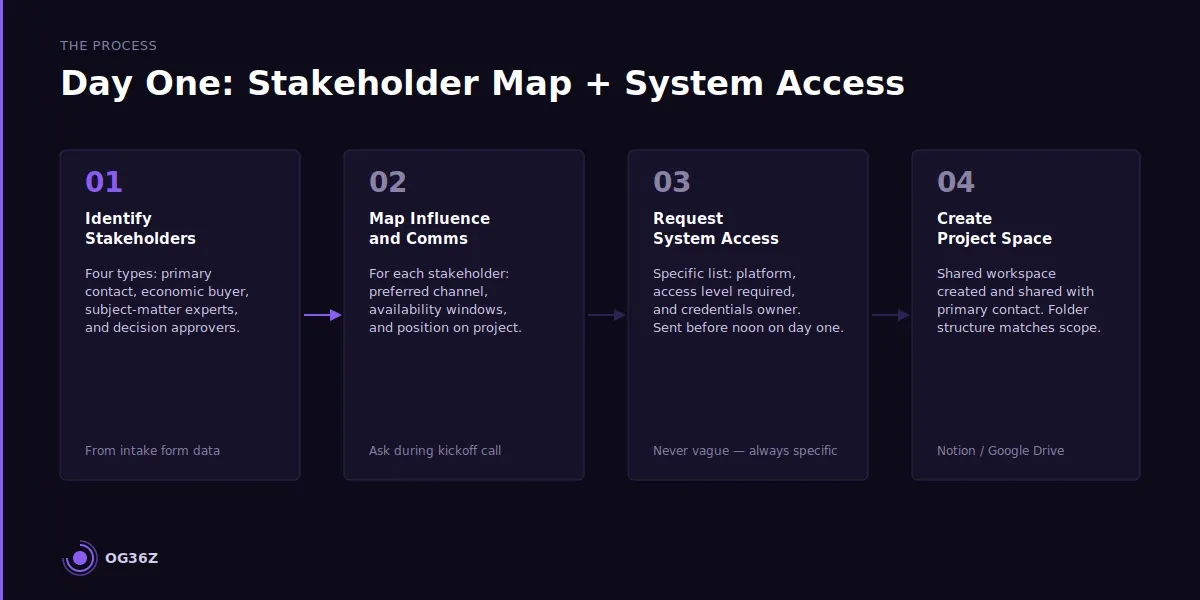
Stakeholder mapping and system access are the two day-one items that enable every other first-week activity. Without the stakeholder map, the consultant does not know who to involve in what decisions. Without system access, analysis and context capture cannot begin. Both items must be complete before the end of day one — not initiated, complete.
Stakeholder mapping is the practice of documenting every person whose input, approval, or awareness affects the engagement. The map is not an org chart — it is an influence map. Three questions define each stakeholder entry:
Who are they and what is their role in relation to the engagement? The primary contact is the person who hired the consultant and manages the day-to-day relationship. The economic buyer is the person who approved the budget — often not the same as the primary contact. Subject-matter experts are the people whose input the consultant needs to produce quality work. Decision approvers are the people who must sign off on deliverables or recommendations.
What is their communication preference and availability? Some stakeholders respond to email within hours. Others are accessible only through the primary contact. The map captures this — not as an afterthought, but as day-one infrastructure. A consultant who discovers on week three that the CFO needs to approve the final recommendation and the CFO reviews documents only once a month has a timeline problem that did not exist until it was too late.
What is their position on the engagement? Early-stage buy-in varies. Some stakeholders are enthusiastic; others are skeptical or indifferent. Knowing this on day one shapes how the consultant frames updates and which proof points to emphasize in early deliverables.
System access covers every platform the consultant needs to access to do the work: data repositories, project management tools, communication channels, reporting systems, and document storage. The specific access list depends on the engagement type. For a strategy engagement, this is typically the client's shared drive and a Slack or Teams channel. For an implementation engagement, it includes production or staging systems, dashboards, and technical documentation. For an advisory engagement, it is often limited to a shared document workspace and calendar access.
The day-one access request should be a specific list — platform name, access level required, and the name of the person who controls the credentials — sent to the primary contact via the agreed communication channel before noon. A vague "please make sure I have the access I need" request generates a vague, delayed response.
See How to Onboard a New Consulting Client in 48 Hours for the intake form field architecture that captures access requirements before day one begins.
How do you capture client context efficiently in the first week?
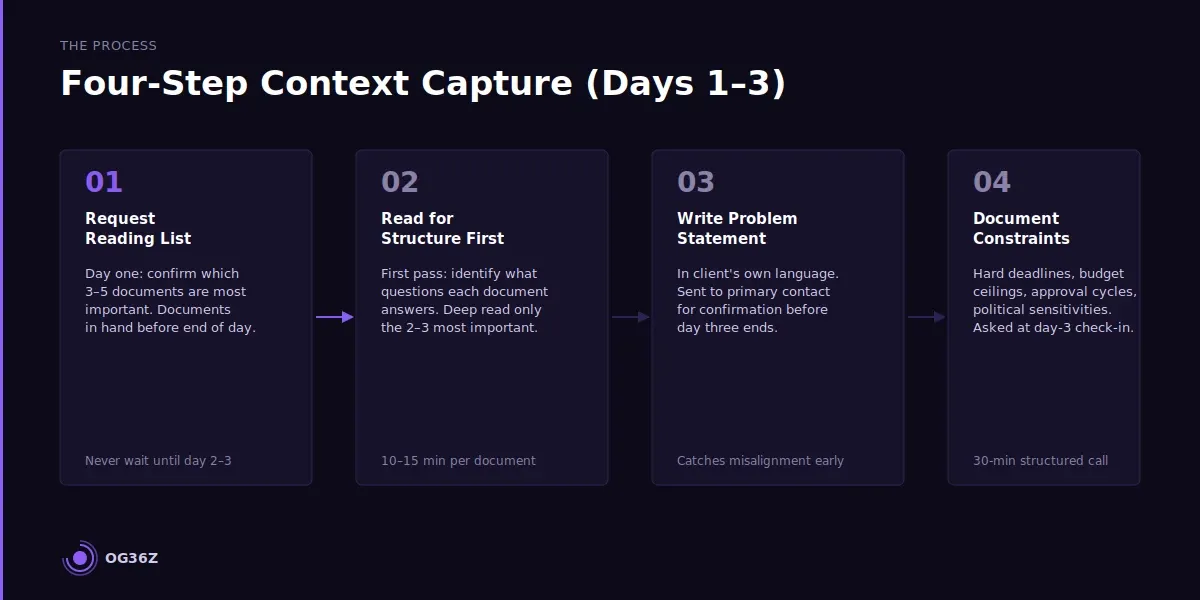
Client context captures efficiently in the first week when the consultant enters day one with a defined reading list and a structured note-taking framework, rather than reading documents in the order they are received and hoping the relevant information surfaces. The goal is to complete primary context capture by end of day three, leaving days four and five for production and communication.
Step 1: Request the reading list on day one, not day three. The intake form submitted before the kickoff call asks for links to relevant documents. The kickoff call confirms which three to five documents are the most important. By end of day one, the reading list is defined and the documents are in hand. Consultants who wait until day two or three to identify what to read lose half of the available context-capture window.
Step 2: Read for structure before reading for content. The first pass through any client document should identify the structure — what questions does this document answer, what decisions does it support, and what assumptions does it rely on. A strategic plan that has never been stress-tested against the market data the client actually has is a different document than one that has. Reading for structure takes 10 to 15 minutes per document; reading for content takes 30 to 60 minutes. Do the structural pass first across all documents, then return for deep reading on the two or three most important ones.
Step 3: Write the problem statement before day three ends. The problem statement is the consultant's synthesis of the client's situation: what the problem is, what is causing it, and what a successful resolution requires. Writing this in the client's language — using terms and frames the client named in the intake form and kickoff call — serves two purposes. First, it forces the consultant to own the problem definition rather than accumulating a general sense of the situation. Second, sending it to the primary contact for confirmation on day three catches misalignments before they are built into the analysis framework.
Step 4: Document constraints before they surface as surprises. Hard deadlines, budget ceilings, internal approval cycles, and political sensitivities are constraints that shape what solutions are viable. Some of these appear in the documents; most are known by stakeholders but not written anywhere. The structured first check-in on day three — a 30-minute call with the primary contact — includes two or three direct questions about constraints: What decisions require leadership approval before implementation? What is the latest this project can deliver and still be on time? What has been tried before and not worked?
See The Client Knowledge System That Prevents Repetitive Work for the Notion-based context capture system that stores and structures this information for reuse across the full engagement.
What deliverables should clients expect to see by the end of week one?
Clients should expect one concrete deliverable by the end of week one — a first output that demonstrates the consultant's understanding of the problem and signals the working style that will define the engagement. The deliverable is not the final product. It is an early proof of competence that earns the client's confidence before the engagement is fully underway.
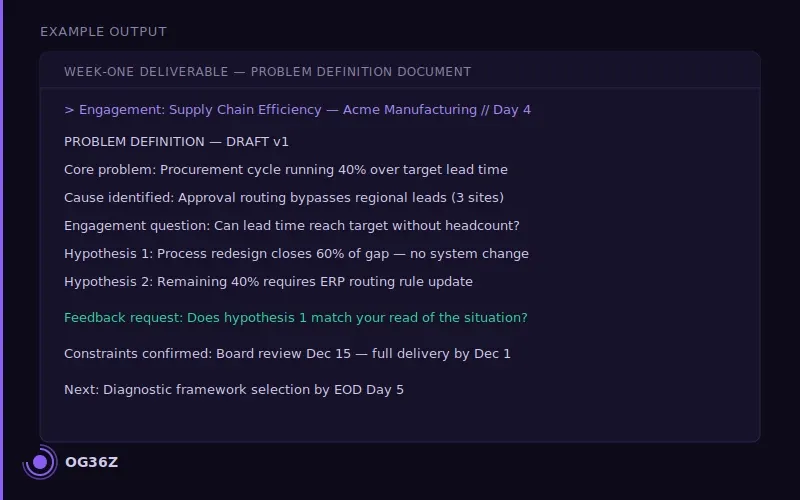
The specific form of the week-one deliverable depends on the engagement type. For a strategy engagement, the week-one output is a problem definition document: a structured summary of the situation, the core question the engagement will answer, and the initial hypotheses that will guide the analysis. For an implementation engagement, the week-one output is a project plan with milestones, owners, and dependencies mapped to the engagement timeline. For an advisory engagement, the week-one output is a summary of the most important things the consultant observed in the first-week documents and conversations, framed as the three to five questions that the engagement will answer.
In every case, the deliverable has four properties:
It is specific. A generic "initial assessment" is not a week-one deliverable. A three-page document titled "Problem Definition: [Client Name] Supply Chain Efficiency" with named hypotheses and a diagnostic framework is.
It is early. Week-one deliverables are drafts, not finals. Sending a draft and requesting specific feedback — "Does this problem framing match your understanding? Is hypothesis two accurate?" — is more valuable than waiting for a polished document in week two.
It is structured. The deliverable uses a format the client can scan in five minutes: a clear headline, a short executive summary, and a structured body organized around questions or hypotheses. Consultants who deliver unstructured prose in week one signal that the client will spend the engagement managing document quality rather than receiving insight.
It is accompanied by a specific feedback request. "Please review and let me know your thoughts" is not a feedback request. "Please confirm that hypothesis two accurately reflects your understanding of the root cause, and flag any constraints we should factor into the diagnostic approach" is.
How do you customize an onboarding checklist for different engagement types?
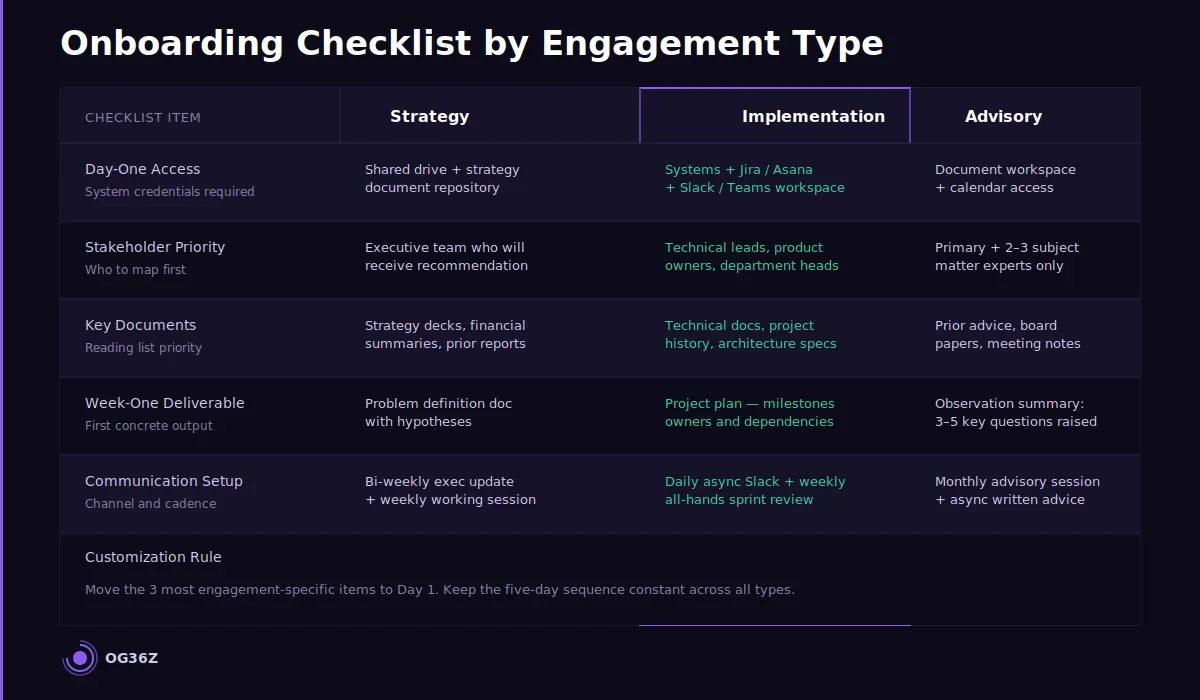
A consulting onboarding checklist customizes to the engagement type by changing which day-one access items, which context documents, and which first deliverable format are relevant. The sequence — stakeholders first, access second, context third, first deliverable fourth, communication fifth — remains constant. The specific contents of each category change significantly based on whether the engagement is strategy, implementation, or advisory.
Strategy engagements prioritize access to the client's strategic planning documents, financial summaries, and prior assessment work. Day-one access requests cover the shared document workspace and any relevant market research repositories. The first-week deliverable is the problem definition document or a refined statement of the strategic question. The stakeholder map includes the executive team members who will receive the final recommendation — they should be identified and their approval criteria understood before the analysis begins.
Implementation engagements prioritize access to technical systems, project management platforms, and cross-functional team contacts. Day-one access requests cover production or staging environments, ticketing systems like Jira or Asana, and the Slack or Teams workspace where the project team communicates. The stakeholder map includes the technical leads, product owners, and department heads whose cooperation is required for delivery. The first-week deliverable is the project plan — milestones, dependencies, and owners named with specific dates.
Advisory engagements prioritize access to the primary contact and the relevant subject-matter experts whose input shapes the advice. Day-one items cover the communication channel for regular advisory sessions and the document workspace where the consultant will deliver written advice. The stakeholder map is smaller — often two or three people — but the communication protocol for each is more important, since advisory relationships depend on trust built through consistent, high-quality communication. The first-week deliverable is the observation summary: the most important things the consultant noticed in the first-week conversations, framed as questions the advisory relationship will address.
The customization principle is: identify the three items most specific to the engagement type and move them to day one. Everything else follows in the standard sequence. A strategy consultant who treats day one like an implementation project will waste time on access requests that are not relevant and miss the strategic document review that is.
Summary
The first week of a consulting engagement is the highest-leverage week for long-term success. A structured checklist converts that week from reactive setup to proactive capital — with specific deliverables for days one through five.
Day one locks in the stakeholder map and system access. Days two and three complete context capture, including the problem statement sent to the client for confirmation. Day four delivers the first concrete output. Day five confirms the communication cadence that governs the rest of the engagement.
The checklist customizes by engagement type — strategy, implementation, and advisory each require different day-one priorities and different week-one deliverables. The constant is structure: every item has a named output, a specific completion day, and a completion criterion that can be verified, not estimated.