
The Client Kickoff System for Independent Consultants
A consulting client kickoff system is a structured data-collection and alignment protocol — not a meeting agenda. Its output is a single reference document both parties confirm before delivery begins.
KEY TAKEAWAYS
- A kickoff meeting without a system produces optimism in the client and uncertainty in the consultant — both leave without shared facts.
- A kickoff system is a structured data-collection and alignment protocol, not a meeting agenda.
- Scope drift is prevented in the kickoff meeting, not during delivery — the questions asked at the start determine the clarity of the entire engagement.
- The output of a kickoff system is a single reference document both parties trust for the duration of the engagement.
What is a consulting client kickoff system?
A consulting client kickoff system is a structured data-collection and alignment protocol that converts the kickoff meeting from a conversation into a binding operational document.
It differs from a kickoff meeting agenda in that it has a defined output — a shared reference document capturing project scope, success criteria, working rhythm, and decision authority — not just a sequence of topics to discuss.
A kickoff system prevents scope drift, misalignment, and week-two re-alignment calls by ensuring both parties leave the meeting with the same documented understanding of what the engagement is and is not.
CORE COMPONENTS:
- Pre-kickoff intake — structured questions that surface client context before the meeting
- Kickoff agenda template — a protocol that produces a usable output document, not just a conversation
- Context-unlocking questions — specific questions that surface information the client assumes the consultant already knows
- Shared reference document — the single output both parties sign off on at the end of the kickoff
- Post-kickoff follow-up sequence — the steps that lock in shared understanding within 24 hours
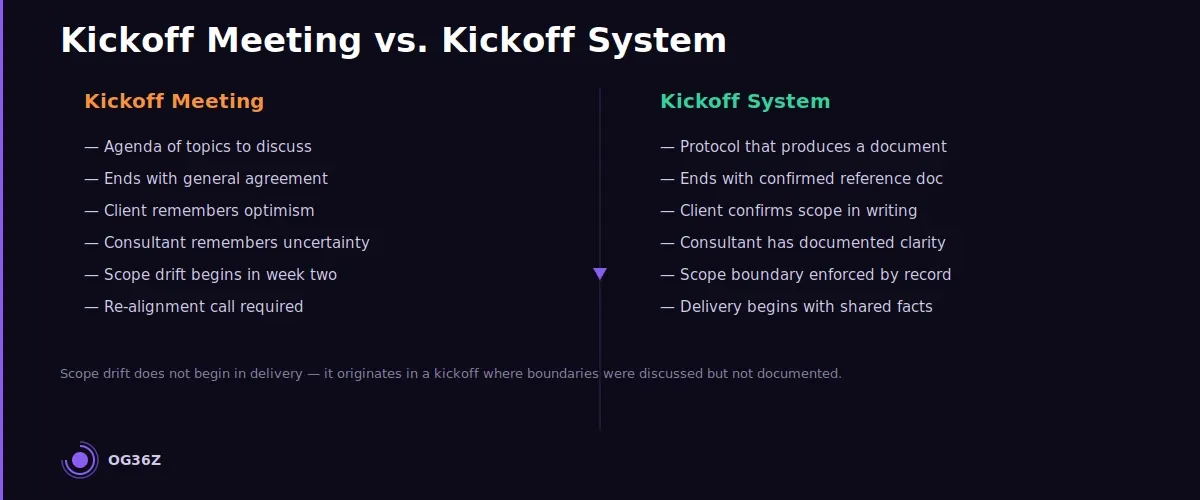
A consulting kickoff meeting without a system is just a conversation. The client leaves optimistic; the consultant leaves uncertain. A kickoff system converts that conversation into a binding operational document.
Sana, an independent strategy consultant billing $200 per hour, approaches each kickoff meeting without a fixed structure. She covers different topics with different clients depending on what comes up in conversation. With one client, she spends forty minutes on stakeholder context. With another, she never clarifies the definition of done. Both meetings feel productive. Neither produces a document that either party trusts in week three when the scope discussion resurfaces.
The re-alignment conversation in week two costs Sana two to four hours of non-billable time. At her rate, that is $400 to $800 in recovered work she never invoices. The cost does not appear on any invoice — it appears in margin compression, client friction, and engagements that feel harder than they should.
The kickoff system exists to prevent this.
What is a client kickoff system and how does it differ from a kickoff meeting?
A client kickoff system is a structured data-collection and alignment protocol that converts a kickoff meeting from a conversation into a binding operational document. It differs from a kickoff meeting in that it has a defined output requirement — not just a sequence of topics, but a completed document that both parties review and confirm before the call ends.
A kickoff meeting, as most consultants conduct it, is an agenda of topics. The consultant introduces themselves, the client explains the context, they discuss the project, they agree on next steps. The meeting ends. Neither party has a written record of what was agreed. Within two weeks, their recollections diverge.
A kickoff system treats the meeting as a data-collection exercise with a document as its output. The agenda is structured to extract specific information in a specific sequence. The consultant fills in a pre-built template during the meeting. By the time the call ends, the document exists and can be sent to the client for confirmation within 24 hours.
The distinction matters because consulting scope drift — the expansion of client expectations beyond what was agreed — almost always originates in a kickoff meeting where the boundaries were discussed but not documented. Discussed boundaries are remembered differently by the two parties, especially when business pressure increases. Documented boundaries survive that pressure.
See The Client Onboarding Workflow Every Independent Consultant Needs for how the kickoff system fits within the broader onboarding architecture.
What must a solo consultant establish in every kickoff to prevent scope drift?
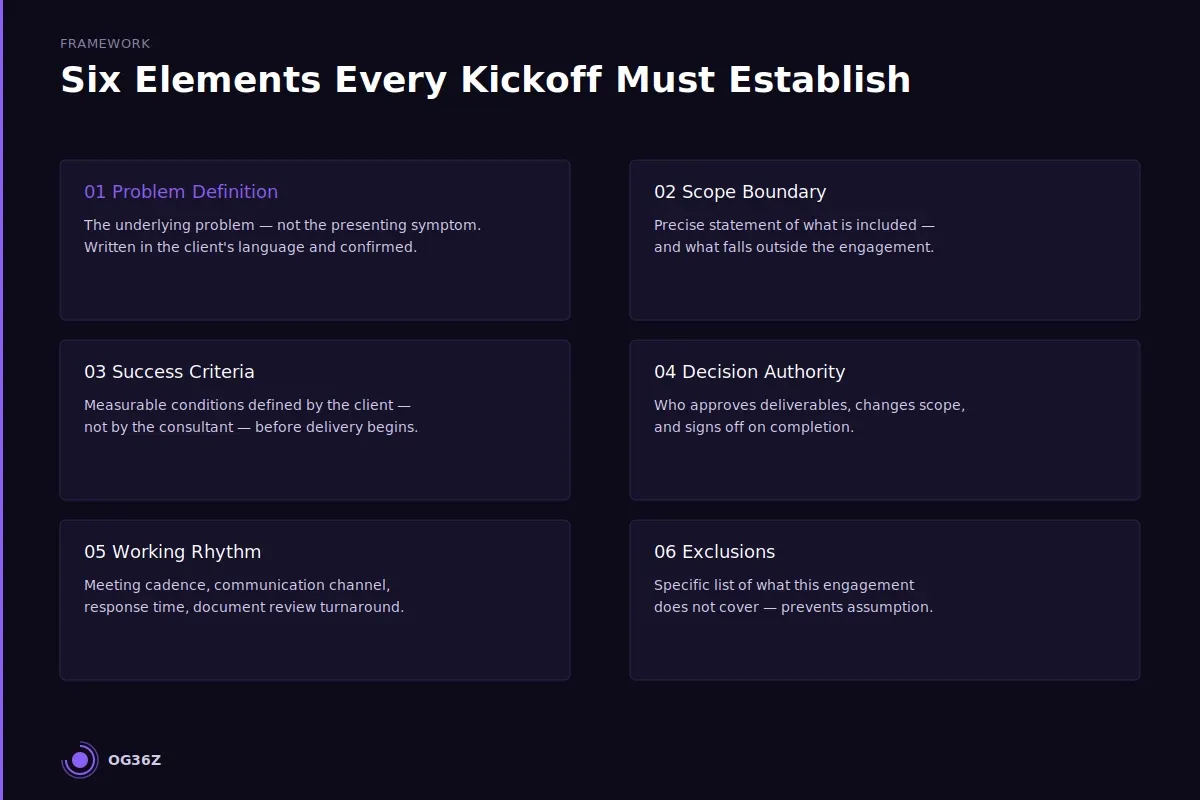
A solo consultant must establish six things in every kickoff to prevent scope drift: the problem definition, the scope boundary, the success criteria, the decision authority, the working rhythm, and the exclusions. These six elements, documented and confirmed, make scope drift structurally difficult — any request that falls outside the documented scope is immediately visible to both parties.
Each element handles a specific failure mode:
Problem definition. The specific problem this engagement is addressing, in writing. Not the presenting symptom — the underlying problem. A client who says "we need a new strategy" may mean they need a market analysis, a competitive response, or an organizational change. The kickoff system forces this to be specific before delivery begins.
Scope boundary. A precise statement of what is included in this engagement. Not a list of deliverables — a boundary that describes what falls inside and outside the work. "This engagement covers the market entry analysis for the APAC region and excludes implementation planning" is a scope boundary. "We will help you with the strategy" is not.
Success criteria. The specific, measurable conditions under which both parties will agree this engagement was successful. These criteria must be defined by the client, not the consultant. A consultant who defines their own success criteria has no accountability — a client who defines theirs does. The kickoff system requires the client to name the conditions before delivery begins.
Decision authority. Who inside the client organization has the authority to approve deliverables, change scope, and sign off on completion? Solo consultants frequently begin delivery before establishing this and later discover the person they have been working with cannot approve the final output. The kickoff meeting is the only efficient moment to establish this before the problem surfaces.
Working rhythm. Meeting cadence, communication channel, response time expectations, and document review turnaround. These are administrative, but their absence generates friction that accumulates across the engagement.
Exclusions. A specific list of what this engagement does not cover. Exclusions are as important as inclusions — they prevent the client from reasonably assuming that adjacent work is included. See How to Onboard a New Consulting Client in 48 Hours for the rapid-onboarding version of this scope-setting process.
How do you structure the kickoff agenda to produce a usable output document?
A kickoff agenda produces a usable output document when each agenda section maps directly to a field in the kickoff reference document, so the consultant fills in the document during the meeting rather than reconstructing it from notes afterward.
The structural principle is that the agenda is a form, not a script. Each section of the agenda asks a question that has a specific answer. The consultant records the answer in real time. By the end of the meeting, the document is populated. Nothing requires post-meeting reconstruction.
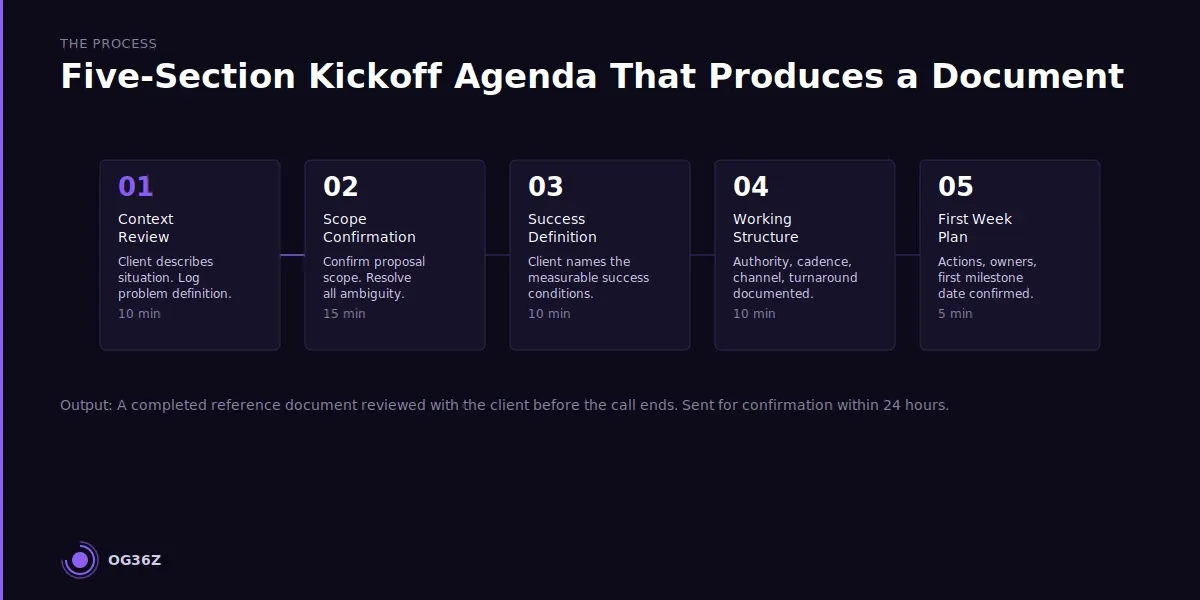
A five-section kickoff agenda that produces a complete reference document:
Section 1: Context review (10 minutes). The client describes the situation in their own words. The consultant listens and records: the presenting problem, the business context, the prior attempts to address it, and the urgency driver. This section produces the problem definition field in the reference document.
Section 2: Scope confirmation (15 minutes). The consultant presents the scope as written in the proposal and asks the client to confirm, adjust, or challenge it. Any changes are recorded. Any areas of ambiguity are resolved. This section produces the scope boundary and exclusions fields.
Section 3: Success definition (10 minutes). The consultant asks the client to describe what success looks like at the end of the engagement. What will be true that is not true today? How will they know this engagement delivered value? The client's answers become the success criteria field.
Section 4: Working structure (10 minutes). Decision authority, meeting cadence, communication channel, document review turnaround, escalation path. These are covered systematically, not conversationally. Each question has a field in the document. When answered, it is recorded.
Section 5: First week plan (5 minutes). The specific actions for the first seven days, who is responsible for each, and the date of the first milestone review. This section closes the meeting with a shared operational plan, not a general sense of direction.
At the end of the meeting, the consultant reviews the completed document with the client and confirms that each field accurately reflects what was discussed. The document is sent within 24 hours for written confirmation.
What questions unlock the client context that prevents future misalignment?
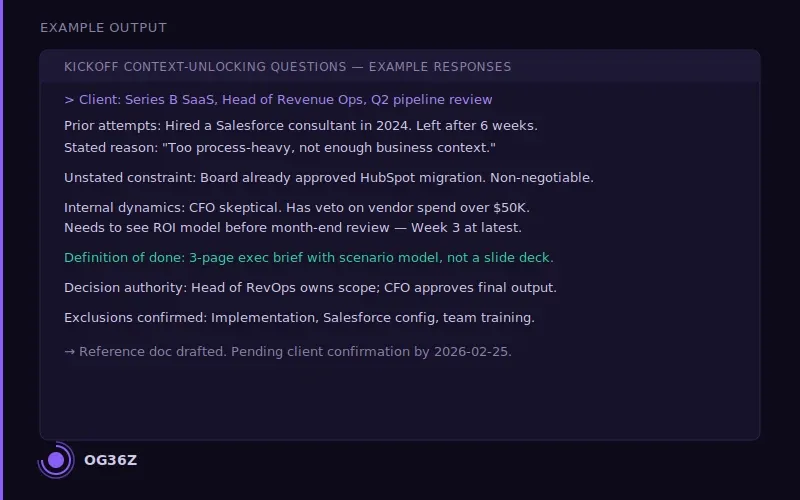
The questions that unlock the client context that prevents future misalignment are the ones that surface information the client assumes the consultant already knows — organizational dynamics, prior failed attempts, internal politics, and unstated constraints that never appear in the brief but shape every deliverable.
Most misalignment in consulting engagements does not originate in disagreement. It originates in assumption. The client assumes the consultant understands their organizational constraints. The consultant assumes the client has authority over the decisions their deliverable will inform. Neither assumption is stated. Both are wrong.
Four categories of context-unlocking questions:
Prior attempts. "What has already been tried to address this problem, and what happened?" This question surfaces the failure modes that a new approach must avoid. A client who has already hired two consultants for the same problem has specific and often unstated requirements for what this engagement must do differently.
Unstated constraints. "Are there decisions that have already been made that this work needs to work around?" A client who has already selected a vendor, committed to a timeline, or made a board-level promise will not always disclose this upfront. Asking directly surfaces constraints that would otherwise derail a deliverable in review.
Internal dynamics. "Who inside your organization has the strongest opinion about how this problem should be solved, and how does their view differ from yours?" This question identifies the internal stakeholder whose opposition can block approval of the final deliverable — and whose perspective the work needs to account for.
Definition of done. "If this engagement ends and you have exactly what you need, what does that document or output look like?" This question forces the client to specify the format, level of detail, and practical use case of the deliverable. It is different from success criteria — success criteria define the outcome, definition of done defines the output format.
These questions are embedded in the kickoff agenda as structured prompts, not improvised as conversation permits.
How do you follow up after a kickoff to lock in shared understanding?
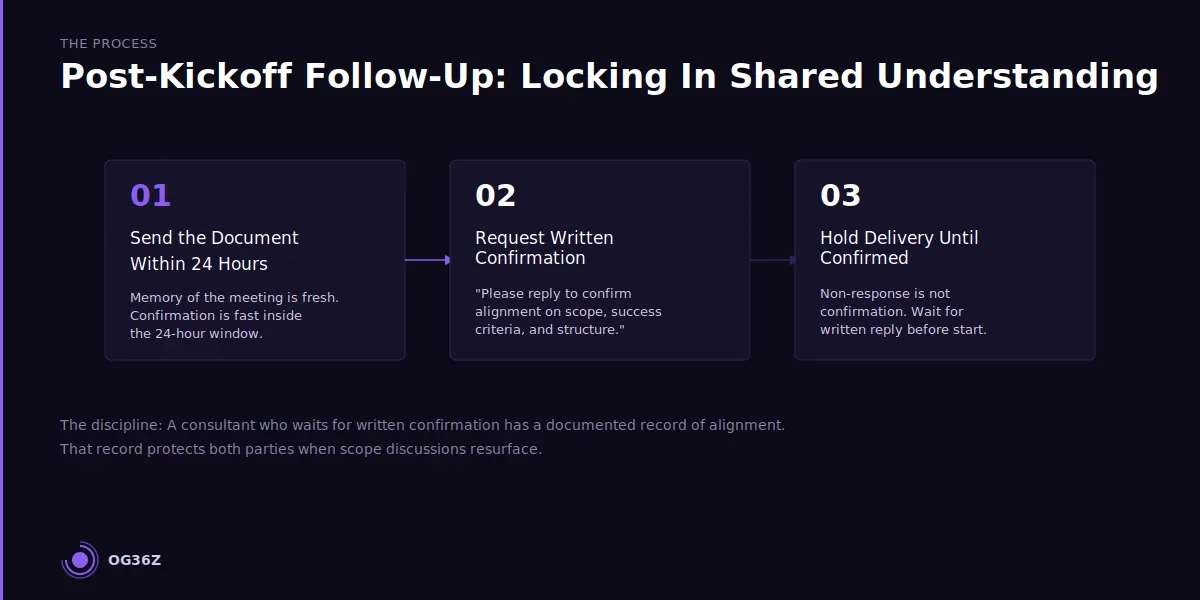
Following up after a kickoff to lock in shared understanding requires sending the completed kickoff reference document within 24 hours and requesting written confirmation from the client before delivery work begins. The follow-up is not a courtesy — it is the step that converts a verbal agreement into a documented one.
The 24-hour window matters. Within that window, the client's memory of the meeting is fresh and confirmation is fast. Beyond 48 to 72 hours, the client has moved on, the meeting has faded, and confirmation requests feel like administrative overhead rather than operational clarity.
The follow-up sequence has three steps:
Step 1: Send the document within 24 hours. The kickoff reference document — populated during the meeting — is sent to the primary client contact with a cover note: "This document captures what we aligned on in today's kickoff. Please review and confirm that each section accurately reflects our shared understanding. If anything is unclear or needs adjustment, let me know by [date]."
Step 2: Request specific written confirmation. The request is not "let me know if you have any questions." It is "please reply to confirm you are aligned on the scope, success criteria, and working structure as documented." Confirmation requires the client to read the document. A non-response is not confirmation.
Step 3: Do not begin delivery work before confirmation is received. This is the discipline that makes the follow-up functional rather than procedural. A consultant who begins delivery before written confirmation has no protection if the client later contests the scope. A consultant who waits for confirmation has a documented record of alignment that protects both parties. See Status Updates, Milestones, and Client Communication: A System for Independent Consultants for how the kickoff document integrates with ongoing client communication throughout the engagement.
Summary
A consulting client kickoff system is a structured data-collection and alignment protocol — not a meeting agenda. Its output is a single reference document both parties confirm before delivery begins.
The six elements that prevent scope drift are problem definition, scope boundary, success criteria, decision authority, working rhythm, and exclusions. The kickoff agenda is structured so each section maps directly to a field in the reference document, which the consultant completes in real time during the meeting.
Context-unlocking questions surface prior attempts, unstated constraints, internal dynamics, and the client's definition of done. The follow-up sequence sends the document within 24 hours and requires written confirmation before delivery work begins.
Sana's week-two re-alignment conversations disappear when the kickoff produces a document that both parties already confirmed. The engagement does not get easier because the consultant is more skilled — it gets easier because the scope is documented and both parties own it.