
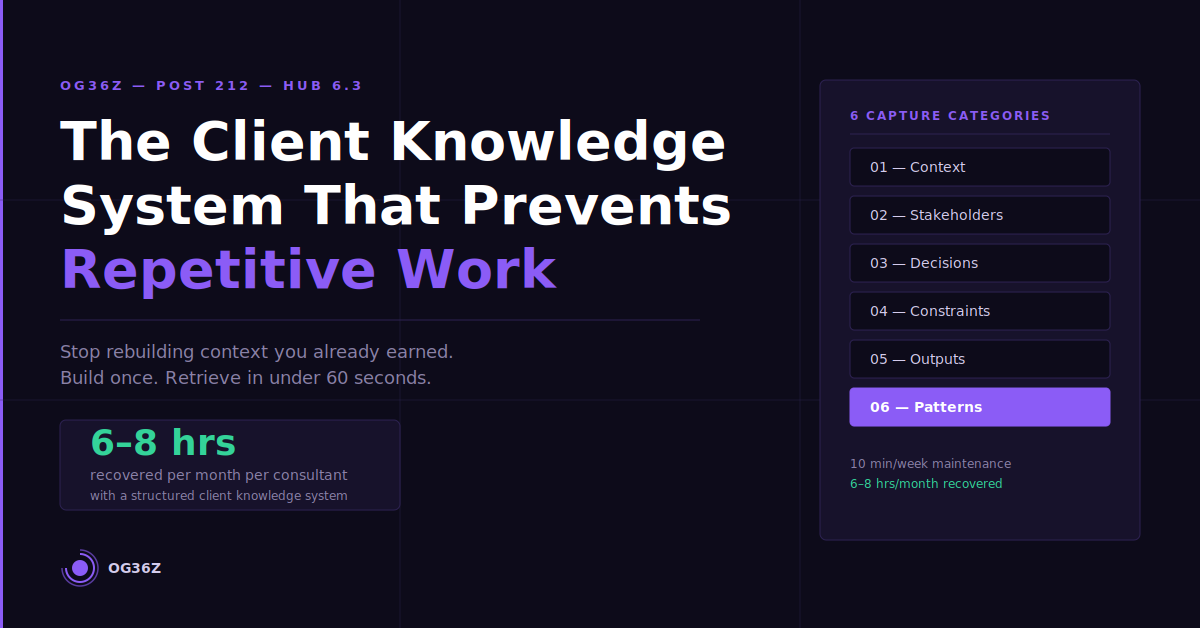
The Client Knowledge System That Prevents Repetitive Work
A client knowledge system is a per-client repository of structured information that makes every future interaction faster, sharper, and more credible.
KEY TAKEAWAYS
- Without a client knowledge system, solo consultants rebuild the same mental models repeatedly — costing 3–5 hours per new engagement
- A client knowledge system is not a CRM. It is a structured capture of decisions, context, and outputs for each client relationship
- The retrieval architecture matters more than the capture volume — what you store is useless if you cannot find it in under 60 seconds
- Maintenance takes under 10 minutes per week when the system is structured around natural work rhythms
What is a client knowledge system for consultants?
A client knowledge system is a structured repository that captures and organizes everything a solo consultant learns about each client — their goals, constraints, decisions, stakeholder dynamics, and past outputs — so that knowledge is immediately accessible during future work. It prevents the tax of rebuilding context from scratch every time you re-engage.
CORE TERMS:
- Client knowledge system — a per-client structured capture of context, decisions, and deliverables
- Context tax — time spent reconstructing understanding you have already developed
- Retrieval architecture — how your system is organized so you find things fast, not just stores them
- Engagement log — a chronological record of work sessions, decisions, and outputs per client
- Stakeholder map — structured notes on decision-makers, influencers, and their positions
- Knowledge artifact — any reusable output: frameworks, templates, analysis, scripts
You took a call with a client you worked with two years ago. They need something adjacent to what you delivered before. You know the organizational dynamics shaped the outcome — but the details are gone. You spend the next three hours reconstructing what you already knew.
That is not a memory problem. That is the absence of a system.
Solo consultants do not have the institutional infrastructure that large firms use to retain client context. No account team. No CRM maintained by a support staff. No knowledge base curated by analysts. What you know lives in your head, your inbox, and a folder structure you improvised during a busy quarter.
The client knowledge system is the answer to that gap. Not a complex tool. Not a new subscription. A deliberate structure for capturing, organizing, and retrieving everything that matters about each client relationship — so your past work funds your future work.
What is a client knowledge system and why do solo consultants need one?
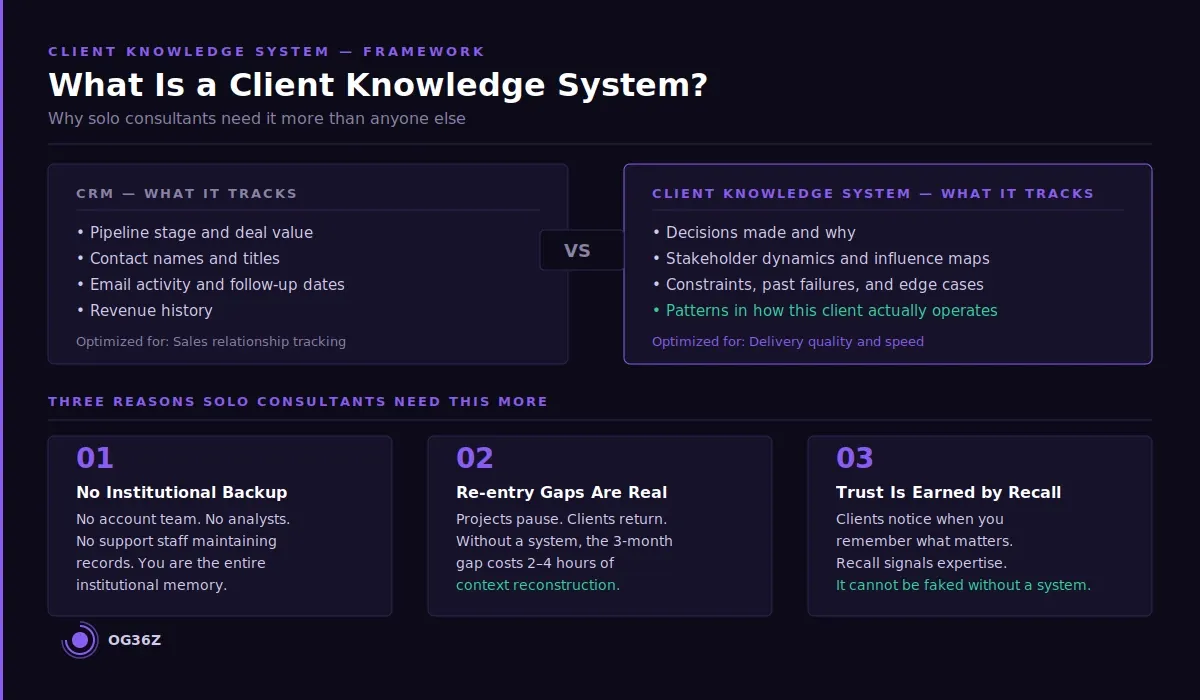
A client knowledge system is a per-client repository of structured information that makes every future interaction faster, sharper, and more credible.
It is distinct from a CRM, which tracks pipeline and contact data. A client knowledge system tracks understanding — what you know about how this client operates, what they care about, what you have tried, and what worked.
Solo consultants need this more urgently than any other type of practitioner. You do not have colleagues to debrief. You do not have analysts to synthesize. You are the entire institutional memory of every engagement you run. When that memory is stored only in your head, it degrades. When it is externalized and structured, it compounds.
The practical consequence shows up fast. A consultant with a client knowledge system re-engages in 20 minutes. One without it spends half a day reconstructing context, reviewing old emails, and trying to remember what the CFO's actual concern was underneath the stated one.
There is also a trust dimension. Clients notice when you arrive prepared — when you reference a constraint they mentioned six months ago, when you do not make them repeat their org structure, when your recommendations account for decisions already made. That kind of recall signals expertise. It is difficult to fake. With a system, it is not difficult at all.
What should a client knowledge system capture for each engagement?
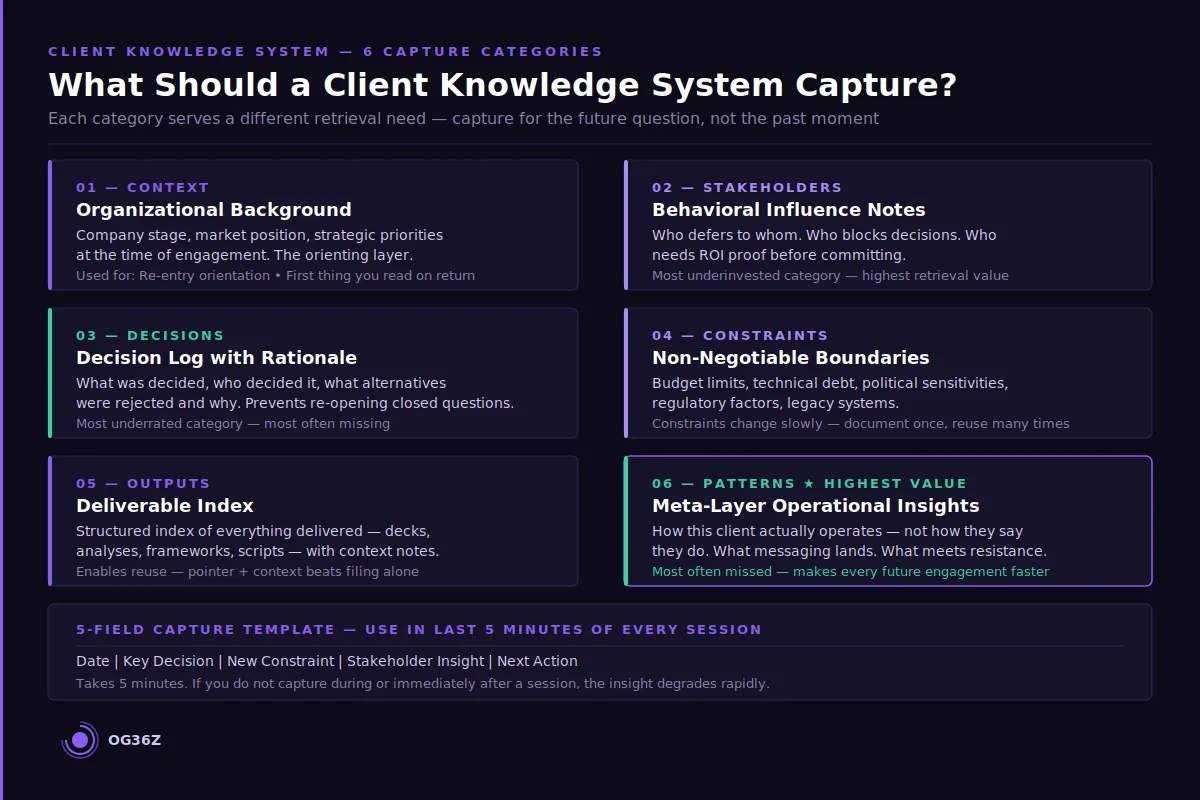
A client knowledge system should capture six categories of information: context, stakeholders, decisions, constraints, outputs, and patterns. Each category serves a different retrieval need.
Context covers the organizational background — company stage, market position, internal dynamics, strategic priorities at the time of engagement. This is the orienting layer. When you re-engage six months later, context is the first thing you need to reconstruct.
Stakeholders means structured notes on everyone who shapes outcomes. Not just names and titles — actual behavioral notes. Who defers to whom. Who blocks decisions. Who champions new approaches. Who needs to see ROI before committing. This is where most consultants underinvest, and where the retrieval value is highest.
Decisions is a chronological log of every significant choice made during the engagement — what was decided, who decided it, what alternatives were rejected, and why. This is the most underrated category. Decisions made three months ago often constrain options today, and without a record, both you and your client will revisit closed questions.
Constraints captures the non-negotiable boundaries: budget limits, technical debt, political sensitivities, regulatory factors, legacy systems. Constraints change slowly. Documenting them once pays dividends across multiple engagements.
Outputs is a structured index of everything you have delivered — decks, analyses, frameworks, scripts, templates. Not the files themselves necessarily, but pointers to them with enough context to know when they are relevant again.
Patterns is the most valuable and most often missed category. What did you learn about how this client actually operates — as distinct from how they say they operate? What communication style landed? What approaches met resistance? Patterns are the meta-layer that makes every future engagement faster.
How do you structure client knowledge so it is retrievable, not just stored?
Retrieval architecture is where most client knowledge systems fail. Consultants capture notes during an engagement, then cannot find the relevant insight six months later. The problem is almost never the tool. It is the structure.
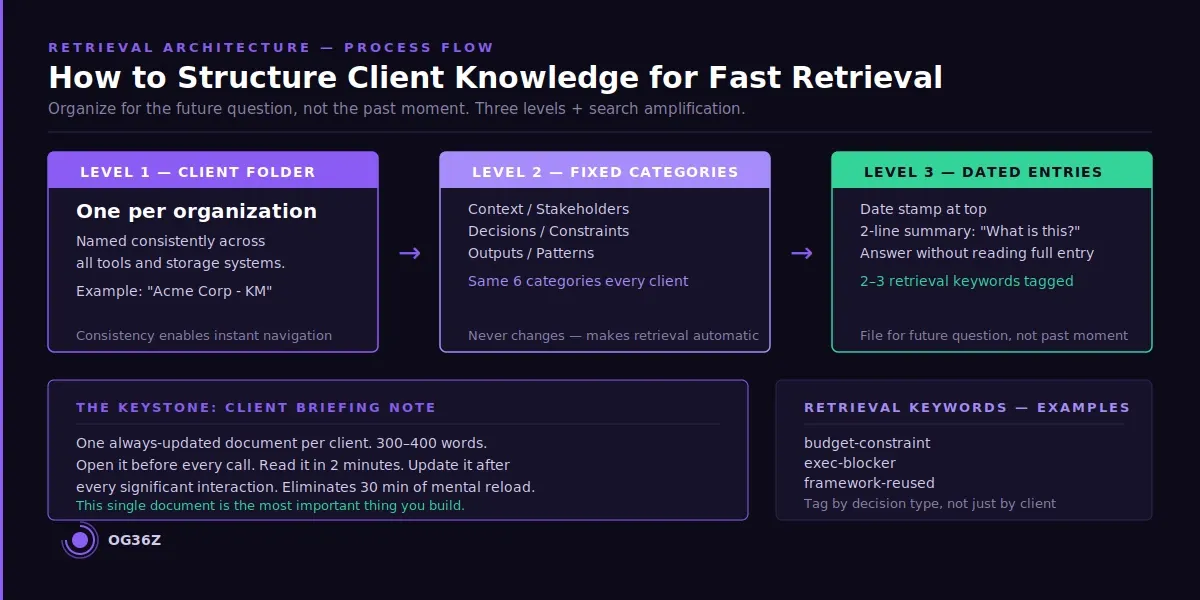
The principle is: organize for the future question, not the past moment. When you capture something, ask yourself what question you will be trying to answer when you need this. Then file and tag it for that question, not for the date or project phase when it happened.
A practical structure has three levels. The first level is the client folder — one per organization, named consistently. The second level is fixed categories within each client folder: Context, Stakeholders, Decisions, Constraints, Outputs, Patterns. These never change regardless of the client. Consistency here is what makes retrieval automatic. The third level is dated notes within each category — entries with a date stamp and a two-line summary at the top that answers "what is this?" without requiring you to read the whole entry.
Search amplifies structure. Every significant note should include two or three keywords that represent the retrieval question — not just what the note is about, but what you would type if you were looking for it later. Tags like "budget-constraint," "exec-blocker," "framework-reused" make the system searchable by decision type, not just by client.
One additional structural element changes retrieval speed significantly: a client briefing note. A single, always-updated document per client that synthesizes the most important current context in 300–400 words. This is the first thing you open before any client call. It takes two minutes to read. It eliminates the first 30 minutes of mental context-loading. You update it after every significant interaction.
How do you maintain a client knowledge system without it becoming another burden?
The maintenance failure mode is real. Consultants build an elaborate system, use it heavily for two months, then stop capturing because delivery pressure is too high. Six months later, the system is a ghost town and they are back to rebuilding context from scratch.
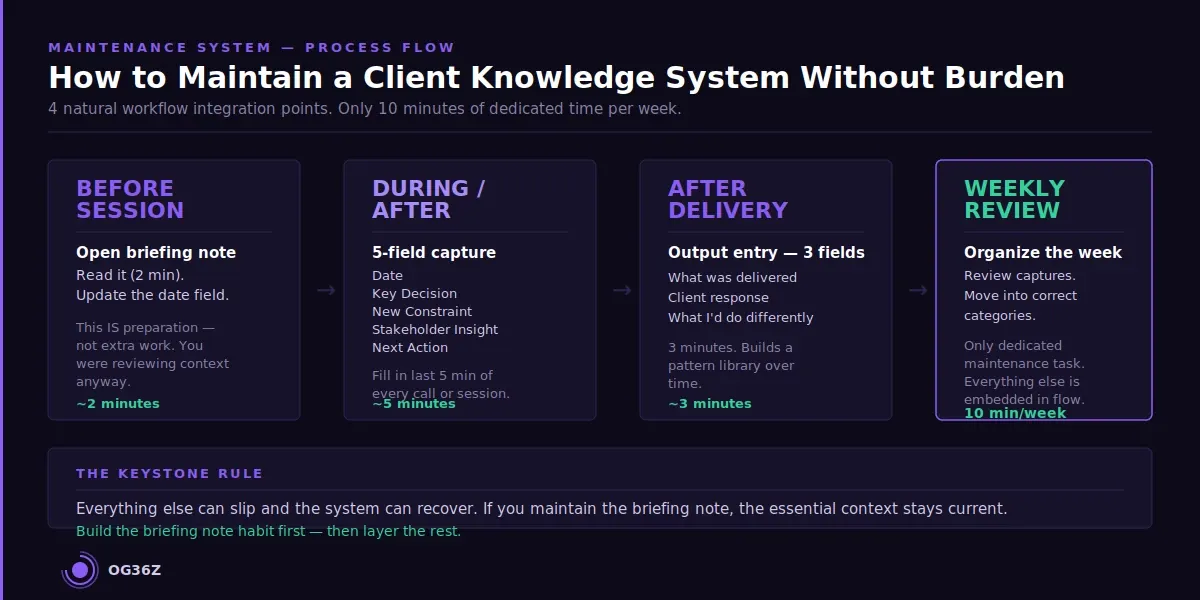
Maintenance works when it is integrated into existing workflow moments rather than added as a separate practice. There are four natural integration points that cover 90% of what the system needs.
Before each client session: open the client briefing note. Read it. Update the date field at the top. This is not a maintenance task — it is preparation. You would be reviewing context anyway. The system just makes it structured.
During sessions: use a capture template with five fields — Date, Key Decision, New Constraint, Stakeholder Insight, Next Action. Fill this in the last five minutes of every call or working session. Five minutes. If you do not capture during or immediately after, the insight degrades rapidly.
After deliverables: add an output entry with three fields — What was delivered, What the client response was, What I would do differently. This takes three minutes and builds a pattern library over time.
Weekly: spend 10 minutes reviewing captures from the week and moving anything actionable into the appropriate category. This is the only dedicated maintenance task. Ten minutes per week is the cost of a system that saves hours per engagement.
The briefing note is the keystone habit. Everything else can slip and the system can recover. If you maintain the briefing note, the essential context stays current. Build the discipline around that single document first.
How does a client knowledge system reduce repetitive work across engagements?
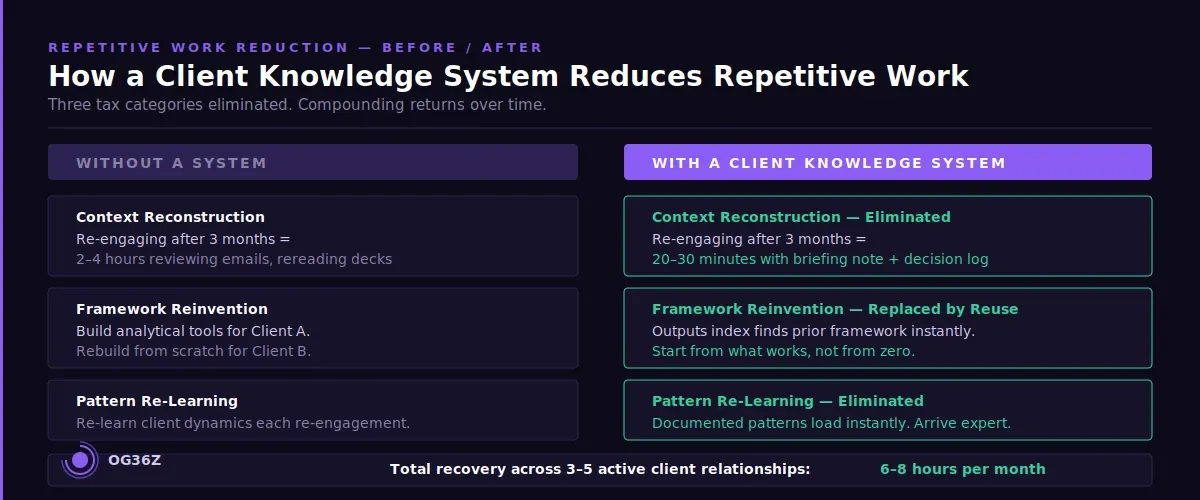
The repetitive work tax for solo consultants has three components: context reconstruction, framework reinvention, and pattern re-learning. A client knowledge system addresses all three.
Context reconstruction is the most visible cost. Without a system, a consultant re-engaging with a client after three months spends 2–4 hours reviewing emails, rereading decks, and trying to remember organizational details. With a client briefing note and structured decision log, that time drops to 20–30 minutes. Across a practice running three to five active client relationships, this recovery compounds to 6–8 hours per month.
Framework reinvention is more subtle. Solo consultants frequently build analytical frameworks, communication templates, and diagnostic tools for one client — then rebuild something similar from scratch for the next. An outputs index with sufficient context notes makes reuse fast. The framework already built for a client in retail should be the starting point for the next retailer, not an afterthought.
Pattern re-learning is the highest-leverage benefit. When you have documented how a client makes decisions, what messaging resonates with their leadership team, and what approaches have failed — you arrive at every subsequent engagement with strategic insight that would take a new consultant weeks to develop. You are not smarter. You are better equipped.
The compounding effect is significant. A consultant running a client knowledge system for two years has accumulated retrieval-ready institutional knowledge across every relationship they have managed. That knowledge is a competitive moat. It produces better recommendations with less effort. It justifies higher rates. It reduces the anxiety of re-entry after gaps.
A system that takes 10 minutes per week to maintain and returns 6–8 hours per month is not overhead. It is leverage.
Summary
A client knowledge system is not a documentation exercise. It is the mechanism by which solo consultants turn individual engagements into compounding institutional intelligence.
The system captures six categories — context, stakeholders, decisions, constraints, outputs, and patterns — and organizes them for retrieval rather than storage. The briefing note is the keystone habit. The weekly 10-minute review is the only dedicated maintenance task. The payoff is 6–8 hours per month in recovered time, sharper recommendations, and a trust signal to clients that their consultant remembers what matters.
Start with one client. Build the briefing note. Add the capture template. Run it for four weeks before expanding. The system compounds. The sooner it starts, the more it returns.
For foundational knowledge management principles, see Post 210 (knowledge-management-independent-consultants). For building the broader second brain that houses client knowledge, see Post 211 (second-brain-solo-consulting). For constructing and maintaining a consulting knowledge base over time, see Post 214 (consulting-knowledge-base-build-maintain).