
How to Capture and Reuse Institutional Knowledge as a Solo Consultant
Institutional knowledge is the understanding that comes from doing — not from reading or training.
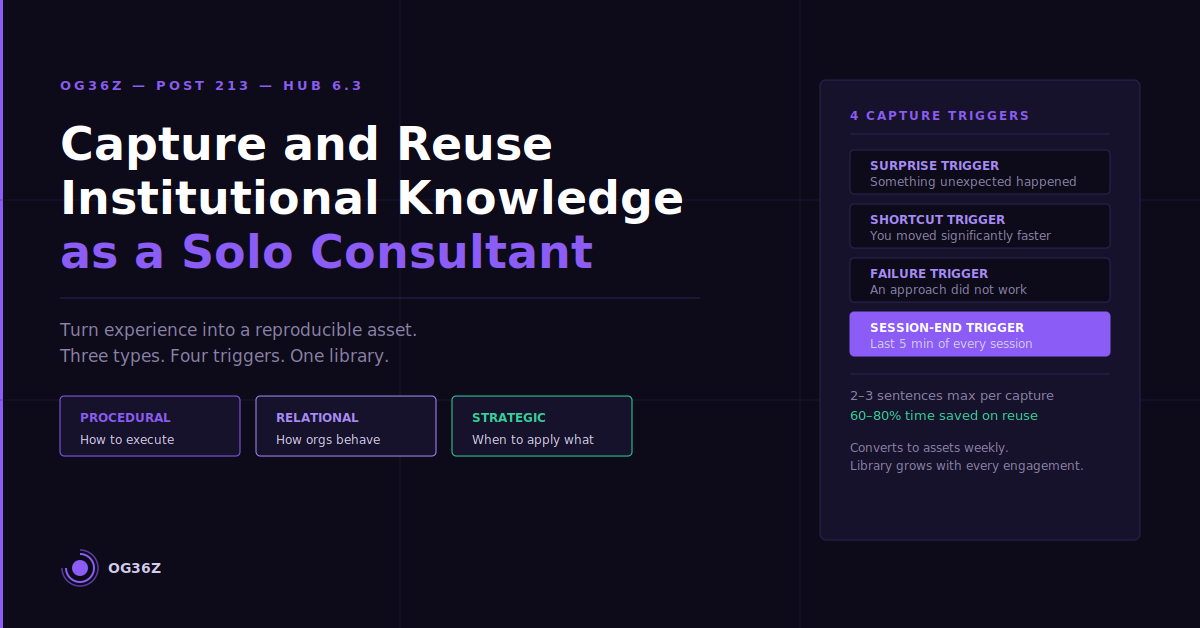
KEY TAKEAWAYS
- Institutional knowledge is not the same as documentation — it includes tacit patterns and judgment calls that never make it into deliverables
- Solo consultants accumulate institutional knowledge faster than large firm consultants but have no system to retain it
- The three types worth capturing are procedural, relational, and strategic — each requires a different capture method
- Reuse is not copy-paste — it is the structured application of prior insight to a new context, saving 60–80% of the time on recurring problem types
What is institutional knowledge for solo consultants and why does it matter?
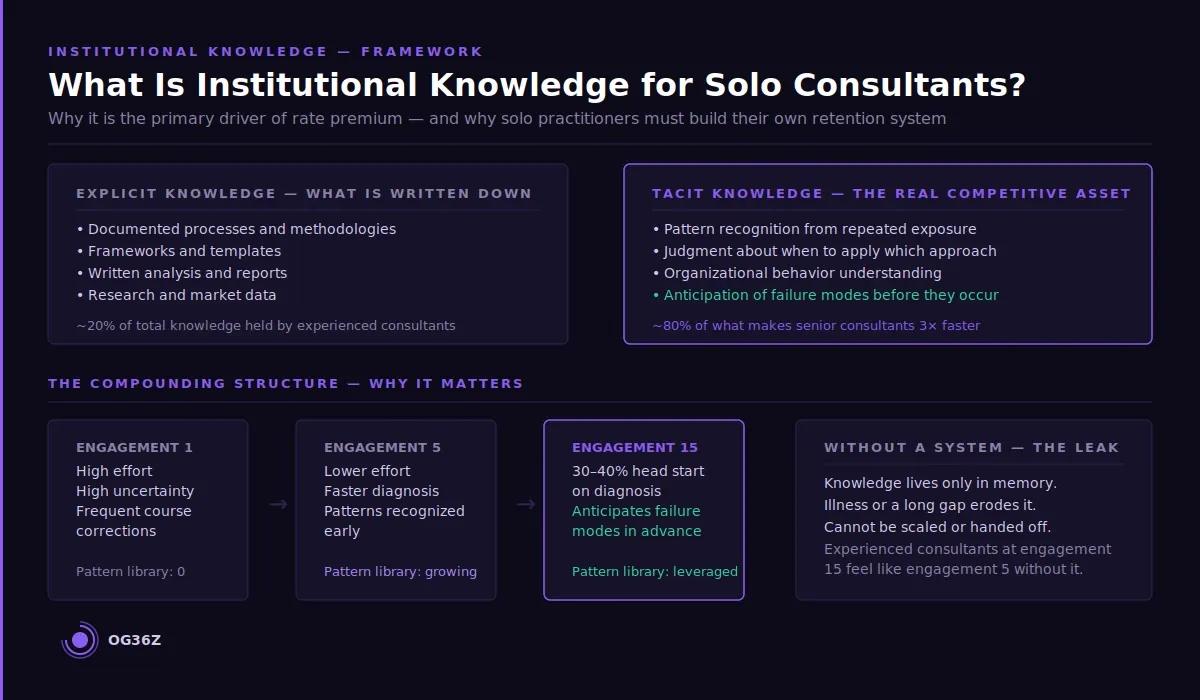
Institutional knowledge for solo consultants is the accumulated understanding of how specific industries, clients, and problem types actually work — including the patterns, exceptions, and judgment calls that experience builds but documents rarely capture. It matters because it is the primary driver of why experienced consultants charge more and deliver better outcomes than junior ones.
CORE TERMS:
- Institutional knowledge — accumulated understanding built through experience across engagements
- Tacit knowledge — knowledge that exists in practice but is difficult to articulate or document
- Explicit knowledge — knowledge that can be captured, written down, and shared directly
- Knowledge artifact — any reusable asset created from captured knowledge: template, framework, checklist
- Procedural knowledge — how to do something; step-by-step operational understanding
- Relational knowledge — how people and organizations actually behave, not how they say they do
- Strategic knowledge — when and why to apply which approach in which context
You have solved this problem before. Not this exact instance — but the same underlying structure. The same organizational resistance. The same technical constraints. The same stakeholder dynamics playing out in a new context.
You know this. You can feel it in the speed of your diagnosis. You reach for the same mental models. You anticipate the objections. You know which approach will land and which will meet resistance before you have said a word.
That judgment — that compressed, pattern-matched recognition — is institutional knowledge. It is the actual product you are selling when a client pays your rate. And almost all of it lives only in your head.
For solo consultants, that is a structural problem. There is no firm to capture it. No training program to codify it. No analyst to synthesize it into reusable intelligence. If you do not build the system for capturing and reusing your own institutional knowledge, it evaporates when you are not actively using it — and you rebuild it from scratch every time you re-engage.
What is institutional knowledge and why does it matter to solo consultants?
Institutional knowledge is the understanding that comes from doing — not from reading or training. It is the difference between knowing that a stakeholder alignment problem exists and knowing exactly how it tends to manifest in mid-size organizations with a recently promoted VP of Operations. It is the kind of insight that takes three failed attempts to develop, but once developed, becomes a reliable diagnostic lens.
For solo consultants, institutional knowledge has a compounding structure. Early engagements are expensive — high effort, high uncertainty, frequent course corrections. Later engagements in similar domains are faster, sharper, and more likely to succeed because the accumulated pattern library reduces diagnostic time and increases the accuracy of recommendations.
The problem is that this compounding is invisible by default. Most consultants experience it as intuition — a feeling of confidence or hesitation that they cannot fully explain. When that intuition is not externalized and structured, it is fragile. Illness, distraction, or a long gap between similar engagements can erode it. It cannot be scaled. It cannot be handed off. It cannot be deliberately built.
The consultants who charge the highest rates in any domain are, in most cases, the ones with the most structured access to accumulated institutional knowledge — not necessarily the most raw intelligence. They have turned experience into a reproducible asset. That is the goal of any institutional knowledge system.
What are the three types of institutional knowledge worth capturing?
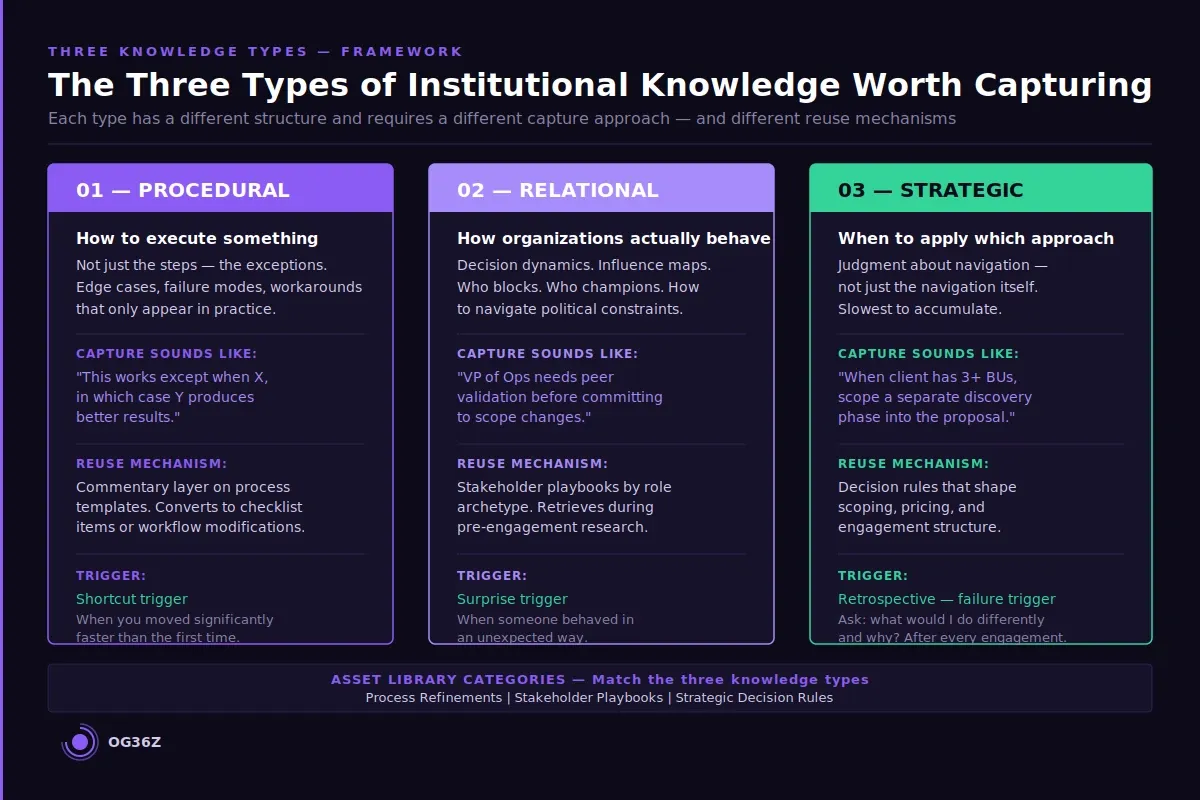
Not all knowledge is equally worth capturing. The three types that generate the highest reuse value for solo consultants are procedural, relational, and strategic knowledge. Each has a different structure and requires a different capture approach.
Procedural knowledge is the operational layer — how to actually execute something, not just what the steps are. The difference between a written process and procedural knowledge is the exceptions: the edge cases, the failure modes, the workarounds that only show up in practice. Procedural knowledge capture sounds like: "This works except when X, in which case Y produces better results." It is the commentary layer on top of the documented process. This is the type most consultants are closest to capturing — they just do not.
Relational knowledge is the organizational behavior layer. How does this client's leadership team actually make decisions? What political dynamics shape which ideas get adopted? Which department heads are blockers versus champions? How do decision-makers respond to data versus narrative versus peer pressure? Relational knowledge is largely tacit — it lives in observational memory. Capturing it requires a specific trigger: the moment you notice something surprising about how an organization works. That moment is the capture point.
Strategic knowledge is the meta layer. When should you use which approach? In what contexts does a facilitated workshop outperform a written analysis? When do you lead with data and when do you lead with story? Strategic knowledge is the judgment about how to navigate — not just the navigation itself. It accumulates slowly and is the hardest to capture explicitly. The best approach is retrospective: after each major engagement, ask yourself what you would do differently and why. The answer is strategic knowledge.
How do you build a capture habit that does not slow down delivery?
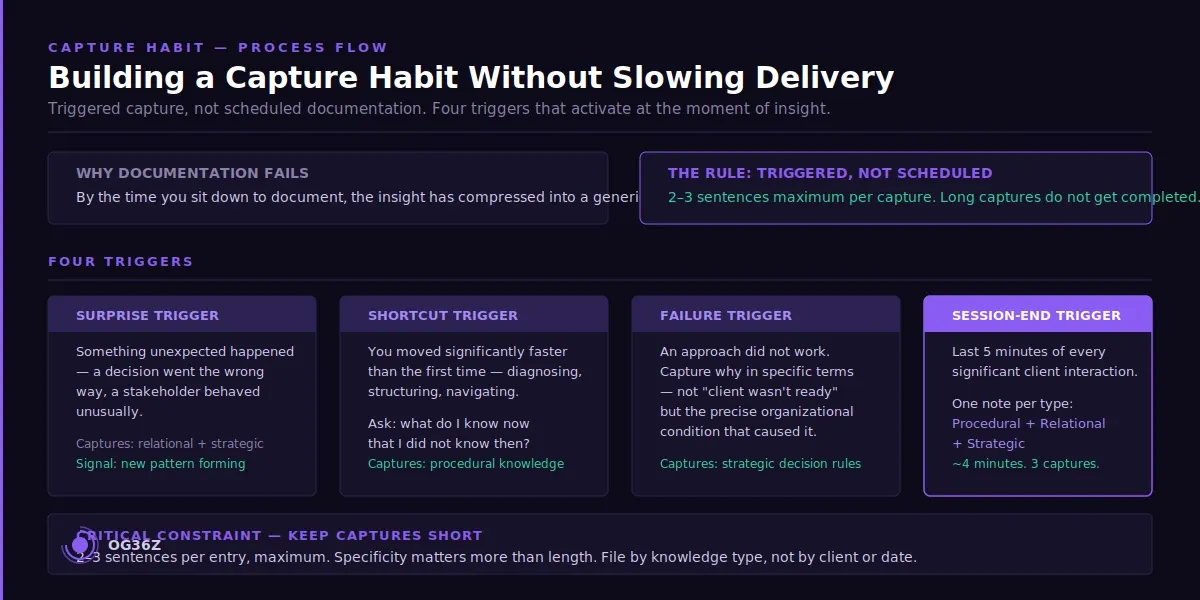
The capture habit fails when it is treated as documentation. Documentation is slow, effortful, and disconnected from the moment of insight. By the time a consultant sits down to document what they learned, the insight has been compressed into a generic lesson that loses 80% of its specificity.
Effective institutional knowledge capture is triggered, not scheduled. Instead of reserving time to document, you build triggers that activate capture at the moment of insight.
Four triggers work reliably for solo consultants. The first is the surprise trigger: any time something happens that you did not expect — a decision that went the wrong way, a stakeholder who behaved unusually, a recommendation that landed better than expected — pause and capture the observation in two to three sentences. Surprise is the signal that a new pattern is forming.
The second is the shortcut trigger: any time you catch yourself doing something significantly faster than you did the first time — diagnosing a situation, structuring a proposal, navigating a difficult conversation — pause and ask what you know now that you did not know then. The delta is procedural knowledge.
The third is the failure trigger: any time an approach does not work, capture why in specific terms. Not "the client was not ready" but "the CFO required board-level validation before approving a change of this scope, and we did not have that sponsor." Specificity is what makes the capture reusable.
The fourth is the session-end trigger: in the last five minutes of any significant client interaction, capture one observation per knowledge type. One procedural note. One relational note. One strategic note. This takes under four minutes and produces three distinct knowledge entries per session.
The key constraint: keep capture to two to three sentences maximum per entry. Long captures do not get completed. Short captures do.
How do you convert raw captures into reusable consulting assets?
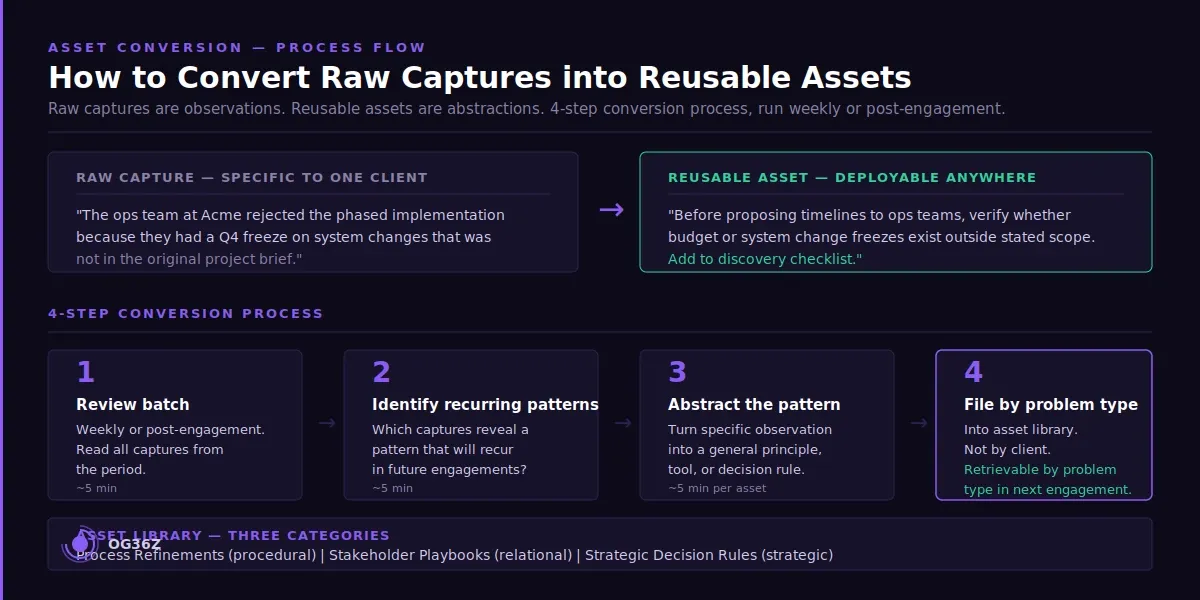
Raw captures are observations. Reusable assets are abstractions. The conversion process — moving from a specific observation to a reusable tool — is where institutional knowledge actually becomes leverage.
Raw captures are specific: "The ops team at Acme rejected the phased implementation because they had a Q4 freeze on system changes that was not in the original project brief." That is valuable observation — but it is tied to one client.
A reusable asset abstracts the pattern: "Before proposing implementation timelines to ops teams in mid-size companies, verify whether budget or system change freezes exist that are not reflected in the stated project scope. Add to discovery checklist." Now the insight is deployable anywhere.
The conversion process has four steps. First, review a batch of raw captures — weekly or after each engagement. Second, identify which captures reveal a pattern that will recur in future engagements. Third, abstract the specific observation into a general principle or tool: a checklist item, a diagnostic question, a decision rule, a template modification. Fourth, file the abstracted asset in a reusable asset library organized by problem type — not by client.
The asset library has three categories that match the three knowledge types: process refinements, stakeholder playbooks, and strategic decision rules. Process refinements are modifications to existing templates or workflows. Stakeholder playbooks are pattern notes on how certain organizational roles tend to behave. Strategic decision rules are principles for when to apply which approach.
Over time, the asset library becomes the most valuable output of your consulting practice. It is the compressed intelligence of every engagement you have run, organized for retrieval rather than archival.
How do you reuse institutional knowledge across different clients and engagements?
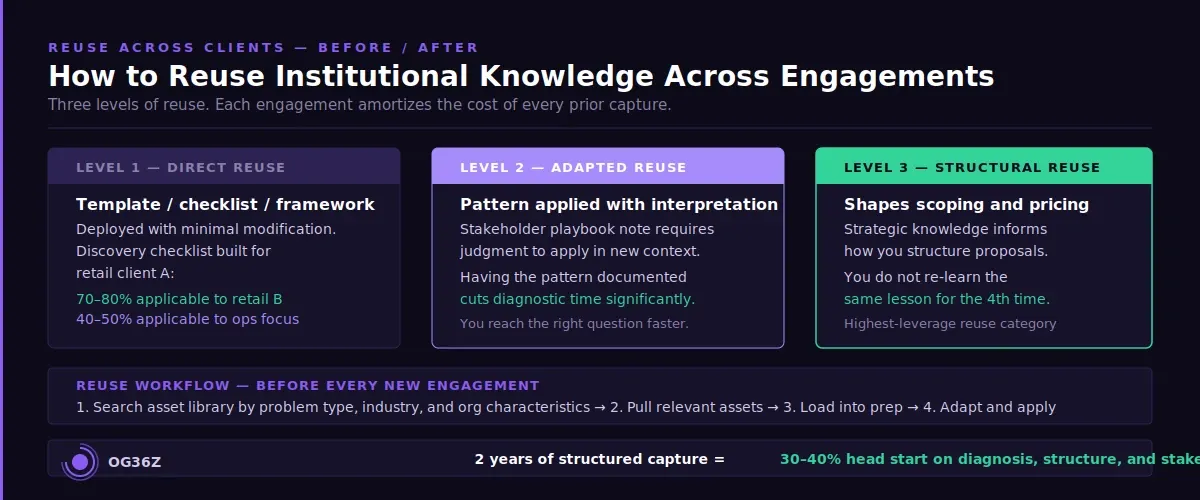
Reuse is the payoff. Every asset in the library represents an investment that has already been made. Every time you deploy it, the cost of the original capture is amortized. The leverage compounds with each engagement.
Reuse operates at three levels. The first is direct reuse: a template, checklist, or framework deployed in a new context with minimal modification. A discovery checklist built for a retail client, for example, is 70–80% applicable to the next retail engagement and 40–50% applicable to any new engagement with an operations focus.
The second level is adapted reuse: a pattern or decision rule applied in a new context that requires interpretation. A stakeholder playbook note that says "product managers at SaaS companies tend to resist timeline commitments until they have had direct input into scope" requires judgment to apply — but having the pattern documented cuts diagnostic time significantly. You arrive at the right question faster.
The third level is structural reuse: the accumulated strategic knowledge that shapes how you scope, price, and structure new engagements. If your institutional knowledge tells you that a certain type of engagement consistently requires an extra discovery phase when the client has more than three business units involved, you price accordingly. You do not learn that lesson again for the fourth time.
The practical workflow for reuse is simple: before starting any new engagement, spend 20–30 minutes searching your asset library by problem type, industry, and organizational characteristics. Pull the relevant assets. Load them into your engagement preparation. Adapt and apply.
Consultants with two years of structured institutional knowledge capture arrive at every new engagement with a 30–40% head start on diagnosis, structure, and stakeholder navigation. That is not a productivity trick. That is a compounding professional moat.
Summary
Institutional knowledge is the actual source of consulting leverage. It is the pattern library that makes experienced practitioners faster, sharper, and more accurate than their junior counterparts — not raw intelligence. The problem for solo consultants is that there is no institutional infrastructure to capture and retain it. You have to build your own.
The system has three components: a triggered capture habit (surprise, shortcut, failure, session-end), a conversion process that abstracts specific observations into reusable assets, and a structured library organized by problem type rather than client. The capture habit takes under five minutes per session. The conversion process takes 15–20 minutes per week. The library pays back its investment with every engagement where you deploy it.
Start with one engagement. Use the four triggers for one month. At the end of the month, run your first conversion session. Build your first three assets. That is the foundation. Everything after that compounds.
For the foundational knowledge management system that houses these assets, see Post 210 (knowledge-management-independent-consultants). For building per-client knowledge repositories that feed into the broader asset library, see Post 212 (client-knowledge-system-consultant). For the longer-term knowledge base architecture, see Post 214 (consulting-knowledge-base-build-maintain).